
Drain, Waste & Vent Defects
~13 min read · Explain trap seals, slope and venting, and why an S-trap fails where a P-trap works.
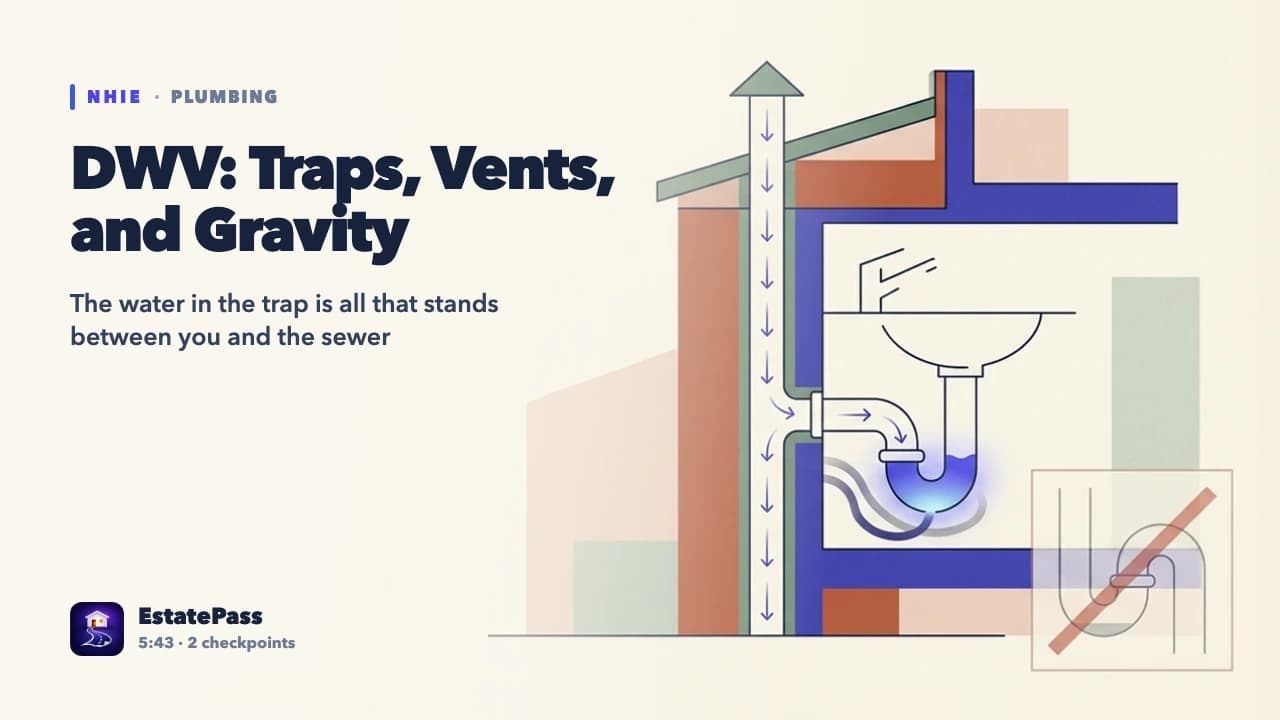
Drain-waste-vent systems run on physics: slope carries solids, traps hold a water seal against sewer gas, and vents protect that seal from siphonage. The S-trap — self-siphoning by design — is the classic defect that explains the whole system.
Traps and their seal
Every fixture's P-trap holds a water plug — 2 to 4 inches of seal depth — blocking sewer gas. Defects: S-traps (the outlet dives straight down — discharge momentum siphons the seal out; prohibited, common under old and DIY sinks), missing traps, double traps (air-locking), dry traps at unused fixtures (odor complaints — the floor drain in the corner), flexible-accordion traps (debris catchers), and 'bell' traps in old floors. Evidence: gurgling after discharge (a seal fighting siphonage), sewer odor at a fixture.
- Seal: 2-in min, 4-in max
- S-trap = self-siphoning = prohibited
- Gurgle and odor: the seal is losing
Venting
Vents admit air behind discharging water so the moving column doesn't vacuum the traps — every trap needs venting within its limits (trap-arm length limits are table-driven by size; the PRINCIPLE: an over-long unvented arm lets the falling water siphon the seal — that's the finding language). Field defects: unvented fixture additions (the island sink saga; islands use listed loop-vent details), flat vents (vent piping run level where it must rise), vents terminating indoors or in the attic (sewer gas delivery system), and AAVs (air admittance valves) — mechanical one-way substitutes: acceptable where allowed IF listed, accessible, and upright; a finding when buried or aged shut.
- Vents defend trap seals from siphonage
- Gurgling fixtures = venting complaints
- Attic-terminating vents and dead AAVs are gas leaks in waiting
Slope, materials, and evidence
Drain slope: the durable convention ~1/4 inch per foot for small drains (too little strands solids; TOO MUCH outruns them — water leaves, solids stay). Materials each with a story: cast iron (scale, bottom-channel rot — tap it), ABS/PVC (joints, improper cement mixing), old clay laterals (roots — the sewer-scope referral), and lead closet bends in antiques. Functional drainage test: fill-and-release at fixtures, watch tub/shower drains, look under everything, and read stains on the ceiling below wet rooms.
Worked example
Under a remodeled kitchen island: an accordion-flex trap drops into an S-configuration with no vent visible; the sink gurgles loudly after draining, and by afternoon a faint sewer smell hangs in the cabinet; upstairs, a bathroom vent terminates in the attic near a soffit vent. Explain and report.
The island tells the whole physics lesson: an S-trap with no vent — the discharge column dives and siphons; the gurgle is the seal's death rattle; the afternoon smell is the empty trap letting sewer gas in. The accordion tubing adds a debris-collecting non-listed fitting. Correction: proper P-trap with a code venting method for islands (listed loop vent or, where permitted, an accessible AAV). The attic vent: sewer gas discharging into the attic — moisture and odor — and near a soffit vent, gas re-enters living space; extend through the roof. Report both as system defects with mechanisms — 'S-trap siphons its own seal' is one sentence a buyer never forgets.
Common exam pitfalls
Passing S-traps because they 'still drain.'
Draining is the mechanism of failure — momentum empties the seal after every use; prohibited configuration, report it.
Quoting trap-arm length tables as fixed numbers.
Tables differ by trap size and model code — report the over-long unvented arm by its siphonage principle.
Ignoring maximum slope.
Steeper isn't better past ~1/4 in/ft — water outruns solids and the line clogs; grade matters both ways.
Seal it two-to-four, vent it or lose it, slope it a quarter — and the S-trap flushes its own defense.
Recap
- P-trap seal 2–4 in; S-traps prohibited (self-siphoning)
- Vents protect seals; gurgle and odor mark failures
- AAVs: listed, accessible, upright — or a finding
- Attic/indoor vent terminations deliver sewer gas
- Slope ~1/4 in/ft — both too little and too much fail
- Material stories: cast iron, clay roots, flex traps
VIDEO LESSON
Watch this lesson on video — free
Prove it: 10 questions on this topic
Every lesson ends with a ten-question check in the free course — your progress syncs between the web and the EstatePass app.