
Pick the 2026 change that applies to the work.
Which bulletin item are you updating?
Choose a focus to see the next checks and relevant sources. This tool does not determine eligibility, compliance or authority to work.
Two dates, not one “2026” stamp
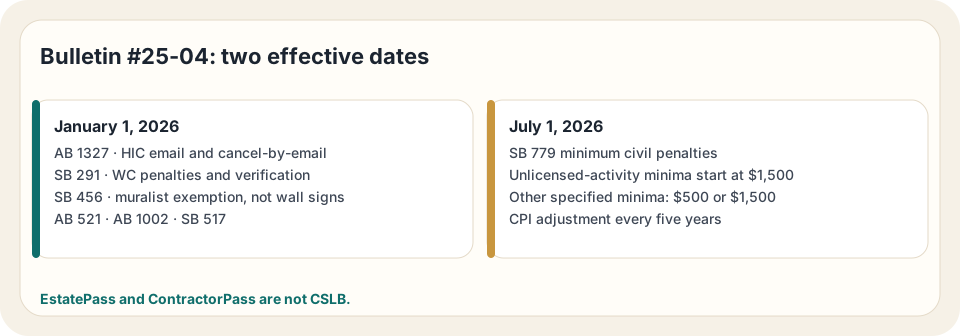
On December 29, 2025, the Contractors State License Board published Industry Bulletin #25-04, “New Laws Affecting Contractors Starting in 2026.” The 2026 bulletin index lists it with the other 2026 notices. Checked November 9, 2026. Most of the items in that bulletin are framed as taking effect January 1, 2026. One penalty change is later: Senate Bill 779’s higher minimum civil penalties begin July 1, 2026. A study note that says “everything changed on New Year’s Day” misses that second date.
The Fall 2025 California Licensed Contractor newsletter carries the same new-laws narrative. This hub follows the bulletin. It is not the Contractors License Law & Reference Book, and it is not legal advice on a contract you have already signed.
| Bill | What #25-04 says changed | When the bulletin places it | Where to read more |
|---|---|---|---|
| AB 1327 | Email on the home improvement contract, cancel by email, phone help for the Notice of Cancellation | January 1, 2026 | HIC email guide |
| SB 291 | Higher penalties for workers’ compensation violations, plus a verification process to design | January 1, 2026 framing; report to the Legislature by 2027 | WC exemption guide |
| SB 456 | Muralist exemption for qualifying fine-art murals; not painted wall signs | January 1, 2026 | Muralist exemption |
| SB 779 | Higher minimum civil penalties | July 1, 2026 | This section |
| AB 521, AB 1002, SB 517 | Cash-deposit fees, wage-judgment actions, subcontractor disclosure | January 1, 2026 | Short notes below |
The three laws with their own pages
Home improvement contracts (AB 1327)
Assembly Bill 1327 requires home improvement contractors to put their email address in the contract and to let the buyer cancel by email. The contract also needs a telephone number that helps the buyer find and complete the Notice of Cancellation. If that notice is missing, the consumer may complain to CSLB. The field-level checklist is on the home improvement contract email page. This hub does not reprint a full contract form.
Workers’ compensation (SB 291)
Senate Bill 291 significantly increases penalties for workers’ compensation insurance violations. The bulletin does not list a new dollar schedule in the summary this page relies on, so this page does not invent one. The bill also directs CSLB to build a process to verify exemption eligibility and to report to the Legislature by 2027, and it calls for annual WC enforcement reporting. Who may still file an exemption, and who may not, is the subject of the workers’ compensation exemption guide.
Muralists (SB 456)
Senate Bill 456 creates a license exemption for certain muralists: a unique work of fine art, painted by hand, under an agreement with someone authorized to approve the work, with copyright or a similar right. Painted wall signs are outside that exemption. Wall repair and scaffolding affixed to a structure can still be licensed work. Conditions and the off-ramp are on the muralist exemption page. The April 2026 newsletter is the elaboration CSLB published after the bulletin.
The other four bills, in one pass
Senate Bill 779, beginning July 1, 2026, raises minimum civil penalties. The bulletin states that unlicensed-activity minimums start at $1,500, and that other specified violations are $500 or $1,500, with CPI adjustments every five years. Those are the minima #25-04 states. They are not a complete penalty table, and they are not a quote of what a registrar will assess on a particular case.
Assembly Bill 521 clarifies attorney-fee treatment around a cash deposit. Assembly Bill 1002 addresses civil actions by the Attorney General and CSLB when wage judgments or worker-pay failures are involved. Senate Bill 517 requires disclosure, on request, of a subcontractor’s identity, license number, and classification on a home improvement project. Each of those is a bulletin summary, not a full annotation of the bill text.
What applicants should change in their study
Law and Business questions track business practices, not headlines. If you are still an applicant, add four ideas to the closed-book stack: the home improvement contract now has an email and an email-cancellation path; a missing cancellation notice is a complaint path; workers’ compensation exemptions are under a verification project; mural work and wall signs are not the same license question. The closed-book study guide is where pacing and the reference habit live. A failed Law and Business attempt still follows the recovery rules on Law and Business failed. How hard the CSLB exams are is a separate difficulty page. None of those pages issue a license.
Classification is still B versus C versus B-2. Experience is still the four-year journeyman record. Whether you need a license at all, including the minor-work exemption, stays on do I need a license.
What a shop that already has a license should change
Update the home improvement contract template with counsel or CSLB’s own materials: email, cancel-by-email, and the telephone path to the Notice of Cancellation. Recheck any workers’ compensation exemption against the disqualifiers on the CSLB page before you assume a sole proprietor filing still fits. Do not describe a painted wall sign as a mural to avoid a license. Unlicensed activity is the SB 779 fact pattern the July 1, 2026 minimums attach to.
Issuance steps that are not in this bulletin — bond, exam passage, and the rest of the new-license file — belong on a separate after-you-pass checklist at /contractor/california/after-you-pass/. This hub does not rebuild that list.
Where ContractorPass fits
ContractorPass is exam practice for people who still have a CSLB exam to take. EstatePass is not CSLB, not an approved education provider, and not your lawyer. A practice score does not mean a contract complies with AB 1327, that an exemption will survive SB 291’s verification process, or that a mural meets SB 456. If the work is truly exempt, you do not need exam prep for that job. If the work needs a license, confirm classification and experience before you buy a question bank. The California contractor hub collects the state routes. ContractorPass is only the practice product.
Pause. Apply. Understand.
Make the next call.
Original learning scenarios. Choose an answer, then explore the reasoning. These are not official examination questions or a scored readiness assessment.
From reading to doing
Your next three moves.
A personal planning checklist. Tick off each step as you finish it; progress lasts until you leave or reload this page.
A little more clarity
Questions, answered.
What is CSLB Industry Bulletin #25-04?
It is the December 29, 2025 bulletin summarizing new laws that affect contractors beginning in 2026. Read the PDF on CSLB’s site.
When do the 2026 laws take effect?
The bulletin frames the package as starting January 1, 2026, except SB 779’s minimum civil penalties, which begin July 1, 2026.
What did AB 1327 change?
Home improvement contracts must include the contractor’s email, allow cancellation by email, and include a phone number that helps the buyer find the Notice of Cancellation.
What did SB 291 change?
It significantly increases penalties for workers’ compensation violations and directs CSLB to build an exemption-verification process, with a report to the Legislature by 2027. The bulletin summary does not list new fine dollars.
Are muralists exempt from a contractor license?
SB 456 exempts qualifying hand-painted fine-art murals. Painted wall signs are not exempt. Wall repair and affixed scaffolding can still be licensed work.
What are the SB 779 minimums?
Beginning July 1, 2026, unlicensed-activity minima start at $1,500, and other specified violations are $500 or $1,500, with a CPI adjustment every five years. That is not a full penalty schedule.
What are AB 521, AB 1002, and SB 517 in one line each?
AB 521 clarifies attorney fees around a cash deposit. AB 1002 covers civil actions for wage-judgment and worker-pay failures. SB 517 requires subcontractor identity, license, and classification on request.
Is EstatePass CSLB?
No. EstatePass and ContractorPass are exam practice. They are not CSLB, not an education provider, and not legal advice on your contract.
Put your next step into focus.
Take what you have learned into your next study session. Use the linked practice and resources to decide where to focus.
Find your next stepEducational information and independent practice. Confirm current examination, education and licensing requirements with the linked official sources. Practice results do not guarantee an examination result or eligibility.