
Decide whether this is a form edit or an exam note.
What are you doing with AB 1327?
Choose a focus to see the next checks and relevant sources. This tool does not determine eligibility, compliance or authority to work.
What Bulletin #25-04 says AB 1327 changed
Assembly Bill 1327 (Aguiar-Curry) is one entry in CSLB Industry Bulletin #25-04, dated December 29, 2025. The bulletin places the home improvement contract changes with the laws that begin January 1, 2026. Checked November 9, 2026. Three duties are the whole of what this page will claim, because they are the three the bulletin states:
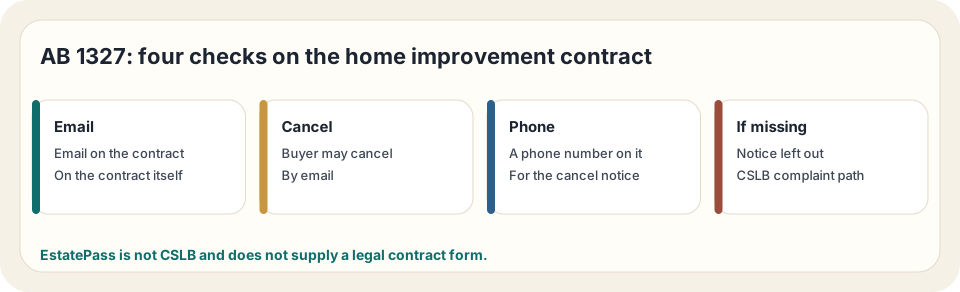
- The contractor’s email address has to be in the home improvement contract.
- The buyer has to be allowed to cancel by email.
- The contract has to include a telephone number that helps the buyer locate and complete the Notice of Cancellation.
If the Notice of Cancellation is missing, the consumer may file a complaint with CSLB. That complaint path is part of the bulletin summary. It is not a promise about how any single complaint will be resolved.
This page does not invent a cooling-off day count, a full list of statutory contract fields, or a template you can paste into a bid. The Contractors License Law and a lawyer who drafts your form are the sources for the rest of the document. EstatePass does not sell a home improvement contract as a legal form.
An operations checklist, not a form
Use this list to brief whoever edits your template. It is not a compliance certificate.
- Put a working email address for the contractor on the home improvement contract itself, not only on a business card or a proposal cover.
- Make cancel-by-email a real path. A sentence that says “call the office” does not meet a rule that the buyer may cancel by email.
- Put a telephone number on the contract whose job is to help the buyer find and complete the Notice of Cancellation.
- Keep the Notice of Cancellation with the contract packet. The bulletin treats a missing notice as a reason a consumer can complain to CSLB.
- Have counsel or CSLB’s published materials review the template. Do not treat this article as the review.
Home improvement salespeople who present the contract need the same three facts. The bulletin frames the duty around home improvement contracts, not around one classification nickname. This page does not invent a carve-out that says Class B is covered and a specialty is not, or the reverse. If your work uses a home improvement contract, read #25-04 and the statute with your own counsel.
The umbrella map of the 2026 bills, including Senate Bill 517’s on-request subcontractor disclosure, is the 2026 new laws hub. SB 517 is a different duty: identity, license, and classification of a subcontractor when the owner asks. It is not a substitute for the email and cancellation rules.
What Law and Business candidates should study
Exam awareness and a compliant form are different jobs. A Law and Business candidate should be able to say what AB 1327 added: email, email cancellation, a phone path to the notice, and a complaint if the notice is absent. That is a business-practices point in a closed-book exam. It does not mean the candidate’s future contract is legal, and it does not mean a practice question is the statute.
Study pacing stays on the closed-book study guide. If Law and Business was the portion you failed, the wait and the file rules are on Law and Business failed. Classification, which decides which trade exam sits next to Law and Business, is B versus C versus B-2. Whether the job needs a license at all is do I need a license.
Passing the exam does not update a template that is already in the truck. Newly licensed contractors still have issuance tasks that are not this bill. Those sit on the separate checklist at /contractor/california/after-you-pass/.
Where ContractorPass fits
ContractorPass is exam practice. EstatePass is not CSLB and not a law firm. Neither one will tell you that your current home improvement contract complies with AB 1327. If you are still preparing for Law and Business or a trade exam, practice belongs after you know which exam CSLB has assigned. If you are already licensed, the next step is the template and CSLB’s bulletin, not a question bank.
The California contractor hub is the state route map. ContractorPass is only the practice product, and only when an exam is actually in front of you.
Pause. Apply. Understand.
Make the next call.
Original learning scenarios. Choose an answer, then explore the reasoning. These are not official examination questions or a scored readiness assessment.
From reading to doing
Your next three moves.
A personal planning checklist. Tick off each step as you finish it; progress lasts until you leave or reload this page.
A little more clarity
Questions, answered.
Must a California home improvement contract include an email address?
Yes. CSLB’s bulletin summary of AB 1327 says the contractor’s email address has to be in the home improvement contract.
Can the buyer cancel by email?
Yes. The bulletin says buyers must be allowed to cancel by email, beginning with the January 1, 2026 framing.
What if the Notice of Cancellation is missing?
The bulletin says the consumer may file a complaint with CSLB.
What is the phone-number requirement?
The contract needs a telephone number that helps the buyer locate and complete the Notice of Cancellation.
Does this page apply only to Class B?
The bulletin frames the duty around home improvement contracts. It does not publish a classification carve-out, and this page will not invent one.
Does passing Law and Business update my template?
No. Exam awareness is not a compliant form. Update the template with counsel or CSLB’s materials.
Does EstatePass provide a home improvement contract?
No. EstatePass is not a form vendor and not a law firm.
Is EstatePass CSLB?
No. EstatePass and ContractorPass are exam practice. They do not decide that your contract complies.
Put your next step into focus.
Take what you have learned into your next study session. Use the linked practice and resources to decide where to focus.
Find your next stepEducational information and independent practice. Confirm current examination, education and licensing requirements with the linked official sources. Practice results do not guarantee an examination result or eligibility.