
Sort the license question before you study.
Which description matches the work?
Choose a focus to see the next checks and relevant sources. This tool does not determine eligibility, compliance or authority to work.
The $1,000 baseline took effect on January 1, 2025
California’s minor-work exemption is a narrow exception in the Contractors State License Law, not a general permission to do small construction jobs without looking further. CSLB industry bulletin 24-07, dated December 31, 2024, and CSLB press release 24-21, dated December 30, 2024, describe Assembly Bill 2622 (Carrillo, Chapter 240, Statutes of 2024). Both were checked November 4, 2026. The bill raised the long-standing dollar figure from $500 to $1,000 and kept the conditions that make the exception fail.
The enrolled text of AB 2622 amends Business and Professions Code section 7048. The chapter does not apply to a work or operation on one undertaking or project, by one or more contracts, if the aggregate contract price for labor, materials, and all other items is less than $1,000, the work is of a casual, minor, or inconsequential nature, and the work or operation does not require a building permit. “Aggregate” means you add the pieces. A low labor quote does not create the exemption if materials and other items carry the same project to $1,000 or more. CSLB’s press release states that the $1,000 includes all costs associated with the project.
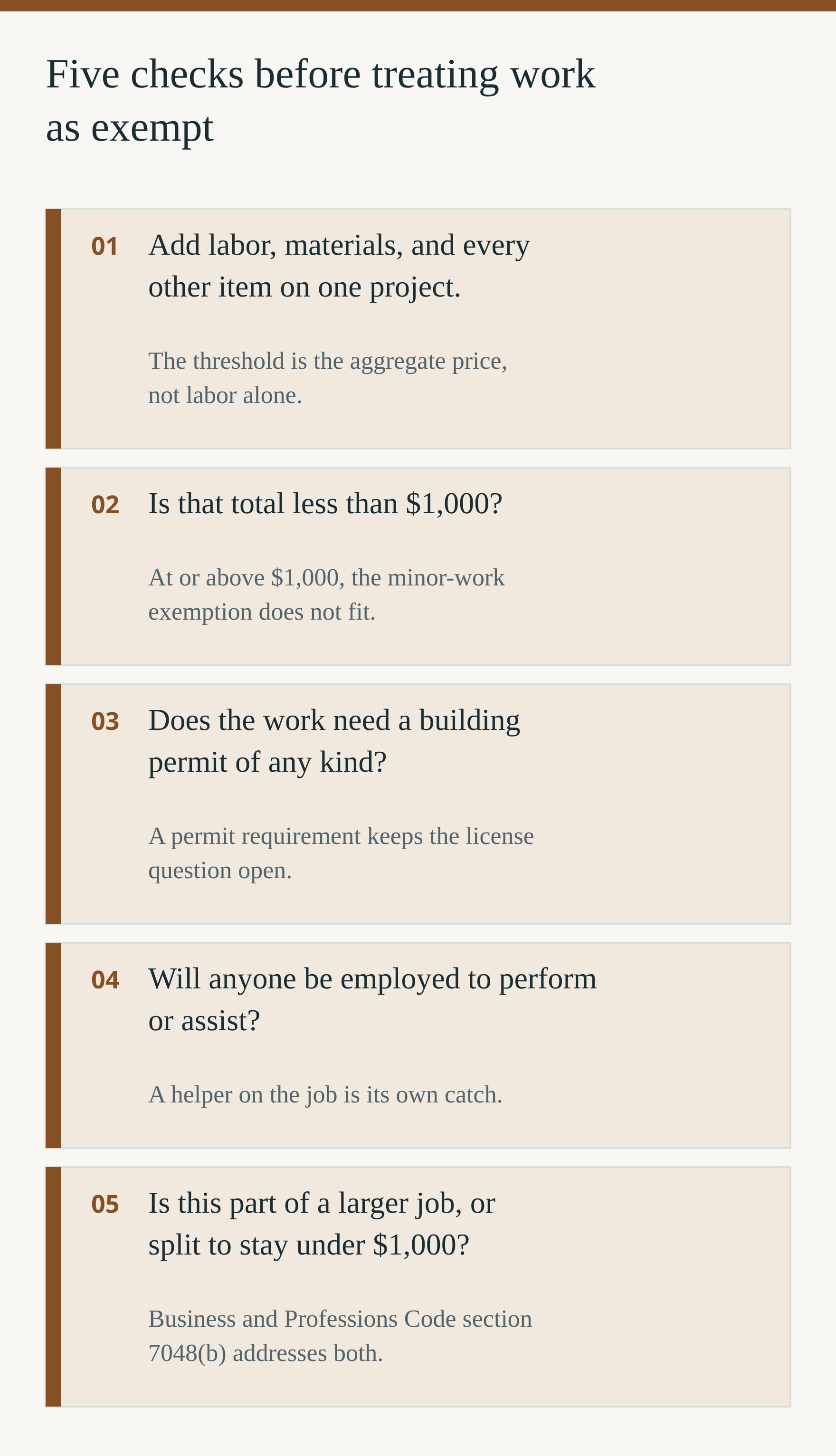
Write the project down before you apply the number. List the labor, the materials, and anything else the same undertaking includes. If the total is not under $1,000, stop. The minor-work exemption is the wrong tool, and the next questions are classification and experience, not a smaller invoice.
This page cannot tell you that your job is exempt. A permit, a helper, or a larger operation can defeat a price that looks small. EstatePass and ContractorPass are exam practice. They are not the Contractors State License Board, and they do not decide exemptions.
Two catches that still require a license
A price under $1,000 is only the first screen. CSLB’s bulletin states the catch in plain language: if the minor work is subject to a permit requirement of any kind, or if the unlicensed person hires one or more workers to assist or perform the work, a license is required even if the project is less than $1,000.
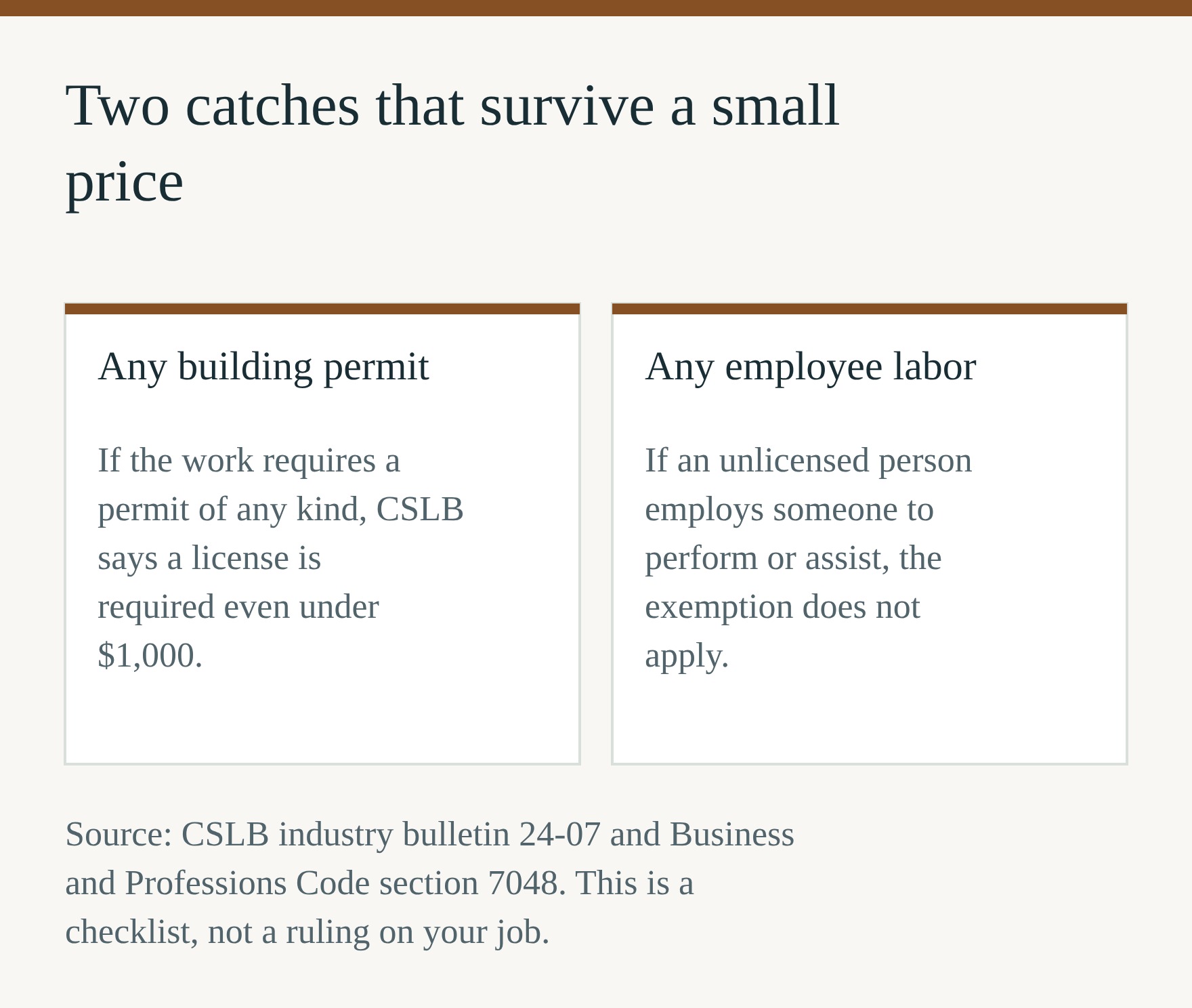
Any building permit
Section 7048(a) requires that the work or operation not need a building permit. The bulletin uses “a permit requirement of any kind.” Do not treat a city counter conversation, a homeowner’s guess, or a past job that “never needed a permit” as the answer for this scope. Ask the local building authority whether this scope needs a permit. If the answer is yes, the exemption in section 7048 does not fit, regardless of a $700 or $900 total.
Changing the description so the permit question disappears is not a reading of the statute. If the real work needs a permit, the license question stays open.
Any employee or helper labor
Section 7048(c)(2) says the exemption does not apply to a person who employs another person to perform, or to assist in performing, the work or operation. The bulletin uses the same idea: hiring one or more workers to assist or perform the work means a license is required even under $1,000.
A helper on a $900 day is not a technicality to talk around. If someone else will be employed to do or assist the work, do not plan the job as exempt minor work. The statute does not ask whether the helper is a friend, a day laborer, or a short shift. It asks whether another person is employed to perform or assist.
Splitting the job does not create the exemption
Section 7048(b) keeps the exemption from being used as a slicing tool. It does not apply when the work of construction is only a part of a larger or major operation, whether undertaken by the same or a different contractor. It also does not apply when a division of the operation is made in contracts of amounts less than $1,000 for the purpose of evasion of the chapter or otherwise.
Two invoices under $1,000 are not automatically two exempt projects. If they are parts of one larger operation, or if the split exists to stay under the threshold, subsection (b) says the exemption does not apply. The same is true when a different person holds the other piece of a larger job. “Otherwise” means you should not invent a motive test and then declare yourself safe. Describe the whole undertaking first.
Consumers have a matching warning in the bulletin. Before contracting with an unlicensed individual for minor work, make sure that person will not use any workers and that the project will not require any building permits. If an unlicensed person provides a bid greater than $1,000, performs work requiring a permit, or employs any workers, CSLB says that person is subject to legal action.
Advertising while unlicensed
AB 2622 also amended Business and Professions Code section 7027.2. A person who is not licensed may advertise for construction work or a work of improvement only if the aggregate contract price for labor, material, and all other items on a project or undertaking is less than $1,000, and the person states in the advertisement that the person is not licensed.
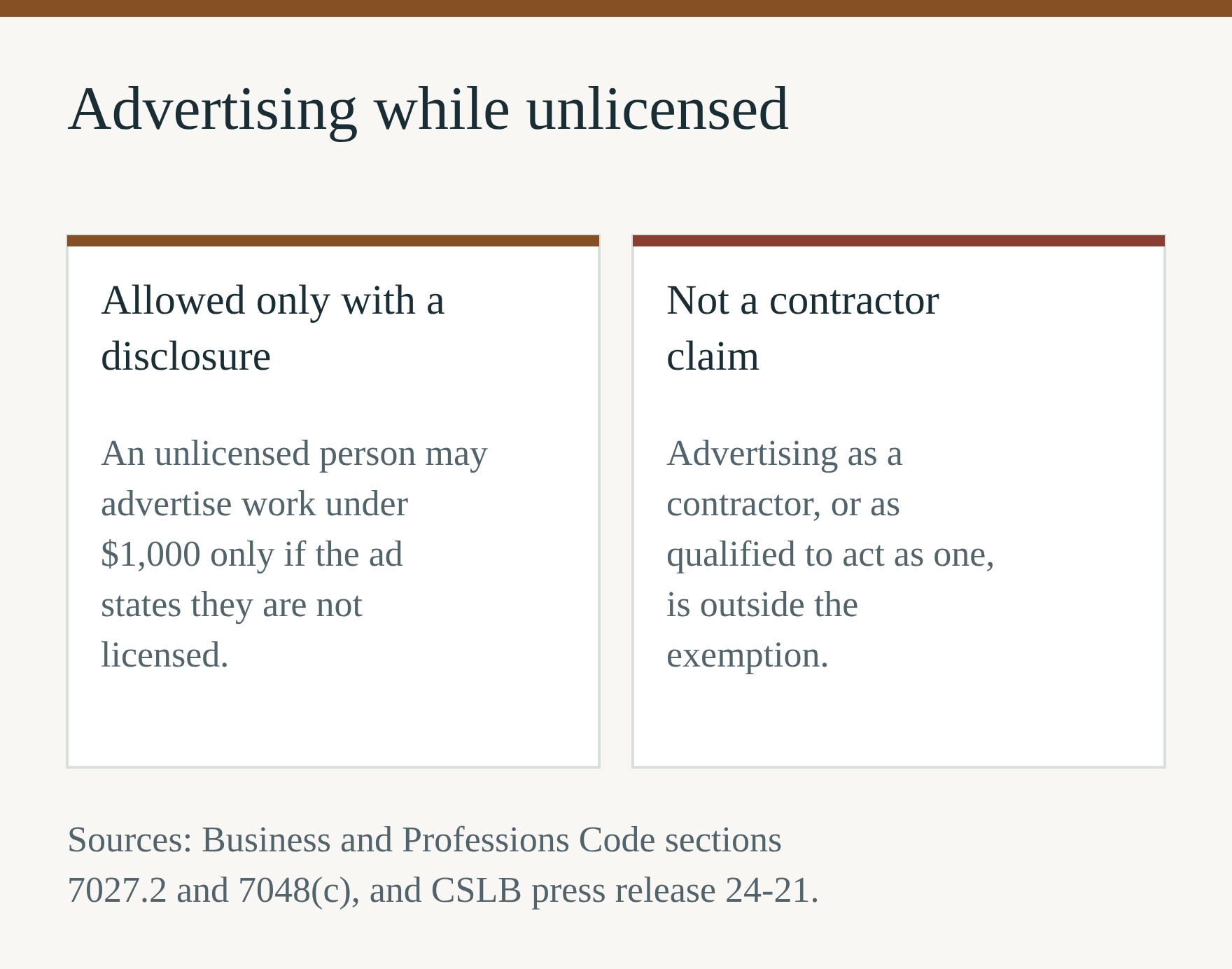
Section 7048(c)(1) is the other half. The minor-work exemption does not apply to a person who advertises, or puts out a sign, card, or other device, that might indicate to the public that the person is a contractor or is qualified to engage in the business of a contractor. CSLB’s bulletin says the exemption does not apply to people who advertise that they are licensed or qualified to act as contractors.
“Handyman” on a flyer is not a CSLB classification. It does not create a license class, and it does not replace the disclosure. If you are unlicensed and the ad is even eligible, the ad has to say you are not licensed. If the ad suggests you are a contractor, section 7048(c)(1) says the exemption does not apply.
The press release also describes penalties for unlicensed contracting, including administrative fines of up to $15,000, jail of up to six months, and fines of up to $5,000, with higher repeat-offender consequences. Those figures are the press release’s description of penalties, not a bonding or license-fee table, and not a prediction of what any one case will bring. Read the release and the statute rather than treating this paragraph as a charge sheet.
If you do need a license, separate the next decisions
Needing a license is not the same as being ready to sit for an exam. Keep the questions in order.
First, identify the classification that matches the work. Class B, a Class C specialty, and B-2 residential remodeling are different scopes. Use CSLB Class B vs Class C vs B-2 for that comparison. This page does not restate the trade-counting rules or the B-2 structural limits.
Second, ask whether you can document the experience CSLB requires for that classification. The usual gate is at least four years at journey level or higher, with its own verification rules. Use CSLB experience requirements for that question. Do not buy a large practice plan while the experience record is still an open doubt.
Third, follow CSLB’s applicant instructions for Law and Business and any trade examination that applies to your route. Passing an exam is not the same event as license issuance. Bonds, insurance, and the rest of the issuance file are CSLB’s process. This article does not publish a fee table for them.
When the route is real, study habits matter. The California closed-book study guide is about preparing for that setting. The Law and Business recovery guide is for a result you already have. How hard the CSLB exams are is a difficulty discussion, not a pass forecast. California exam delivery covers where the exam is taken. If you are still choosing among states, start with NASCLA vs Florida vs California instead of assuming one national contractor license.
If the exemption may actually fit
There is an honest stop. If the aggregate price for one casual, minor undertaking is under $1,000, no building permit is required, nobody is employed to perform or assist, the work is not part of a larger operation or a split to stay under the cap, and advertising does not suggest you are a contractor, the statute describes an exemption. In that case you do not need ContractorPass for this job. Practice questions do not make an exempt repair more lawful, and they do not replace a license you have decided you do not need.
Revisit the facts when the work changes. A customer who adds a wall, a permit, a second worker, or more materials can move the same “small job” out of section 7048. Write the new scope down and run the checks again. Do not keep yesterday’s conclusion taped to a different project.
Nothing here is a determination that your bid, your ad, or your crew qualifies. Take the project description to CSLB or a qualified advisor when the permit, employment, or “larger operation” facts are unclear.
Where ContractorPass fits
ContractorPass is independent exam practice for people who are preparing for a CSLB exam they actually need. It is not CSLB, not an official education provider, and not a licensing decision. The ContractorPass page describes the practice product. The contractor hub and the California contractor pages collect related guides. An article about the exemption does not mean every classification has a practice bank, and a practice score does not issue a license or declare a job exempt.
Use this sequence. Confirm the price, the permit, and the labor facts against the bulletin and section 7048. If a license is required, confirm the classification and the experience record. Then build a Law and Business and trade plan from CSLB’s own guides, and use practice only for that exam. If the exemption really fits, stop. Do not buy exam prep to solve a job that does not involve the exam.
Pause. Apply. Understand.
Make the next call.
Original learning scenarios. Choose an answer, then explore the reasoning. These are not official examination questions or a scored readiness assessment.
From reading to doing
Your next three moves.
A personal planning checklist. Tick off each step as you finish it; progress lasts until you leave or reload this page.
A little more clarity
Questions, answered.
Do I need a California contractor license for a job under $1,000?
Not automatically. Business and Professions Code section 7048 exempts one casual, minor undertaking under $1,000 only when it needs no building permit and you employ no one to perform or assist. A permit or a helper means a license is still required.
What did AB 2622 change, and when?
Effective January 1, 2025, AB 2622 raised the minor-work figure from $500 to $1,000 and stated the permit and employee limits. CSLB bulletin 24-07 and press release 24-21 describe the change.
Does a building permit end the exemption?
Yes. If the work requires a building permit of any kind, CSLB says a license is required even when the price is under $1,000.
Can I stay unlicensed if I hire a helper on a small job?
No. Section 7048(c)(2) says the exemption does not apply to a person who employs someone to perform or assist in the work, even under $1,000.
Does splitting contracts keep the job exempt?
No. Section 7048(b) says the exemption does not apply when the work is only part of a larger operation, or when the job is divided into contracts under $1,000 to evade the license law or otherwise.
What must an unlicensed advertisement say?
Section 7027.2 allows an unlicensed person to advertise work under $1,000 only if the advertisement states that the person is not licensed. Advertising as a contractor, or as qualified to be one, is outside the exemption.
Is “handyman” a CSLB classification?
No. It is not a license class. Class B, Class C, and B-2 are classifications for work that needs a license. Use the classification guide after you know a license is required.
Does ContractorPass decide the exemption or issue a license?
No. ContractorPass is independent exam practice. It is not CSLB, not an official education provider, and not a determination that a project is exempt. Passing an exam is also not license issuance.
Put your next step into focus.
Take what you have learned into your next study session. Use the linked practice and resources to decide where to focus.
Find your next stepEducational information and independent practice. Confirm current examination, education and licensing requirements with the linked official sources. Practice results do not guarantee an examination result or eligibility.