
See whether exam prep is timely.
Where is the experience record?
Choose a focus to see the next checks and relevant sources. This tool does not determine eligibility, compliance or authority to work.
The four-year rule is classification-specific
To qualify for a California contractor examination, CSLB’s Qualifying Experience for the Examination page says you must have at least four years of experience in the class you are applying for. Credit is given only for experience at a journey level or as a foreman, supervising employee, contractor, or owner-builder. The page was checked November 4, 2026. Four years in a neighboring trade, or four years of general construction presence, is not the same claim as four years in the classification on the application.
The Certification of Work Experience (form 13A-11, rev. 12/2024) states the same floor and adds a timing limit: the qualifying individual must document at least four years of journeyman-level or higher experience in the classification, obtained within the last 10 years. Acceptable Supporting Experience Documentation repeats that 10-year window. That page also notes that military service during a national emergency can extend the period in which experience is calculated. Use CSLB’s own military guidance for that extension. This article does not compute one.
You do not need a college degree to qualify. The experience page says there is no education requirement for a contractor license. Education can substitute for part of the four years, within published caps, and only with documentation. It is not a silent replacement for the whole requirement.
If you are not sure a license is required at all, settle that first. The $1,000 / AB 2622 exemption is a different gate. Experience rules matter after the work is work that needs a license.
What “journeyman” and the higher roles mean
CSLB defines a journeyman as a fully qualified, experienced worker who can perform the trade without supervision, as opposed to a trainee, helper, laborer, assistant, or apprentice, or a person who has completed an apprenticeship program. A foreman or supervising employee has the knowledge and skills of a journeyman and directly supervises physical construction. A contractor, in this definition, is a currently licensed California contractor, a former licensed California contractor, personnel of record on a California license, or an out-of-state licensed contractor, with the skills to manage the daily activities of a construction business, including field supervision. An owner-builder has the knowledge and skills of a journeyman and performs work on their own property. Owner-builders must complete a Construction Project Experience form for each project. The certification form describes an additional Owner-Builder B-General Building Construction Project Experience form for B-General Building work on the applicant’s own property.
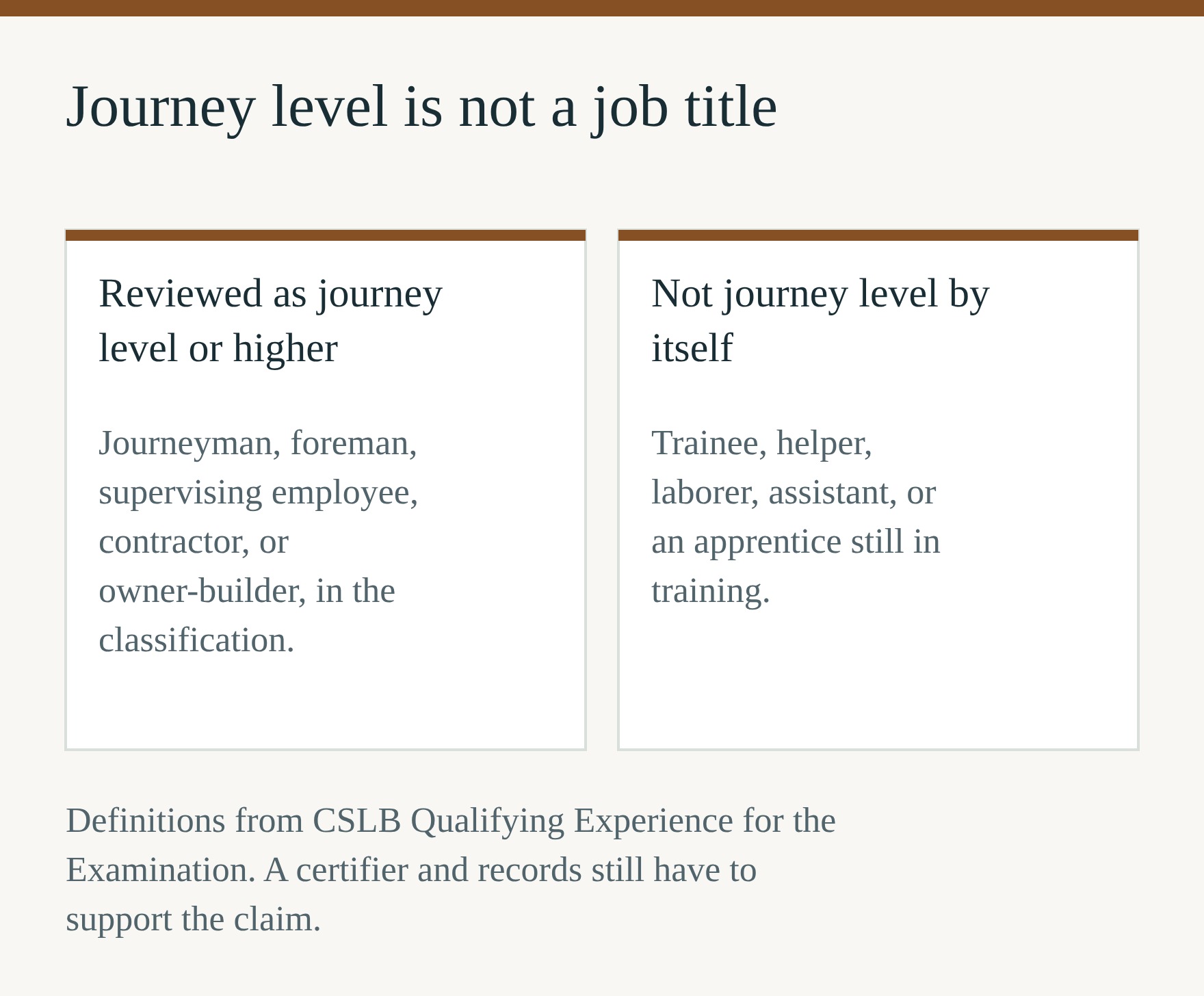
The journeyman FAQ draws the same line and adds practical warnings. Being sent out on basic jobs does not make someone a journeyman. Time spent as an apprentice is learning time, not a label you can skip. Office work does not count toward journey-level experience. Hiring subcontractors to build or remodel your own property does not, by itself, make you a journeyman. Experience has to be hands-on in the trade. The FAQ also says CSLB does not visit sites to watch you work, and that photos do not prove you performed the work.
Roles that generally do not count as journey level
Helper, trainee, laborer, assistant, and apprentice-in-progress time is not journey-level credit merely because it happened on a jobsite. The FAQ is specific about a few other common titles. A building inspector inspects other people’s work, and that experience does not count toward licensure. An estimator, office manager, or HR role that is not hands-on construction does not count. A property manager who does not perform one trade, day after day, will have a hard time proving four years in a specialty such as C-36 plumbing. Those are CSLB’s examples, not a private scoring system. If your history is mixed, describe the hands-on portion and let the certifier and the documents speak to that portion only.
The certification form also refuses full-time credit for part-time work. Its example: if the applicant worked half-time in the specific trade duties for six years, claim three years. Do not list office work or individual project names in the trade-duty section. Use a separate form for each employer or work setting.
Verification and the Certification of Work Experience
Every experience claim has to be verified by a qualified and responsible person with firsthand knowledge. The experience page says that person must have observed the work, and it gives examples: an employer, contractor, foreman or supervisor, fellow employee, other journeyman, union representative, building inspector, architect, engineer, or homeowner. The certification form’s instructions describe the certifier as an employer, fellow employee, journeyman, union representative, contractor, or business associate, and they define direct knowledge as personal knowledge that does not depend on hearsay. Use the current form and the experience page together. The certifier signs under penalty of perjury. Original signatures are required. Strikeouts and uninitialed corrections are a reason the form may not be accepted.
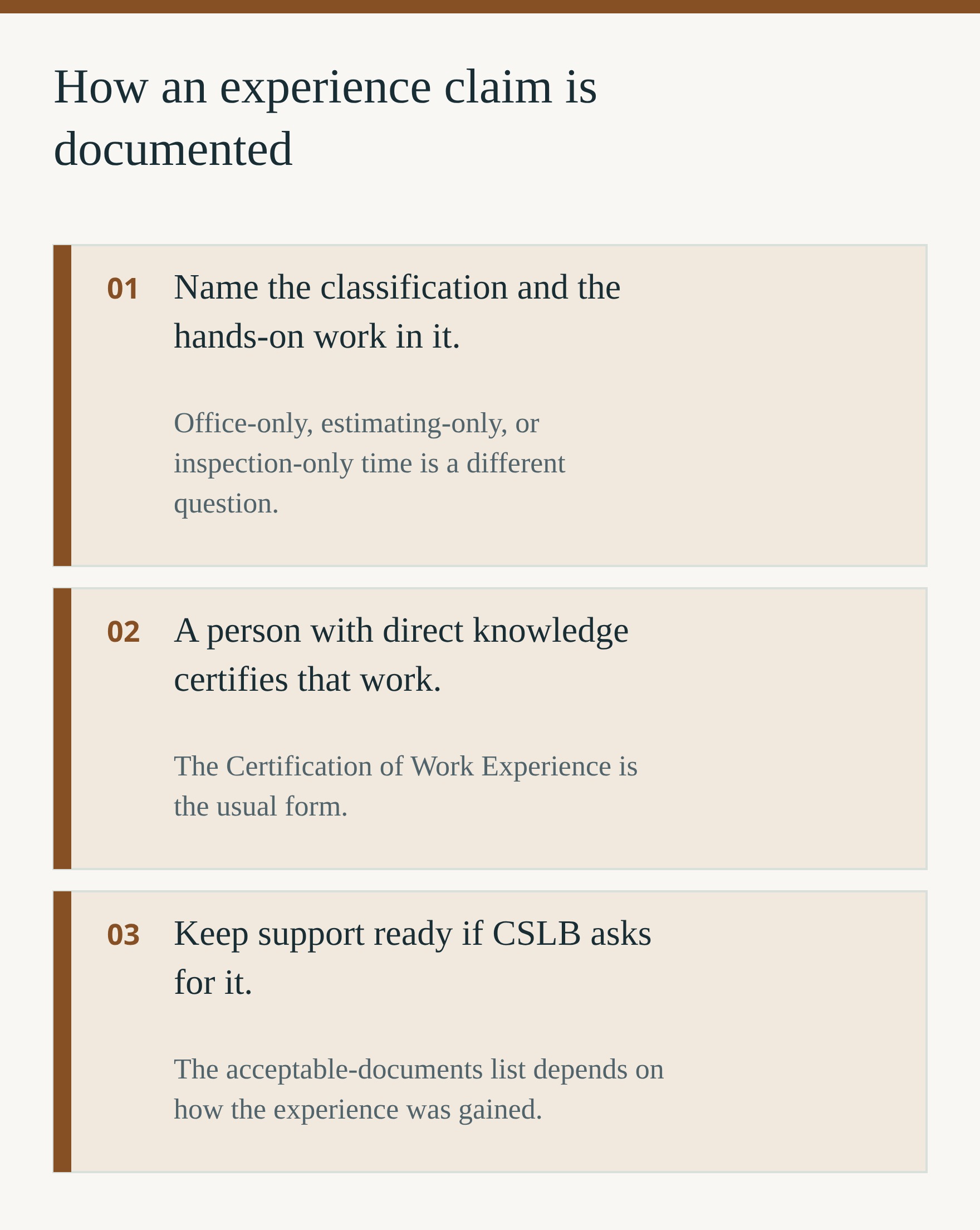
Even a signed certification is not the end of proof. CSLB says you should be prepared to furnish documentation whenever it is requested, and that failure to provide it can mean the application is returned, voided, or denied. The acceptable-documents list is organized by how the experience was gained. Employed applicants, self-employed applicants, and owner-builders are not asked for the identical packet. Examples on that list include wage and tax records, paycheck stubs, permits and inspections, contracts, invoices, and, for education, sealed transcripts. Apprenticeship completion and a union journeyman book can support a claim. Nothing in the list stops CSLB from asking for more.
The form also says a random three percent of applications are reviewed and that experience must be verifiable through payroll records and similar documents. Anyone who files false or forged documents is warned, on the form itself, about Penal Code section 115. Do not ask a friend to sign for work they did not observe.
Education and apprenticeship credit, up to three years
CSLB may grant up to three years of credit for technical training, apprenticeship training, or education toward the four years in the classification. At least one year must be practical experience. You must provide written documentation. For college credit, the school submits official sealed transcripts. Degrees from outside the United States must be translated and evaluated by an accredited evaluation service that does business in the United States.
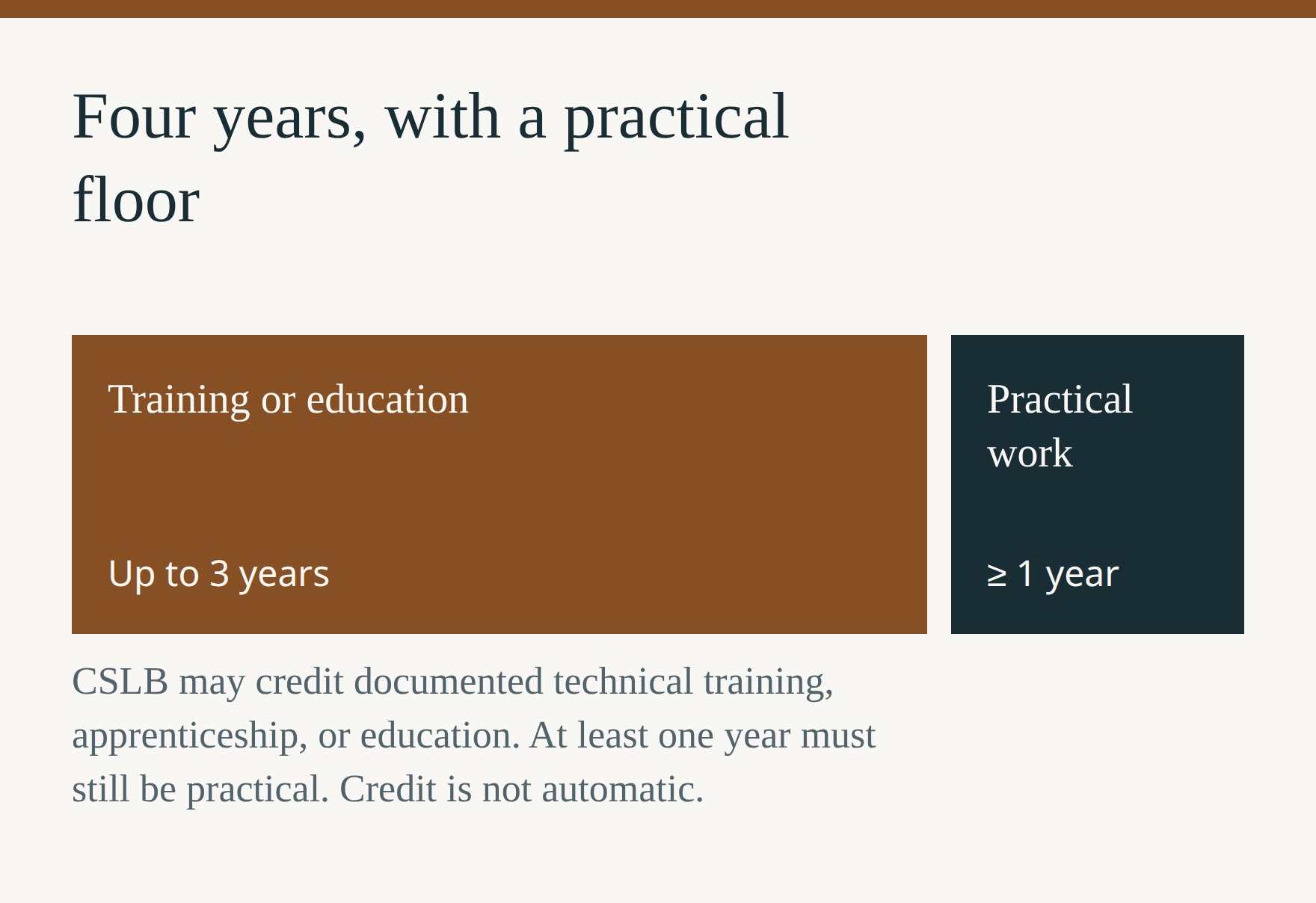
The experience page publishes these maximums. They are caps CSLB may apply after it reviews documents, not a calculator that turns your transcript into a guaranteed number of years.
| Documented education or training | Published maximum |
|---|---|
| Accredited A.A. in building or construction management | 1.5 years |
| Listed four-year degrees, a professional law degree, or substantial related coursework | 2 years |
| Certificate of completion of apprenticeship in the classification, a related construction-technology or engineering degree, or the listed C-27 or C-33 specialty degrees | 3 years |
The two-year bucket on the live page includes a four-year degree in accounting, architecture (B-General Building only), business, economics, mathematics, physics, or areas related to the trade, plus a professional law degree, or substantial coursework in accounting, architecture, business, construction technology, drafting, economics, engineering, mathematics, or physics. The three-year degree bucket is narrower: construction technology or management, engineering directly related to the classification, horticulture or landscape architecture for C-27, and interior design for C-33. Read the page before you assume a degree title lands in the higher bucket. The journeyman FAQ repeats the one-year practical floor and points applicants to written proof such as apprenticeship certificates and transcripts.
A completed apprenticeship can support credit. An apprenticeship you have not finished is not the same thing as journey-level time, and it is not automatically three years of credit. There is no worksheet on this page that adds your units and tells you that you qualify.
When exam prep is timely
Buy practice after the experience story is one CSLB can review, not before. If you are still a helper, still in an apprenticeship, or missing a certifier who actually watched the work, more practice questions will not fill the application. Delay the purchase and use the time to gather the certification and the support the acceptable-documents list describes.
If the classification is clear and the four-year claim is documented, the study decision is separate. Compare Class B, Class C, and B-2 if you have not locked the scope. Then use the closed-book study guide and, for a realistic view of the exams, how hard the CSLB exams are. A Law and Business result you already have belongs in the recovery guide. Passing still does not issue the license. Issuance stays with CSLB.
Where ContractorPass fits
ContractorPass is independent exam practice. It is not CSLB, and it does not certify experience, sign a Certification of Work Experience, or evaluate a transcript. The ContractorPass page is the product description. The California contractor pages and the contractor hub are the surrounding guides.
Use the experience page, the certification form, and the acceptable-documents list as the record. If that record is not ready, do not treat a practice subscription as a shortcut. If it is ready, practice is only for the exam CSLB actually assigns to your classification.
Pause. Apply. Understand.
Make the next call.
Original learning scenarios. Choose an answer, then explore the reasoning. These are not official examination questions or a scored readiness assessment.
From reading to doing
Your next three moves.
A personal planning checklist. Tick off each step as you finish it; progress lasts until you leave or reload this page.
A little more clarity
Questions, answered.
How many years of experience does CSLB require?
At least four years in the classification you are applying for, at journey level or as a foreman, supervising employee, contractor, or owner-builder. The certification form says that experience must have been obtained within the last 10 years.
What counts as journeyman-level experience?
CSLB describes a journeyman as a fully qualified worker who can perform the trade without supervision, or a person who has completed an apprenticeship program. It is not a trainee, helper, laborer, assistant, or apprentice still in training.
Do helper, trainee, or unfinished apprentice hours count?
Not as journey-level credit by themselves. Completed apprenticeship or other education can be submitted for the separate credit caps. CSLB still has to accept the documentation.
Can education replace some of the four years?
Yes, up to three years of documented technical training, apprenticeship, or education, and at least one year must be practical. The published maximum depends on the credential. This page is not a transcript calculator.
What is a Certification of Work Experience?
It is CSLB’s form for the qualifying individual and a certifier with direct knowledge of the work. Original signatures are required, and CSLB can still ask for supporting documents.
Who can verify my experience?
The experience page lists a qualified person who observed the work, such as an employer, contractor, foreman, fellow journeyman, union representative, inspector, architect, engineer, or homeowner. The form’s instructions list who may sign that form. Use both current documents.
Do I need a college degree?
No. CSLB says you do not have to meet an education requirement to qualify. A degree can support partial credit only after transcripts are reviewed, and it does not erase the practical year.
Does ContractorPass certify experience?
No. ContractorPass is independent exam practice. It is not CSLB and does not sign, score, or approve a work-experience claim. Passing an exam still does not issue the license.
Put your next step into focus.
Take what you have learned into your next study session. Use the linked practice and resources to decide where to focus.
Find your next stepEducational information and independent practice. Confirm current examination, education and licensing requirements with the linked official sources. Practice results do not guarantee an examination result or eligibility.