
See whether the mural exemption actually fits.
Which description matches the work?
Choose a focus to see the next checks and relevant sources. This tool does not determine eligibility, compliance or authority to work.
What SB 456 actually exempts
Senate Bill 456 (Ashby) is the muralist exemption summarized in CSLB Industry Bulletin #25-04 and spelled out further in the April 2026 California Licensed Contractor newsletter. Checked November 9, 2026. The exemption is for a person who paints, draws, applies, executes, restores, or conserves a mural under an agreement with someone legally allowed to approve that work.
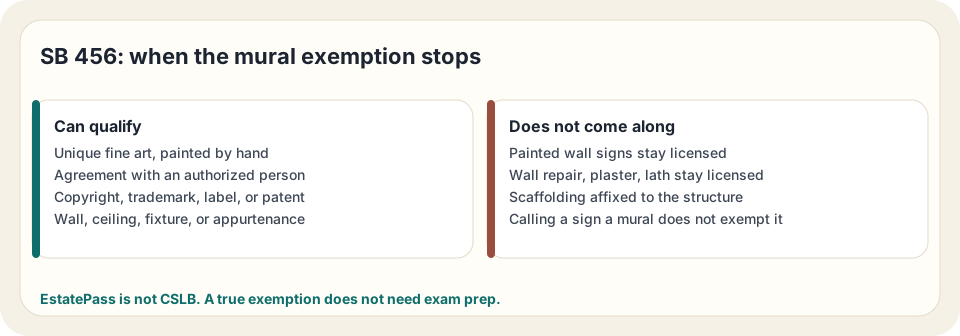
The mural itself has to be a unique work of fine art, made by hand, directly on an interior or exterior wall, ceiling, fixture, or other appurtenance of a building. It also has to be protected by copyright, trademark, label, or patent. The newsletter’s elaboration matches that shape: unique fine art, painted or drawn by hand, on walls, ceilings, fixtures, or appurtenances, plus the agreement and the intellectual-property protection. This page does not decide that your sketch is “fine art.” CSLB’s classification desk is classifications@cslb.ca.gov when the live materials do not answer the job in front of you.
The older minor-work question — price, permit, and employees — remains on do I need a license. SB 456 is a separate exemption with its own conditions. A mural that fails those conditions does not fall back on a guess.
Conditions worth writing down before you skip the license
| Condition | What the CSLB materials require | What this page will not add |
|---|---|---|
| The work | Paint, draw, apply, execute, restore, or conserve the mural | A ruling that a specific piece is fine art |
| Authority | An agreement with a person allowed to approve the work | A handshake counted as that agreement |
| The surface | Hand work directly on a wall, ceiling, fixture, or appurtenance | A panel fabricated off site treated as the same thing |
| The right | Copyright, trademark, label, or patent protection | A claim that every painted wall qualifies |
| The exclusion | Painted wall signs are not exempt | A slogan that “art” covers a sign |
Primer, base paint, and some conservation or sealant steps can be treated as part of the mural work when they fit the statutory framing. Verify that sentence against the April 2026 newsletter before you fold a large prep scope into the exemption. The newsletter is the source. This article is the pointer.
What still needs a license
Painted wall signs
Painted wall signs are not the exemption. A sign that advertises a business, a product, or a place is licensed contractor work even if the painter is skilled and the wall looks artistic. Calling a sign a mural does not move it into SB 456.
Repair, plaster, and affixed scaffolding
The newsletter is explicit about construction that stays licensed even when the mural itself qualifies. Patching, plastering, lathing, or repairing a wall so the mural can be applied can still require a contractor license. Erecting scaffolding that is affixed to the structure can still require a license. Those trades are not “part of the art” by default. Primer and conservation materials are the narrow items the newsletter allows you to examine as mural work. Opening a wall is not.
If the job includes that licensed construction, the painter’s exemption for the artwork does not license the person who repairs the substrate or builds the scaffold. That person still walks the ordinary path: which classification, then experience, then the exams.
If you are exempt, stop. If you are not, do not skip ahead to a question bank
When the conditions all fit, and the exclusions do not, SB 456 is an off-ramp. You do not need ContractorPass to paint that mural. Buying exam prep for a job the statute exempts is the wrong purchase. Re-check the moment the owner adds a sign, a wall repair, or a fixed scaffold.
When any condition fails, the license question is open again. Start at do I need a license, then classification and the four-year experience record. Closed-book study habits are on the CSLB study guide. The rest of the 2026 bill list, including this exemption as one row, is the 2026 new laws hub.
Where EstatePass fits
EstatePass and ContractorPass are exam practice. They are not CSLB and they are not art-law counsel. They will not certify that your wall is a unique work of fine art or that your agreement satisfies SB 456. ContractorPass is useful only after a license is actually required and you are preparing for that exam. The California hub is the map of those routes.
Write the conditions down, read the bulletin and the April 2026 newsletter, and email classifications@cslb.ca.gov if the live page and the job still do not match. That email is CSLB’s, not ours.
Pause. Apply. Understand.
Make the next call.
Original learning scenarios. Choose an answer, then explore the reasoning. These are not official examination questions or a scored readiness assessment.
From reading to doing
Your next three moves.
A personal planning checklist. Tick off each step as you finish it; progress lasts until you leave or reload this page.
A little more clarity
Questions, answered.
Do muralists need a California contractor license after SB 456?
Not when every condition in the exemption is met. If a condition fails, the license question is open again.
What has to be true of the mural?
CSLB describes a unique work of fine art, made by hand, on a wall, ceiling, fixture, or appurtenance, under an agreement with an authorized person, and protected by copyright, trademark, label, or patent.
Are painted wall signs exempt?
No. Painted wall signs are outside the exemption and still require a contractor license.
Does scaffolding or wall repair still need a license?
Yes. Patching, plastering, lathing, or repairing a wall, and scaffolding affixed to the structure, can still be licensed work even when the mural itself qualifies.
Can primer be part of the mural work?
The April 2026 newsletter says primer, base paint, and some conservation or sealant steps may be treated as part of the mural when they fit the statute. Verify that on the newsletter. Opening the wall is different.
Who decides a close call?
This page does not. CSLB points classification questions to classifications@cslb.ca.gov.
Does a true exemption mean I should buy ContractorPass?
No. If the mural meets SB 456, exam prep is the wrong purchase. Buy practice only if a license is actually required and you are studying for that exam.
Is EstatePass CSLB?
No. EstatePass is not CSLB and not legal advice about whether your artwork qualifies.
Put your next step into focus.
Take what you have learned into your next study session. Use the linked practice and resources to decide where to focus.
Find your next stepEducational information and independent practice. Confirm current examination, education and licensing requirements with the linked official sources. Practice results do not guarantee an examination result or eligibility.