
North Carolina video lessons · Lesson 3 of 10
North Carolina Turns, Lanes and Passing: five situations explained
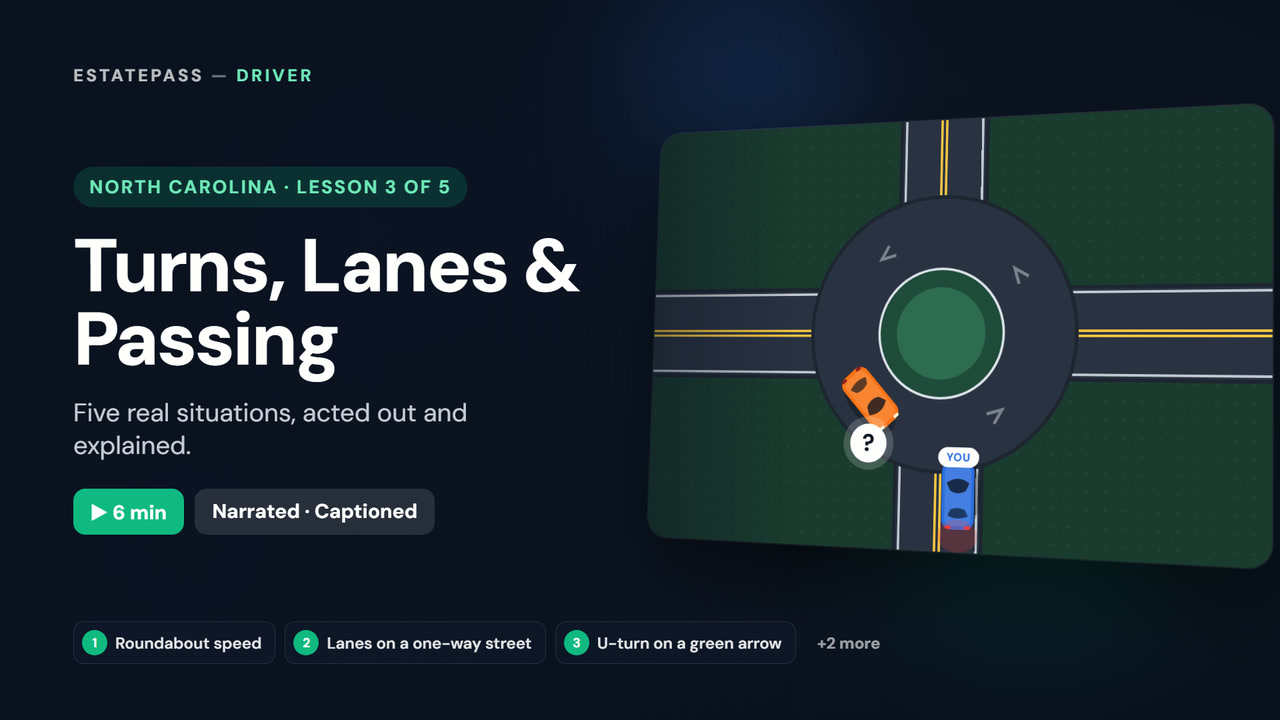
All five situations and their answers are below. To watch the lesson, create a free account.
In this video
- 0:00Intro
- 0:17At about what speed are modern roundabouts designed for?
- 1:09On a one-way street with several lanes, which lanes are for through travel?
- 1:58You are making a U-turn on a green arrow while opposing traffic turns right on its own green arrow. Who yields?
- 2:56When you blow your horn to pass, what does it obligate the driver ahead to do?
- 3:48You enter an interstate going the wrong direction. What should you do?
- 4:52Recap
In short
The modern roundabout is smaller than older traffic circles and requires lower speeds, 15-20 mph. On a one-way street, use the center lane(s) for through travel and the outside lanes for turning. U-turning traffic should yield to opposing right-turning traffic when both have green arrows.
The five situations
Pick an answer first, the way the video pauses for you. Each one cites the North Carolina Driver Handbook.
Situation 1
At about what speed are modern roundabouts designed for?
Answer: A. 15 to 20 mph. The modern roundabout is smaller than older traffic circles and requires lower speeds, 15-20 mph.
North Carolina Driver Handbook › Chapter 4 › Roundabouts
Situation 2
On a one-way street with several lanes, which lanes are for through travel?
Answer: C. The center lanes. On a one-way street, use the center lane(s) for through travel and the outside lanes for turning.
North Carolina Driver Handbook › Chapter 4 › City Driving
Situation 3
You are making a U-turn on a green arrow while opposing traffic turns right on its own green arrow. Who yields?
Answer: B. You, the U-turning driver. U-turning traffic should yield to opposing right-turning traffic when both have green arrows.
North Carolina Driver Handbook › Chapter 5 › Signals
Situation 4
When you blow your horn to pass, what does it obligate the driver ahead to do?
Answer: A. Help you pass by moving right. The horn signal places the driver you are passing under a legal obligation to help you pass.
North Carolina Driver Handbook › Chapter 4 › Passing
Situation 5
You enter an interstate going the wrong direction. What should you do?
Answer: C. Pull to the right shoulder, stop, and turn around when clear. Pull over to the right shoulder and stop. When the way is clear, turn around and head the proper direction.
North Carolina Driver Handbook › Chapter 4 › Interstate Highways
Transcript
0:00Intro
Turning, changing lanes and passing are where small mistakes get expensive. Here are five situations from the North Carolina Driver Handbook. For each one, pick your answer before I reveal it.
0:17Situation 1
You're approaching a modern roundabout, which is smaller than an old traffic circle. At about what speed are modern roundabouts designed for? The answer is A: 15 to 20 mph. The modern roundabout is smaller than older traffic circles and requires lower speeds, 15-20 mph. Modern roundabouts are designed for low speeds, about 15 to 20 miles per hour.
1:09Situation 2
You're driving straight through town on a one-way street with several lanes. On a one-way street with several lanes, which lanes are for through travel? The answer is C: The center lanes. On a one-way street, use the center lane(s) for through travel and the outside lanes for turning. Use the center lanes for through travel and leave the outside lanes for turning.
1:58Situation 3
You're making a U-turn on a green arrow, while the oncoming driver is turning right on their own green arrow. You are making a U-turn on a green arrow while opposing traffic turns right on its own green arrow. Who yields? The answer is B: You, the U-turning driver. U-turning traffic should yield to opposing right-turning traffic when both have green arrows. The U-turning driver yields to opposing right-turning traffic.
2:56Situation 4
On a two-lane road, a driver behind you taps the horn and starts to pass. When you blow your horn to pass, what does it obligate the driver ahead to do? The answer is A: Help you pass by moving right. The horn signal places the driver you are passing under a legal obligation to help you pass. That horn signal obligates you to help them pass by moving right.
3:48Situation 5
You realize the headlights on the interstate are coming straight at you. You entered going the wrong way. You enter an interstate going the wrong direction. What should you do? The answer is C: Pull to the right shoulder, stop, and turn around when clear. Pull over to the right shoulder and stop. When the way is clear, turn around and head the proper direction. Pull onto the right shoulder and stop. When the way is clear, turn around and head the right direction.
4:52Recap
The modern roundabout is smaller than older traffic circles and requires lower speeds, 15-20 mph. On a one-way street, use the center lane(s) for through travel and the outside lanes for turning. U-turning traffic should yield to opposing right-turning traffic when both have green arrows. The horn signal places the driver you are passing under a legal obligation to help you pass. Pull over to the right shoulder and stop. Nice work. Try more turning and passing questions in Practice by Topic, then test yourself with a full mock exam.
The rules in this lesson
- The modern roundabout is smaller than older traffic circles and requires lower speeds, 15-20 mph.
- On a one-way street, use the center lane(s) for through travel and the outside lanes for turning.
- U-turning traffic should yield to opposing right-turning traffic when both have green arrows.
- The horn signal places the driver you are passing under a legal obligation to help you pass.
- Pull over to the right shoulder and stop.
Original practice lesson written from the North Carolina Driver Handbook. EstatePass is not affiliated with or endorsed by the North Carolina NCDMV; these are not official test questions.