
North Carolina video lessons · Lesson 6 of 10
North Carolina Sharing the Road: five situations explained
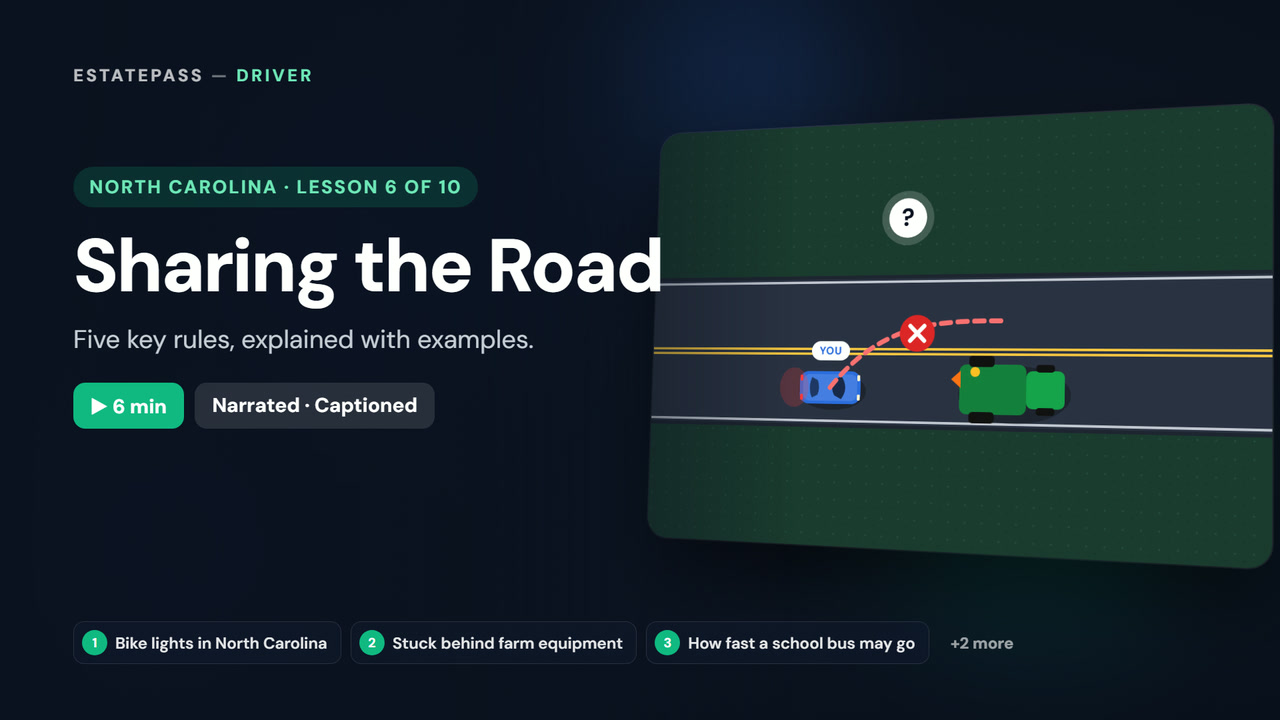
All five situations and their answers are below. To watch the lesson, create a free account.
In this video
- 0:00Intro
- 0:18At night, from how far must a bicycle’s front light be visible in North Carolina?
- 1:14When is the only advisable time to pass farm equipment?
- 2:20What is the maximum speed limit for a North Carolina school bus?
- 3:10Where may a North Carolina bicyclist choose to ride?
- 4:07A farm machinery operator gives a left-hand signal. What is a common crash cause here?
- 5:13Recap
In short
A bicycle at night needs a front light visible for at least 300 feet and a rear red light or reflector visible for 200 feet. If farm equipment delays traffic, the operator should move off the road; this is the only advisable time to pass. The maximum speed limit for a school bus is 45 mph.
The five situations
Pick an answer first, the way the video pauses for you. Each one cites the North Carolina Driver Handbook.
Situation 1
At night, from how far must a bicycle’s front light be visible in North Carolina?
Answer: B. At least 300 feet. A bicycle at night needs a front light visible for at least 300 feet and a rear red light or reflector visible for 200 feet.
North Carolina Driver Handbook › Chapter 6 › Bicycles
Situation 2
When is the only advisable time to pass farm equipment?
Answer: B. When the operator moves off the road to let traffic pass. If farm equipment delays traffic, the operator should move off the road; this is the only advisable time to pass. Passing in a no-passing zone is illegal.
North Carolina Driver Handbook › Chapter 4 › Safe Driving Around Farm Equipment
Situation 3
What is the maximum speed limit for a North Carolina school bus?
Answer: C. 45 mph. The maximum speed limit for a school bus is 45 mph.
North Carolina Driver Handbook › Chapter 4 › School Buses
Situation 4
Where may a North Carolina bicyclist choose to ride?
Answer: C. In a bike lane, on a paved shoulder, or in a travel lane. Bicyclists may ride in bicycle lanes, on paved shoulders, or in all-purpose travel lanes, and may need the full lane.
North Carolina Driver Handbook › Chapter 6 › Bicycles
Situation 5
A farm machinery operator gives a left-hand signal. What is a common crash cause here?
Answer: A. Drivers mistake it as a signal to pass while the equipment turns left. Drivers may mistake a left-hand signal as a sign to pass; when the machinery turns left, the passing vehicle crashes into it.
North Carolina Driver Handbook › Chapter 4 › Safe Driving Around Farm Equipment
Transcript
0:00Intro
You share the road with trucks, bikes, buses and more, and each one changes how you drive. Here are five situations from the North Carolina Driver Handbook. For each one, pick your answer before I reveal it.
0:18Situation 1
A cyclist is riding home after dark. At night, from how far must a bicycle’s front light be visible in North Carolina? The answer is B: At least 300 feet. A bicycle at night needs a front light visible for at least 300 feet and a rear red light or reflector visible for 200 feet. The front light must be visible for at least 300 feet, with a rear red light or reflector visible for 200 feet.
1:14Situation 2
You're behind slow farm equipment, and traffic is starting to back up. When is the only advisable time to pass farm equipment? The answer is B: When the operator moves off the road to let traffic pass. If farm equipment delays traffic, the operator should move off the road; this is the only advisable time to pass. Passing in a no-passing zone is illegal. The operator should move off the road to let traffic by, and that's the only advisable time to pass. Never pass in a no-passing zone.
2:20Situation 3
A school bus is ahead of you on a North Carolina highway. What is the maximum speed limit for a North Carolina school bus? The answer is C: 45 mph. The maximum speed limit for a school bus is 45 mph. The maximum speed limit for a school bus is 45 miles per hour, so expect it to travel slower than other traffic.
3:10Situation 4
A cyclist is riding in the travel lane, even though there's a paved shoulder. Where may a North Carolina bicyclist choose to ride? The answer is C: In a bike lane, on a paved shoulder, or in a travel lane. Bicyclists may ride in bicycle lanes, on paved shoulders, or in all-purpose travel lanes, and may need the full lane. Cyclists may ride in a bike lane, on a paved shoulder, or in a travel lane, and they may need the full lane.
4:07Situation 5
The farm machinery ahead of you shows a left-hand signal. A farm machinery operator gives a left-hand signal. What is a common crash cause here? The answer is A: Drivers mistake it as a signal to pass while the equipment turns left. Drivers may mistake a left-hand signal as a sign to pass; when the machinery turns left, the passing vehicle crashes into it. Don't take it as a signal to pass. The machine is about to turn left, and that's exactly when passing drivers crash into it.
5:13Recap
A bicycle at night needs a front light visible for at least 300 feet and a rear red light or reflector visible for 200 feet. If farm equipment delays traffic, the operator should move off the road; this is the only advisable time to pass. The maximum speed limit for a school bus is 45 mph. Bicyclists may ride in bicycle lanes, on paved shoulders, or in all-purpose travel lanes, and may need the full lane. Drivers may mistake a left-hand signal as a sign to pass; when the machinery turns left, the passing vehicle crashes into it. Nice work. Try more sharing the road questions in Practice by Topic, then test yourself with a full mock exam.
The rules in this lesson
- A bicycle at night needs a front light visible for at least 300 feet and a rear red light or reflector visible for 200 feet.
- If farm equipment delays traffic, the operator should move off the road; this is the only advisable time to pass.
- The maximum speed limit for a school bus is 45 mph.
- Bicyclists may ride in bicycle lanes, on paved shoulders, or in all-purpose travel lanes, and may need the full lane.
- Drivers may mistake a left-hand signal as a sign to pass; when the machinery turns left, the passing vehicle crashes into it.
Original practice lesson written from the North Carolina Driver Handbook. EstatePass is not affiliated with or endorsed by the North Carolina NCDMV; these are not official test questions.