
North Carolina video lessons · Lesson 7 of 10
North Carolina Safe Driving and Conditions: five situations explained
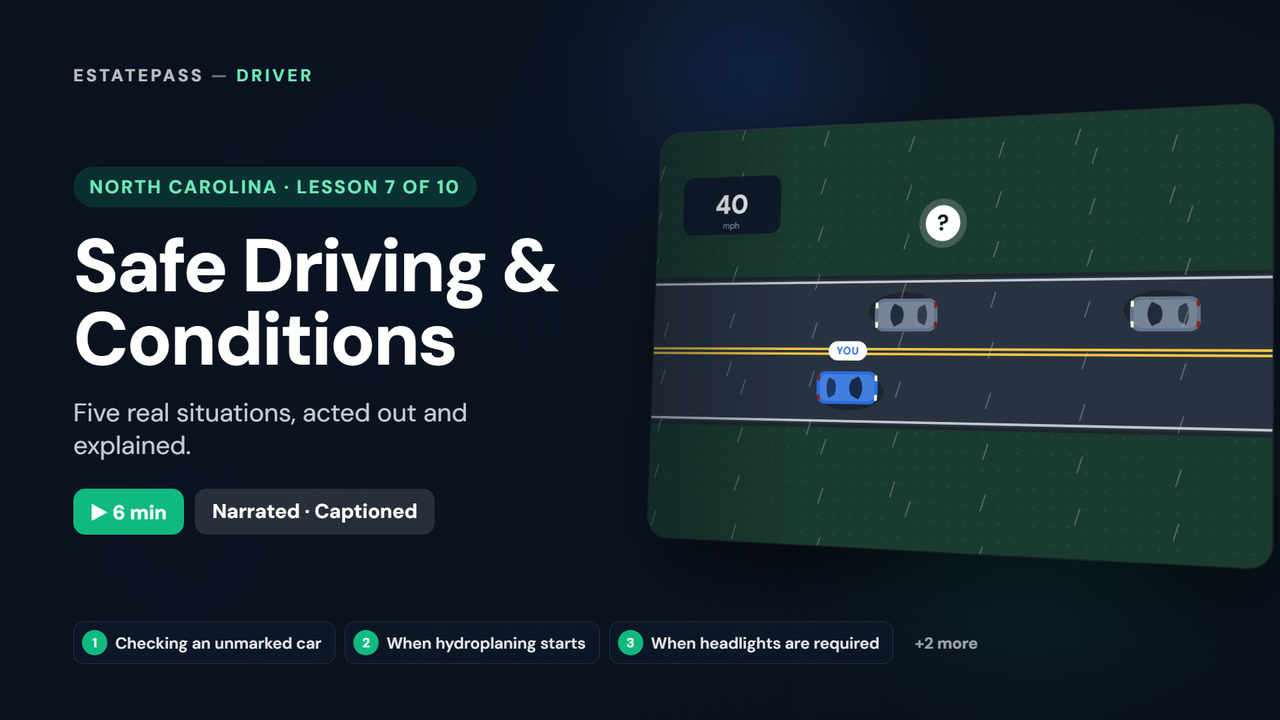
All five situations and their answers are below. To watch the lesson, create a free account.
In this video
- 0:00Intro
- 0:18You doubt an unmarked car stopping you is really the police. What may you do?
- 1:21At what speed can hydroplaning start, according to the North Carolina handbook?
- 2:21When does North Carolina law require headlights?
- 3:21How much should you reduce speed on packed snow?
- 4:08You are about to be hit from behind and nothing is ahead of you. What should you do?
- 5:12Recap
In short
You may call 9-1-1 before pulling over, report your name and location, and verify that a real officer is stopping you. Hydroplaning can start at speeds as low as 30 mph and in water little more than 1/8 inch deep. The law requires headlights from sunset to sunrise and when visibility is 400 feet or less.
The five situations
Pick an answer first, the way the video pauses for you. Each one cites the North Carolina Driver Handbook.
Situation 1
You doubt an unmarked car stopping you is really the police. What may you do?
Answer: A. Call 9-1-1 before pulling over to verify. You may call 9-1-1 before pulling over, report your name and location, and verify that a real officer is stopping you.
North Carolina Driver Handbook › Chapter 4 › What Motorists Should Do When Stopped By Law Enforcement
Situation 2
At what speed can hydroplaning start, according to the North Carolina handbook?
Answer: A. As low as 30 mph, in water little more than 1/8 inch deep. Hydroplaning can start at speeds as low as 30 mph and in water little more than 1/8 inch deep.
North Carolina Driver Handbook › Chapter 4 › Rain
Situation 3
When does North Carolina law require headlights?
Answer: A. Sunset to sunrise, and when visibility is 400 feet or less. The law requires headlights from sunset to sunrise and when visibility is 400 feet or less.
North Carolina Driver Handbook › Chapter 4 › Night Driving
Situation 4
How much should you reduce speed on packed snow?
Answer: B. By more than half. Reduce speed by more than half for packed snow and slow to a crawl on ice.
North Carolina Driver Handbook › Chapter 4 › Snow and Ice
Situation 5
You are about to be hit from behind and nothing is ahead of you. What should you do?
Answer: B. Press the accelerator and move away, bracing your head against the headrest. Press the accelerator and move away; be ready to brake; brace yourself and press your head against the head rest.
North Carolina Driver Handbook › Chapter 4 › Emergencies
Transcript
0:00Intro
Weather, darkness and other drivers can turn an easy drive into a hard one. Let's work through five situations from the North Carolina Driver Handbook. For each one, pick your answer before I reveal it.
0:18Situation 1
An unmarked car signals you to pull over, and you're not sure it's really the police. You doubt an unmarked car stopping you is really the police. What may you do? The answer is A: Call 9-1-1 before pulling over to verify. You may call 9-1-1 before pulling over, report your name and location, and verify that a real officer is stopping you. You may call 9-1-1 before pulling over, give your name and location, and confirm a real officer is stopping you.
1:21Situation 2
Rain has left a thin layer of water on the road. At what speed can hydroplaning start, according to the North Carolina handbook? The answer is A: As low as 30 mph, in water little more than 1/8 inch deep. Hydroplaning can start at speeds as low as 30 mph and in water little more than 1/8 inch deep. Hydroplaning can start as low as 30 miles per hour, in water little more than an eighth of an inch deep.
2:21Situation 3
It's mid-afternoon, but fog has cut how far you can see. When does North Carolina law require headlights? The answer is A: Sunset to sunrise, and when visibility is 400 feet or less. The law requires headlights from sunset to sunrise and when visibility is 400 feet or less. North Carolina law requires headlights from sunset to sunrise, and whenever visibility is 400 feet or less.
3:21Situation 4
The road is covered in packed snow. How much should you reduce speed on packed snow? The answer is B: By more than half. Reduce speed by more than half for packed snow and slow to a crawl on ice. Reduce your speed by more than half on packed snow, and slow to a crawl on ice.
4:08Situation 5
In your mirror, a car is coming up fast and won't stop in time. The road ahead of you is clear. You are about to be hit from behind and nothing is ahead of you. What should you do? The answer is B: Press the accelerator and move away, bracing your head against the headrest. Press the accelerator and move away; be ready to brake; brace yourself and press your head against the head rest. Press the accelerator and move away, be ready to brake, and brace yourself with your head against the head rest.
5:12Recap
You may call 9-1-1 before pulling over, report your name and location, and verify that a real officer is stopping you. Hydroplaning can start at speeds as low as 30 mph and in water little more than 1/8 inch deep. The law requires headlights from sunset to sunrise and when visibility is 400 feet or less. Reduce speed by more than half for packed snow and slow to a crawl on ice. Press the accelerator and move away; be ready to brake; brace yourself and press your head against the head rest. Nice work. Try more safe driving questions in Practice by Topic, then test yourself with a full mock exam.
The rules in this lesson
- You may call 9-1-1 before pulling over, report your name and location, and verify that a real officer is stopping you.
- Hydroplaning can start at speeds as low as 30 mph and in water little more than 1/8 inch deep.
- The law requires headlights from sunset to sunrise and when visibility is 400 feet or less.
- Reduce speed by more than half for packed snow and slow to a crawl on ice.
- Press the accelerator and move away; be ready to brake; brace yourself and press your head against the head rest.
Original practice lesson written from the North Carolina Driver Handbook. EstatePass is not affiliated with or endorsed by the North Carolina NCDMV; these are not official test questions.