
North Carolina video lessons · Lesson 2 of 10
North Carolina Right-of-Way and Pedestrians: five situations explained
All five situations and their answers are below. To watch the lesson, create a free account.
In this video
- 0:00Intro
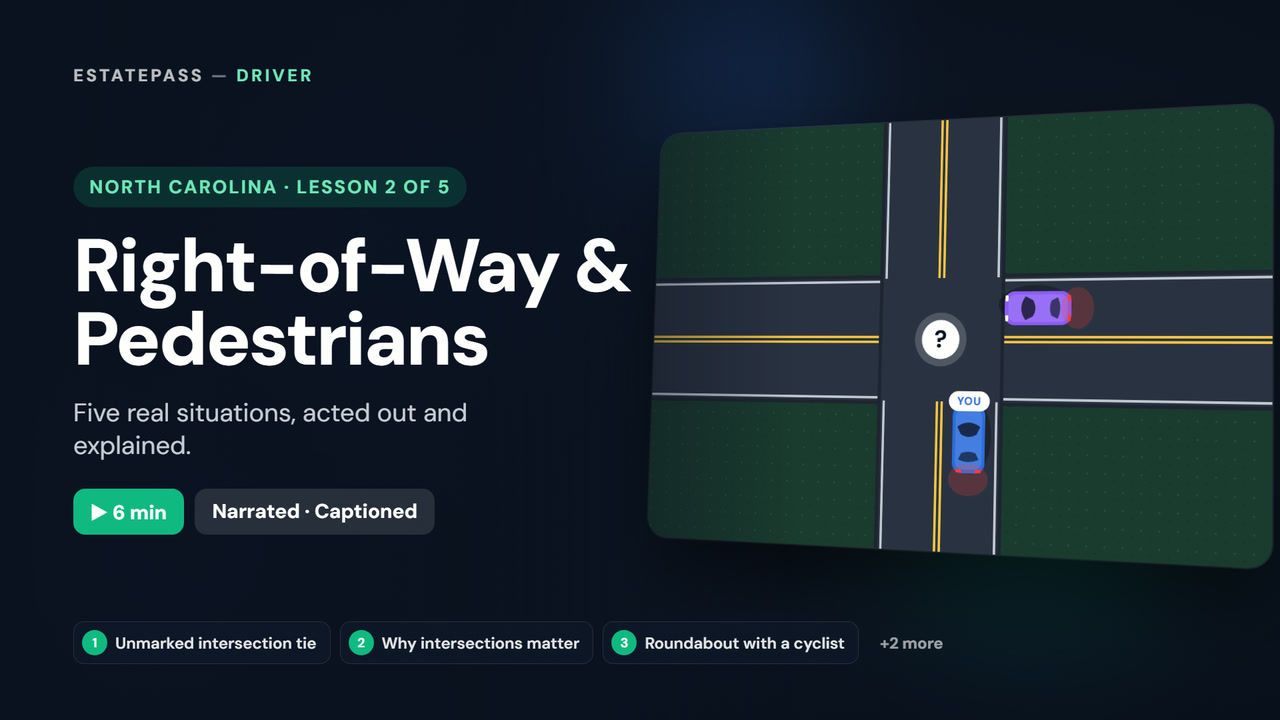
- 0:17Two vehicles reach an intersection without signs at the same time. Who has the right of way?
- 1:16What share of fatal motor vehicle crashes occur at intersections, according to the handbook?
- 2:13Entering a roundabout, whom do you yield to?
- 3:11Two facing vehicles arrive together; one goes straight and the other turns left. Who goes first?
- 4:07The signal turns red while a pedestrian is still in the street. What must you do?
- 5:06Recap
In short
When two or more vehicles reach an intersection at the same time, the vehicle to the right has the right of way. Crashes occur most frequently at intersections; more than one-third of fatal crashes occur there. Drivers yield to any vehicles or bicyclists already in the roundabout; those in it do not yield to approaching vehicles.
The five situations
Pick an answer first, the way the video pauses for you. Each one cites the North Carolina Driver Handbook.
Situation 1
Two vehicles reach an intersection without signs at the same time. Who has the right of way?
Answer: A. The vehicle to the right. When two or more vehicles reach an intersection at the same time, the vehicle to the right has the right of way.
North Carolina Driver Handbook › Chapter 4 › Interchanges, Intersections, Roads, Streets and Highways
Situation 2
What share of fatal motor vehicle crashes occur at intersections, according to the handbook?
Answer: B. More than one-third. Crashes occur most frequently at intersections; more than one-third of fatal crashes occur there.
North Carolina Driver Handbook › Chapter 4 › Interchanges, Intersections, Roads, Streets and Highways
Situation 3
Entering a roundabout, whom do you yield to?
Answer: C. Vehicles and bicyclists already in it. Drivers yield to any vehicles or bicyclists already in the roundabout; those in it do not yield to approaching vehicles.
North Carolina Driver Handbook › Chapter 4 › Roundabouts
Situation 4
Two facing vehicles arrive together; one goes straight and the other turns left. Who goes first?
Answer: B. The one going straight. The driver who wants to turn left must wait; the driver going straight has the right of way.
North Carolina Driver Handbook › Chapter 4 › Interchanges, Intersections, Roads, Streets and Highways
Situation 5
The signal turns red while a pedestrian is still in the street. What must you do?
Answer: A. Let them finish crossing safely. If a signal changes to yellow or red while any pedestrian remains in the street, drivers must let them complete the crossing.
North Carolina Driver Handbook › Chapter 4 › The Driver and Pedestrian
Transcript
0:00Intro
Right-of-way comes down to one question: who goes first? Let's work through five everyday situations from the North Carolina Driver Handbook. For each one, pick your answer before I reveal it.
0:17Situation 1
You and another car arrive at an intersection with no signs at the same time. The other car is on your right. Two vehicles reach an intersection without signs at the same time. Who has the right of way? The answer is A: The vehicle to the right. When two or more vehicles reach an intersection at the same time, the vehicle to the right has the right of way. The vehicle on the right has the right-of-way. Let it go first.
1:16Situation 2
Here's a number that explains why so many test questions are about intersections. What share of fatal motor vehicle crashes occur at intersections, according to the handbook? The answer is B: More than one-third. Crashes occur most frequently at intersections; more than one-third of fatal crashes occur there. More than one-third of fatal crashes happen at intersections. Slow down and scan every time you approach one.
2:13Situation 3
You're about to enter a roundabout, and a car and a cyclist are already circling inside. Entering a roundabout, whom do you yield to? The answer is C: Vehicles and bicyclists already in it. Drivers yield to any vehicles or bicyclists already in the roundabout; those in it do not yield to approaching vehicles. Yield to every vehicle and cyclist already in the roundabout. They don't yield to you.
3:11Situation 4
You and an oncoming car reach the intersection together. You want to turn left; they're going straight. Two facing vehicles arrive together; one goes straight and the other turns left. Who goes first? The answer is B: The one going straight. The driver who wants to turn left must wait; the driver going straight has the right of way. The driver turning left waits. The one going straight goes first.
4:07Situation 5
The light changes, and a pedestrian is still out in the street, partway across. The signal turns red while a pedestrian is still in the street. What must you do? The answer is A: Let them finish crossing safely. If a signal changes to yellow or red while any pedestrian remains in the street, drivers must let them complete the crossing. If the signal changes while someone is still crossing, let them finish safely before you go.
5:06Recap
When two or more vehicles reach an intersection at the same time, the vehicle to the right has the right of way. Crashes occur most frequently at intersections; more than one-third of fatal crashes occur there. Drivers yield to any vehicles or bicyclists already in the roundabout; those in it do not yield to approaching vehicles. The driver who wants to turn left must wait; the driver going straight has the right of way. If a signal changes to yellow or red while any pedestrian remains in the street, drivers must let them complete the crossing. Nice work. Try more right-of-way questions in Practice by Topic, then test yourself with a full mock exam.
The rules in this lesson
- When two or more vehicles reach an intersection at the same time, the vehicle to the right has the right of way.
- Crashes occur most frequently at intersections; more than one-third of fatal crashes occur there.
- Drivers yield to any vehicles or bicyclists already in the roundabout; those in it do not yield to approaching vehicles.
- The driver who wants to turn left must wait; the driver going straight has the right of way.
- If a signal changes to yellow or red while any pedestrian remains in the street, drivers must let them complete the crossing.
Original practice lesson written from the North Carolina Driver Handbook. EstatePass is not affiliated with or endorsed by the North Carolina NCDMV; these are not official test questions.