
Panels: Bonding, Taps & Breaker Sizing
~14 min read · Catch neutral/ground violations, double-taps and breakers oversized for their conductors.
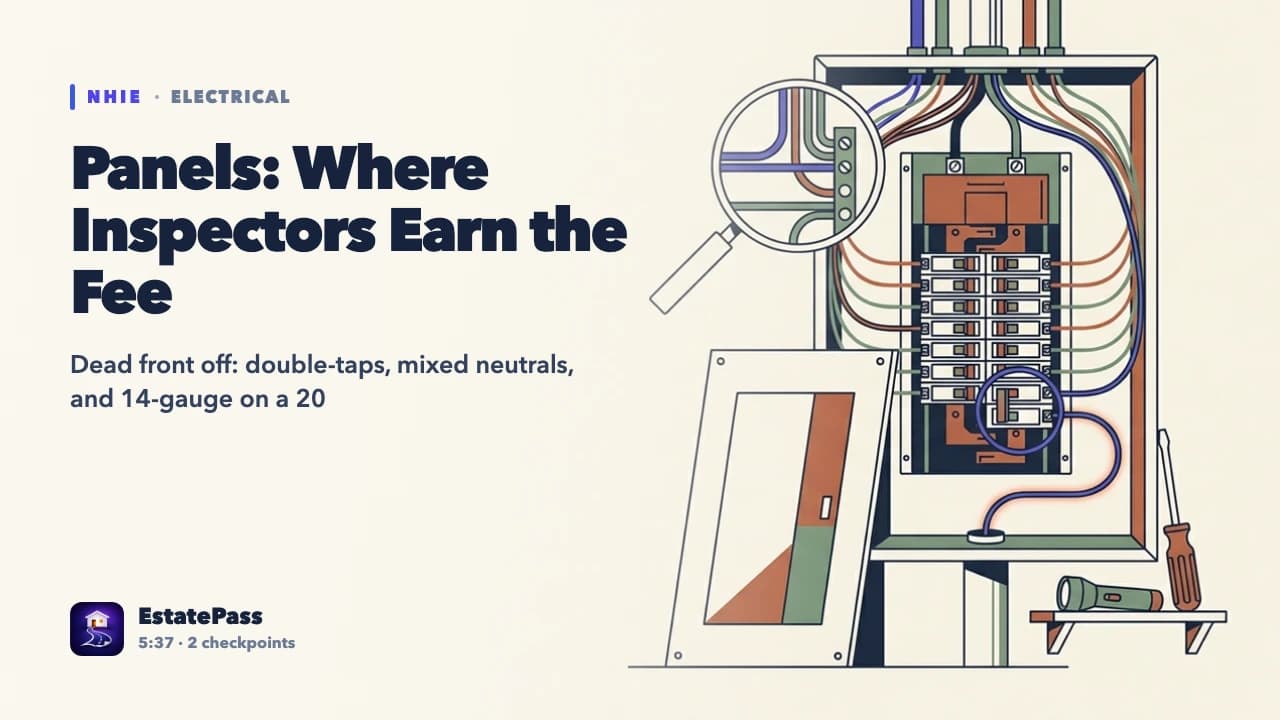
The panel is where the inspector earns the fee: cover off (when safe), and the findings parade — double-taps, neutrals and grounds mingling where they must not, breakers oversized for their wires, and the rule that separates service equipment from subpanels.
The neutral-ground rule
At the service equipment (main panel): neutrals and grounds bond together — the main bonding jumper connects neutral bus to the enclosure; this is the ONE place they meet. At subpanels (remote distribution): neutrals must be isolated on an insulated bus (no bonding screw), grounds on a separate bar bonded to the can, fed by four wires (two hots, neutral, ground). Why: bonded subpanel neutrals put normal return current on grounding conductors and metal parts — energized bare wires and enclosure paths. The finding: green bonding screw installed, or neutrals and grounds sharing a bar, in a subpanel.
- Main panel: neutrals + grounds bonded (once)
- Subpanel: neutrals isolated, grounds separate, 4-wire feed
- Bonded subpanel = current on ground paths — report it
Breakers and conductors
The stable matching rule: 14 AWG copper → 15 A max; 12 AWG → 20 A; 10 AWG → 30 A — a 20-amp breaker on 14-gauge wire lets the wire overheat before the breaker cares (the inspection framing: report the mismatch and its fire implication). Double-taps: two conductors under one breaker terminal designed for one (some breakers are listed for two — most aren't); double-lugged neutrals (two neutrals under one terminal) are their sibling. Also: overheating evidence (discoloration, melted insulation at terminals), corrosion, mixed-brand breakers not listed for the panel, and abandoned/mislabeled circuits.
- 14→15, 12→20, 10→30 — the wire-to-breaker law
- Double-taps and double-lugged neutrals
- Scorch marks and melted insulation = hot connections
Panel conditions and safe practice
Enclosure findings: missing knockout fillers and open slots (finger access to live parts), missing cover screws or wrong (pointed) screws piercing wires, rust and water staining (service-conduit leaks), panels in clothes closets or blocked by shelving (access/working-space principles), and federal-era problem panels (next lesson). Inspector safety doctrine: remove dead-front covers only when conditions are safe — wet floors, rusted covers, or evidence of energized-cover faults justify a stated limitation instead.
Worked example
In a garage subpanel: a green bonding screw ties the neutral bus to the can and grounds share the neutral bar; a 20-A breaker feeds visible 14-gauge copper to the bedroom circuit; one 30-A breaker terminal holds two 10-gauge wires with browned insulation at the lug. Report the three findings with their mechanisms.
Finding one: bonded subpanel — with neutral and ground joined here, normal return current divides onto the grounding system and feeder ground back to the house: metal parts and bare wires now carry current in normal operation; correction is isolating neutrals (remove bonding screw, separate bars) — electrician referral. Finding two: 20-A over 14 AWG — the conductor's protection exceeds its capacity; under sustained load the WIRE is the fuse; either the breaker drops to 15 A or the circuit is verified as 12 AWG throughout. Finding three: double-tap with heat evidence — two conductors under a one-wire lug make a loose, high-resistance joint; the browned insulation says it has been cooking; repair with a listed method (pigtail or two-conductor-rated breaker). All three route to 'evaluation and correction by a licensed electrician' — with mechanisms explained, the urgency explains itself.
Common exam pitfalls
Applying the main-panel bonding picture to subpanels.
Bonding happens ONCE, at the service — every downstream panel isolates neutrals from grounds.
Passing double-taps on breakers 'rated for it' without checking.
Only specific breakers are listed for two conductors — the terminal design tells; when in doubt, report.
Opening every panel regardless of conditions.
Wet, rusted, or suspect panels justify a stated limitation — no finding is worth an arc-flash.
Bond once at the service, size the breaker to the wire, one lug one wire — and scorch marks mean it's already been burning.
Recap
- Main: neutral-ground bonded; sub: isolated neutrals, 4-wire feed
- 14/15, 12/20, 10/30 conductor-breaker pairs
- Double-taps and double-lugged neutrals reported
- Heat discoloration = failing connections
- Open knockouts, wrong screws, water entry, access blockage
- Dead-front removal only when safe; limitation otherwise
VIDEO LESSON
Watch this lesson on video — free
Prove it: 10 questions on this topic
Every lesson ends with a ten-question check in the free course — your progress syncs between the web and the EstatePass app.