
Texas video lessons · Lesson 3 of 10
Texas Turns, Lanes and Passing: five situations explained
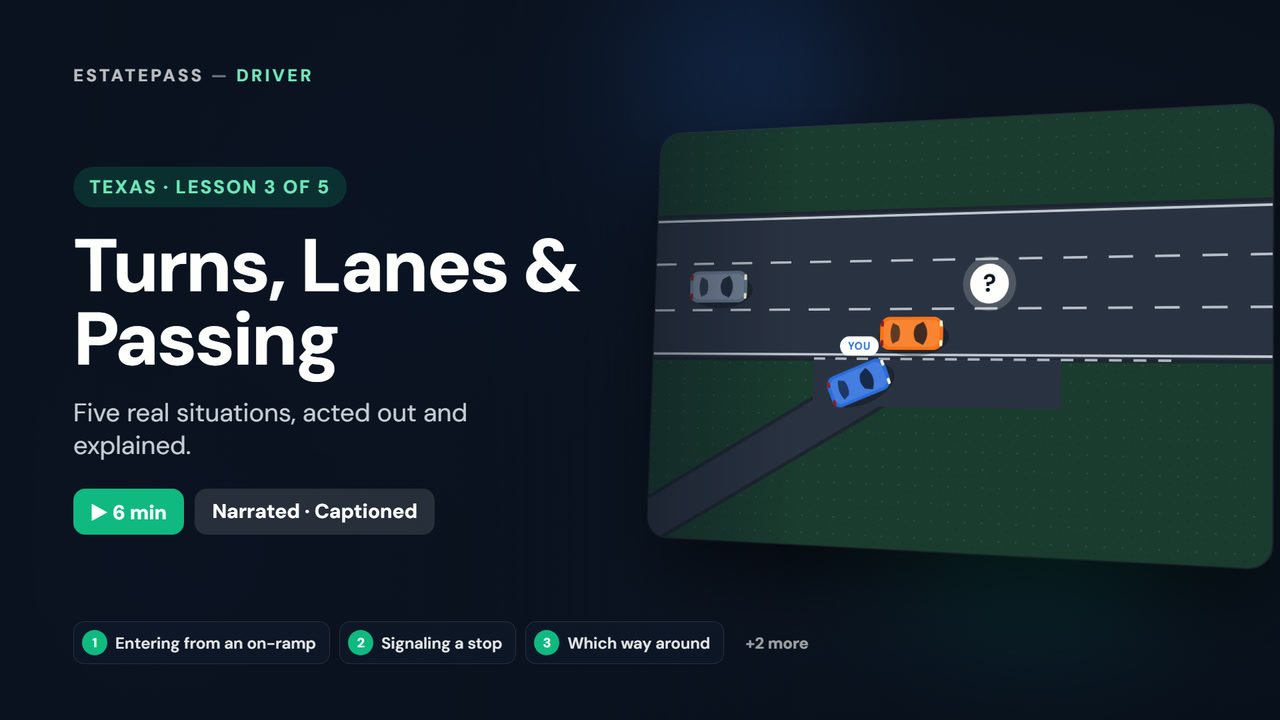
All five situations and their answers are below. To watch the lesson, create a free account.
In this video
- 0:00Intro
- 0:16When you enter a highway from an on-ramp, who has the right-of-way?
- 1:13What does the Texas handbook suggest when you signal a stop?
- 2:08Which way does traffic flow in a modern roundabout?
- 2:57According to the Texas handbook, what should you avoid while in the middle of a turn?
- 3:49You are being passed on a road without marked lanes. What should you do?
- 4:46Recap
In short
Yield to vehicles already on the highway. When signaling a stop, pump your brakes a few times to attract attention. A modern roundabout is a one-way circular intersection where traffic flows counterclockwise around a center island.
The five situations
Pick an answer first, the way the video pauses for you. Each one cites the Texas Driver Handbook (DL-7).
Situation 1
When you enter a highway from an on-ramp, who has the right-of-way?
Answer: C. Vehicles already on the highway. Yield to vehicles already on the highway. Use the speed change lane, signal, and speed up to merge.
Texas Driver Handbook (DL-7) › Chapter 9 › Highway Driving › Entering the Highway
Situation 2
What does the Texas handbook suggest when you signal a stop?
Answer: C. Pump your brakes a few times to attract attention. When signaling a stop, pump your brakes a few times to attract attention.
Texas Driver Handbook (DL-7) › Chapter 6 › Signaling › How to Signal
Situation 3
Which way does traffic flow in a modern roundabout?
Answer: B. Counterclockwise. A modern roundabout is a one-way circular intersection where traffic flows counterclockwise around a center island.
Texas Driver Handbook (DL-7) › Chapter 9 › Roundabouts
Situation 4
According to the Texas handbook, what should you avoid while in the middle of a turn?
Answer: C. Using the brake or clutch. Slow down to a reasonable turning speed before the turn; don’t use the brake or clutch while turning.
Texas Driver Handbook (DL-7) › Chapter 6: Signaling, Passing, and Turning › Turning
Situation 5
You are being passed on a road without marked lanes. What should you do?
Answer: A. Safely move as far right as you can. Do not speed up, stay in your lane, and safely move as far to the right as you can when the lanes are not marked.
Texas Driver Handbook (DL-7) › Chapter 6: Signaling, Passing, and Turning › When Another Vehicle is Passing
Transcript
0:00Intro
Turning, changing lanes and passing are where small mistakes get expensive. Here are five situations from the Texas Driver Handbook. For each one, pick your answer before I reveal it.
0:16Situation 1
You're coming down an on-ramp onto a busy highway. When you enter a highway from an on-ramp, who has the right-of-way? The answer is C: Vehicles already on the highway. Yield to vehicles already on the highway. Use the speed change lane, signal, and speed up to merge. Vehicles already on the highway have the right-of-way. Signal, use the speed change lane, and merge into a gap.
1:13Situation 2
You need to stop, and the driver behind you is following close. What does the Texas handbook suggest when you signal a stop? The answer is C: Pump your brakes a few times to attract attention. When signaling a stop, pump your brakes a few times to attract attention. Tap your brakes a few times before you stop. The flashing brake lights grab the attention of the driver behind you.
2:08Situation 3
You're about to drive through your first modern roundabout. Which way does traffic flow in a modern roundabout? The answer is B: Counterclockwise. A modern roundabout is a one-way circular intersection where traffic flows counterclockwise around a center island. Traffic flows counterclockwise around the center island. Enter to the right and keep going around.
2:57Situation 4
You're coming up to a right turn at a corner. According to the Texas handbook, what should you avoid while in the middle of a turn? The answer is C: Using the brake or clutch. Slow down to a reasonable turning speed before the turn; don’t use the brake or clutch while turning. Do your slowing before the turn. Once you're turning, stay off the brake and the clutch.
3:49Situation 5
On a country road with no lane markings, a car behind you pulls out to pass. You are being passed on a road without marked lanes. What should you do? The answer is A: Safely move as far right as you can. Do not speed up, stay in your lane, and safely move as far to the right as you can when the lanes are not marked. Don't speed up. Stay in your path and move as far to the right as you safely can.
4:46Recap
Yield to vehicles already on the highway. When signaling a stop, pump your brakes a few times to attract attention. A modern roundabout is a one-way circular intersection where traffic flows counterclockwise around a center island. Slow down to a reasonable turning speed before the turn; don’t use the brake or clutch while turning. Do not speed up, stay in your lane, and safely move as far to the right as you can when the lanes are not marked. Nice work. Try more turning and passing questions in Practice by Topic, then test yourself with a full mock exam.
The rules in this lesson
- Yield to vehicles already on the highway.
- When signaling a stop, pump your brakes a few times to attract attention.
- A modern roundabout is a one-way circular intersection where traffic flows counterclockwise around a center island.
- Slow down to a reasonable turning speed before the turn; don’t use the brake or clutch while turning.
- Do not speed up, stay in your lane, and safely move as far to the right as you can when the lanes are not marked.
Original practice lesson written from the Texas Driver Handbook (DL-7). EstatePass is not affiliated with or endorsed by the Texas DPS; these are not official test questions.