
Texas video lessons · Lesson 2 of 10
Texas Right-of-Way and Pedestrians: five situations explained
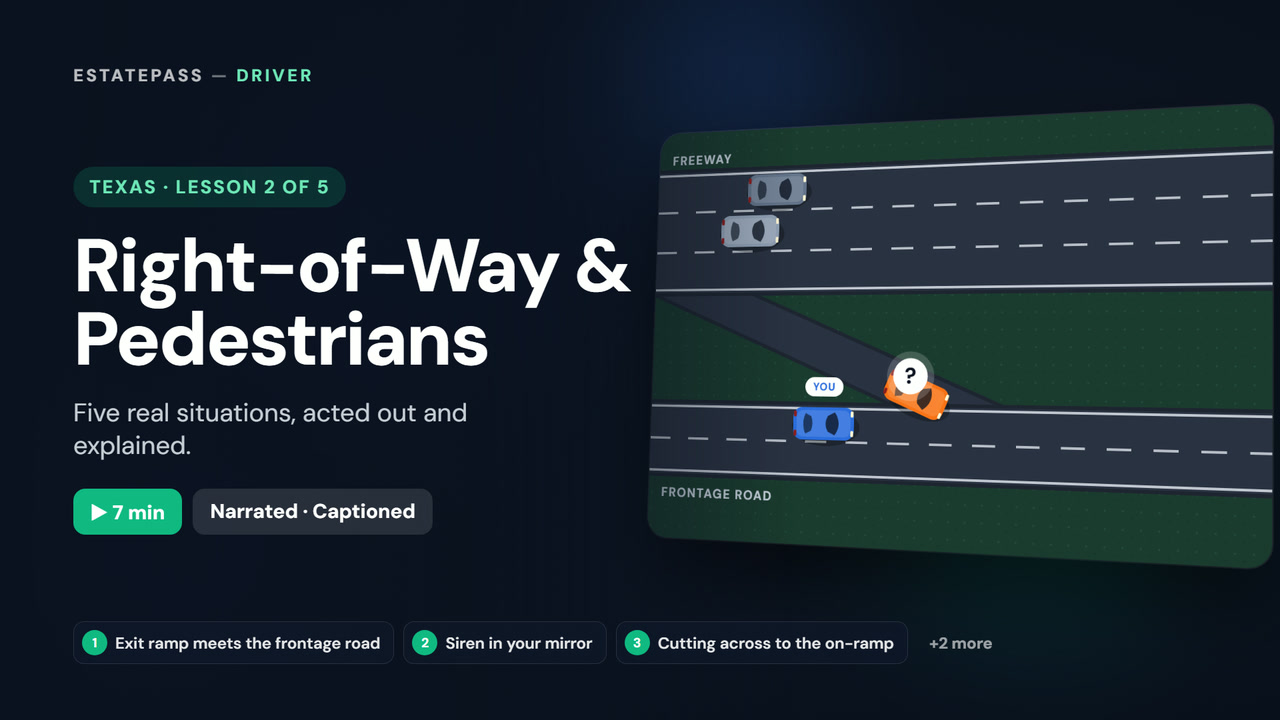
All five situations and their answers are below. To watch the lesson, create a free account.
In this video
- 0:00Intro
- 0:16You are driving on a frontage road beside a freeway. A car is coming down the exit ramp onto your frontage road. Who yields?
- 1:32An ambulance with its siren on is coming up behind you. What should you do if traffic allows?
- 2:49You are on a frontage road and a car ahead of you is about to cross your lane to take the entrance ramp onto the freeway. What do you do?
- 3:58A pedestrian crosses the road instead of using the overhead pedestrian crossing provided. Who must yield?
- 5:11On a road with three lanes going your way, you move from the right lane into the center lane at the same time as a car moving in from the left lane. Who yields?
- 6:27Recap
In short
A driver on a frontage road must yield to vehicles entering the frontage road from the highway and to vehicles leaving it to enter the highway. Yield to emergency vehicles using a siren, bell or flashing red light. Frontage road traffic yields to vehicles leaving or about to leave the frontage road to enter the highway.
The five situations
Pick an answer first, the way the video pauses for you. Each one cites the Texas Driver Handbook (DL-7).
Situation 1
You are driving on a frontage road beside a freeway. A car is coming down the exit ramp onto your frontage road. Who yields?
Answer: B. You yield to the car coming off the freeway. A driver on a frontage road must yield to vehicles entering the frontage road from the highway and to vehicles leaving it to enter the highway.
Texas Driver Handbook (DL-7) › Chapter 4 › Enter or Leave Controlled-Access Highway
Situation 2
An ambulance with its siren on is coming up behind you. What should you do if traffic allows?
Answer: A. Pull to the right edge of the road and stop. Yield to emergency vehicles using a siren, bell or flashing red light. Pull to the right edge and stop; if you cannot, slow down and leave a clear path.
Texas Driver Handbook (DL-7) › Chapter 4 › Yield Right-of-Way to Emergency Vehicles
Situation 3
You are on a frontage road and a car ahead of you is about to cross your lane to take the entrance ramp onto the freeway. What do you do?
Answer: C. Yield to it. Frontage road traffic yields to vehicles leaving or about to leave the frontage road to enter the highway.
Texas Driver Handbook (DL-7) › Chapter 4 › Enter or Leave Controlled-Access Highway
Situation 4
A pedestrian crosses the road instead of using the overhead pedestrian crossing provided. Who must yield?
Answer: A. The pedestrian must yield to vehicles. A pedestrian who crosses without using a provided tunnel or overhead crossing must yield the right-of-way to all vehicles.
Texas Driver Handbook (DL-7) › Chapter 12: Pedestrian Safety
Situation 5
On a road with three lanes going your way, you move from the right lane into the center lane at the same time as a car moving in from the left lane. Who yields?
Answer: A. You yield to the car coming from the left. A vehicle entering a lane from the right must yield to a vehicle entering the same lane from the left.
Texas Driver Handbook (DL-7) › Chapter 4 › Driving on Multiple-Lane Roads
Transcript
0:00Intro
Right-of-way comes down to one question: who goes first? Let's work through five everyday situations from the Texas Driver Handbook. For each one, pick your answer before I reveal it.
0:16Situation 1
Picture this. You're driving along a frontage road, right beside the freeway. Up ahead, a car is rolling down the exit ramp, heading onto your road. You are driving on a frontage road beside a freeway. A car is coming down the exit ramp onto your frontage road. Who yields? The answer is B: You yield to the car coming off the freeway. A driver on a frontage road must yield to vehicles entering the frontage road from the highway and to vehicles leaving it to enter the highway. So even though you were on the frontage road first, ease off and let that car come in ahead of you. Being there first doesn't give you the right-of-way here.
1:32Situation 2
Now you're on a city street, and in your mirror you see flashing lights. An ambulance is coming up behind you with its siren on. An ambulance with its siren on is coming up behind you. What should you do if traffic allows? The answer is A: Pull to the right edge of the road and stop. Yield to emergency vehicles using a siren, bell or flashing red light. Pull to the right edge and stop; if you cannot, slow down and leave a clear path. The ambulance needs a clear lane. Pulling to the right edge and stopping hands it that lane. And if there's no room to pull over, slow down and keep a clear path open.
2:49Situation 3
Back on the frontage road. This time, the car ahead of you signals and starts to cross your lane toward the entrance ramp, onto the freeway. You are on a frontage road and a car ahead of you is about to cross your lane to take the entrance ramp onto the freeway. What do you do? The answer is C: Yield to it. Frontage road traffic yields to vehicles leaving or about to leave the frontage road to enter the highway. It's the same rule from both directions. On a frontage road, cars getting onto or off the freeway go first. You ease off and let them make the move.
3:58Situation 4
Here's one about pedestrians. There's an overhead walkway above this road, but someone decides to walk straight across the traffic lanes instead. A pedestrian crosses the road instead of using the overhead pedestrian crossing provided. Who must yield? The answer is A: The pedestrian must yield to vehicles. A pedestrian who crosses without using a provided tunnel or overhead crossing must yield the right-of-way to all vehicles. That doesn't mean you stop watching for them. Stay alert all the same. But the rule is clear: when a tunnel or an overhead crossing is provided and a pedestrian skips it, the pedestrian must yield.
5:11Situation 5
Last one. You're on a road with three lanes going your way. You start moving from the right lane into the center lane, and at the same moment, a car on the far left starts moving into that same lane. On a road with three lanes going your way, you move from the right lane into the center lane at the same time as a car moving in from the left lane. Who yields? The answer is A: You yield to the car coming from the left. A vehicle entering a lane from the right must yield to a vehicle entering the same lane from the left. An easy way to remember it: when two cars reach for the same lane, the one coming from the left gets it. Coming from the right, you wait.
6:27Recap
A driver on a frontage road must yield to vehicles entering the frontage road from the highway and to vehicles leaving it to enter the highway. Yield to emergency vehicles using a siren, bell or flashing red light. Frontage road traffic yields to vehicles leaving or about to leave the frontage road to enter the highway. A pedestrian who crosses without using a provided tunnel or overhead crossing must yield the right-of-way to all vehicles. A vehicle entering a lane from the right must yield to a vehicle entering the same lane from the left. Nice work. Try more right-of-way questions in Practice by Topic, then test yourself with a full mock exam.
The rules in this lesson
- A driver on a frontage road must yield to vehicles entering the frontage road from the highway and to vehicles leaving it to enter the highway.
- Yield to emergency vehicles using a siren, bell or flashing red light.
- Frontage road traffic yields to vehicles leaving or about to leave the frontage road to enter the highway.
- A pedestrian who crosses without using a provided tunnel or overhead crossing must yield the right-of-way to all vehicles.
- A vehicle entering a lane from the right must yield to a vehicle entering the same lane from the left.
Original practice lesson written from the Texas Driver Handbook (DL-7). EstatePass is not affiliated with or endorsed by the Texas DPS; these are not official test questions.