
Pennsylvania video lessons · Lesson 3 of 10
Pennsylvania Turns, Lanes and Passing: five situations explained
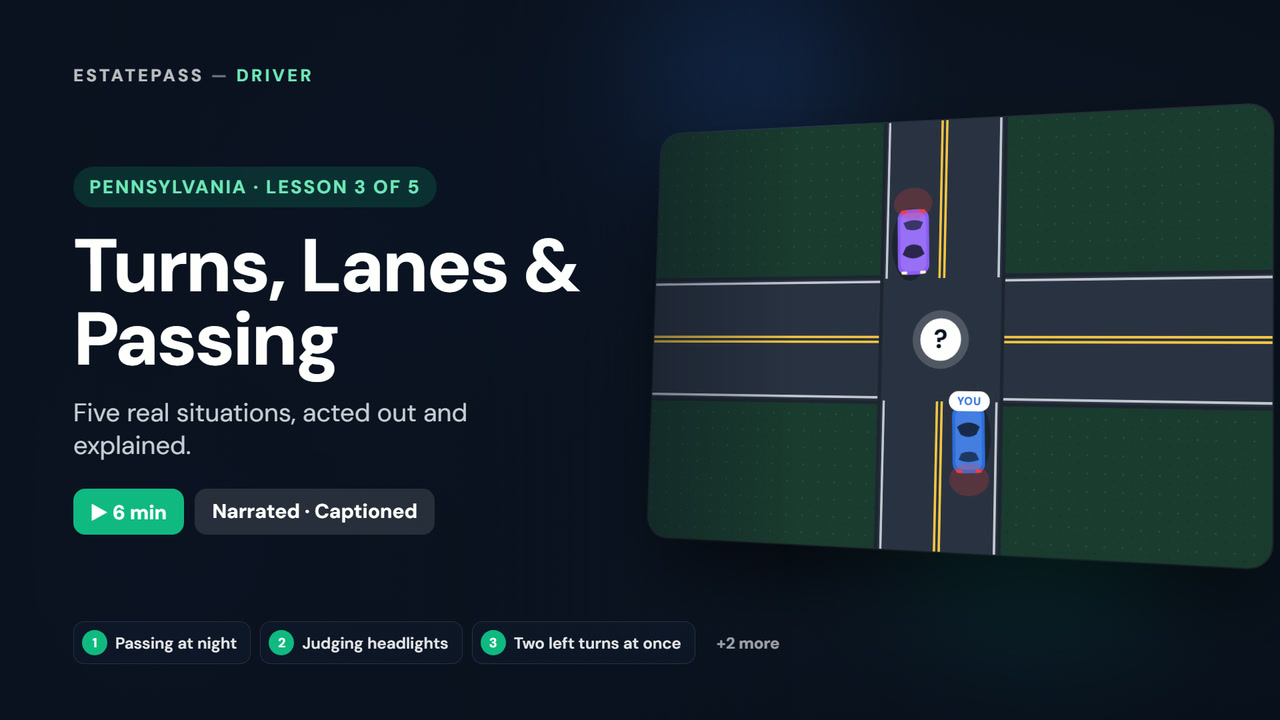
All five situations and their answers are below. To watch the lesson, create a free account.
In this video
- 0:00Intro
- 0:17Why is passing at night most dangerous?
- 1:21Why is passing most dangerous at night?
- 2:23How do you avoid a “tangle turn” with a car turning left from the opposite direction?
- 3:28What may a center lane marked LEFT TURN ONLY be used for?
- 4:28You are driving 45 mph. How far before a turn must you signal in Pennsylvania?
- 5:24Recap
In short
You cannot see as far, and if you can only see an oncoming vehicle’s headlights, you will likely think it is farther away than it is. At night you cannot see as far ahead, and seeing only headlights makes oncoming vehicles seem farther away than they are. Imagine an X at the center.
The five situations
Pick an answer first, the way the video pauses for you. Each one cites the Pennsylvania Driver's Manual.
Situation 1
Why is passing at night most dangerous?
Answer: A. Oncoming headlights can make a car seem farther away than it is. You cannot see as far, and if you can only see an oncoming vehicle’s headlights, you will likely think it is farther away than it is.
Pennsylvania Driver's Manual › Chapter 3 › Turning, Merging, and Passing
Situation 2
Why is passing most dangerous at night?
Answer: B. You cannot see as far and may think oncoming cars are farther away. At night you cannot see as far ahead, and seeing only headlights makes oncoming vehicles seem farther away than they are.
Pennsylvania Driver's Manual › Chapter 3 › Turning, Merging, and Passing › On A Two-Lane Road
Situation 3
How do you avoid a “tangle turn” with a car turning left from the opposite direction?
Answer: B. Turn before you reach the imagined X in the center of the intersection. Imagine an X at the center. Turning before you reach it avoids tangling with the other left-turning driver.
Pennsylvania Driver's Manual › Chapter 3 › Negotiating Intersections
Situation 4
What may a center lane marked LEFT TURN ONLY be used for?
Answer: A. Left turns by traffic from either direction. The center lane is reserved for left-turning vehicles in either direction and is not to be used for through traffic or passing.
Pennsylvania Driver's Manual › Chapter 2 › Signs
Situation 5
You are driving 45 mph. How far before a turn must you signal in Pennsylvania?
Answer: B. At least 300 feet. If you are driving 35 mph or more, you must signal at least 300 feet before turning.
Pennsylvania Driver's Manual › Chapter 3 › Managing Speed
Transcript
0:00Intro
Turning, changing lanes and passing are where small mistakes get expensive. Here are five situations from the Pennsylvania Driver's Manual. For each one, pick your answer before I reveal it.
0:17Situation 1
It's dark, and you're thinking about passing a slow car. You can see a pair of headlights far ahead. Why is passing at night most dangerous? The answer is A: Oncoming headlights can make a car seem farther away than it is. You cannot see as far, and if you can only see an oncoming vehicle’s headlights, you will likely think it is farther away than it is. At night you can't see as far, and headlights alone make an oncoming car seem farther away than it is.
1:21Situation 2
On a dark two-lane road, you're stuck behind a slow car, and oncoming headlights appear in the distance. Why is passing most dangerous at night? The answer is B: You cannot see as far and may think oncoming cars are farther away. At night you cannot see as far ahead, and seeing only headlights makes oncoming vehicles seem farther away than they are. Those headlights are probably closer than they look. Be extra cautious about passing at night.
2:23Situation 3
You're turning left, and the oncoming driver is turning left too. How do you avoid a “tangle turn” with a car turning left from the opposite direction? The answer is B: Turn before you reach the imagined X in the center of the intersection. Imagine an X at the center. Turning before you reach it avoids tangling with the other left-turning driver. Imagine an X in the middle of the intersection, and turn before you reach it. You'll pass in front of each other.
3:28Situation 4
A center lane marked LEFT TURN ONLY runs down the middle of the road. What may a center lane marked LEFT TURN ONLY be used for? The answer is A: Left turns by traffic from either direction. The center lane is reserved for left-turning vehicles in either direction and is not to be used for through traffic or passing. That lane is for left turns by traffic from either direction. It's never for passing or through traffic.
4:28Situation 5
You're driving at 45 miles per hour, and you plan to turn at the next corner. You are driving 45 mph. How far before a turn must you signal in Pennsylvania? The answer is B: At least 300 feet. If you are driving 35 mph or more, you must signal at least 300 feet before turning. At 35 miles per hour or more, signal at least 300 feet before you turn.
5:24Recap
You cannot see as far, and if you can only see an oncoming vehicle’s headlights, you will likely think it is farther away than it is. At night you cannot see as far ahead, and seeing only headlights makes oncoming vehicles seem farther away than they are. Imagine an X at the center. The center lane is reserved for left-turning vehicles in either direction and is not to be used for through traffic or passing. If you are driving 35 mph or more, you must signal at least 300 feet before turning. Nice work. Try more turning and passing questions in Practice by Topic, then test yourself with a full mock exam.
The rules in this lesson
- You cannot see as far, and if you can only see an oncoming vehicle’s headlights, you will likely think it is farther away than it is.
- At night you cannot see as far ahead, and seeing only headlights makes oncoming vehicles seem farther away than they are.
- Imagine an X at the center.
- The center lane is reserved for left-turning vehicles in either direction and is not to be used for through traffic or passing.
- If you are driving 35 mph or more, you must signal at least 300 feet before turning.
Original practice lesson written from the Pennsylvania Driver's Manual. EstatePass is not affiliated with or endorsed by the Pennsylvania PennDOT; these are not official test questions.