
Pennsylvania video lessons · Lesson 4 of 10
Pennsylvania Speed Limits and Parking: five situations explained
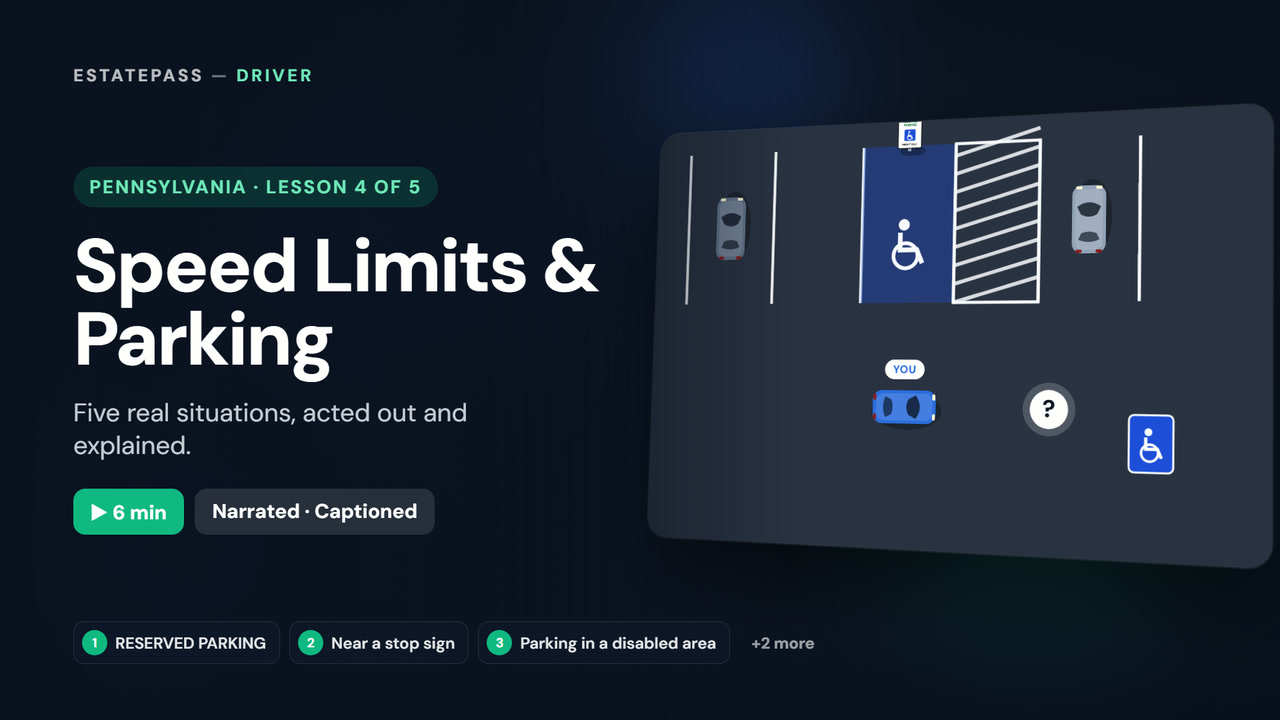
All five situations and their answers are below. To watch the lesson, create a free account.
In this video
- 0:00Intro
- 0:17Who may park in a RESERVED PARKING space for persons with disabilities?
- 1:20How close to a stop sign, yield sign or flashing signal beside the road may you park?
- 2:18What is the fine for unlawfully parking in a disabled parking area in Pennsylvania?
- 3:16How close to the nearest rail of a railroad crossing may you park?
- 4:04You park facing downhill, with or without a curb. Which way do you turn your wheels?
- 4:58Recap
In short
Vehicles parked in these spaces must display authorized registration plates or parking placards; others may be fined and towed. Never park within 30 feet of any flashing signal, stop sign, yield sign or traffic control device at the side of the road. It is a summary offense with a fine of $50 to $200, and the vehicle may be towed.
The five situations
Pick an answer first, the way the video pauses for you. Each one cites the Pennsylvania Driver's Manual.
Situation 1
Who may park in a RESERVED PARKING space for persons with disabilities?
Answer: A. Vehicles displaying an authorized plate or placard. Vehicles parked in these spaces must display authorized registration plates or parking placards; others may be fined and towed.
Pennsylvania Driver's Manual › Chapter 2 › Signs
Situation 2
How close to a stop sign, yield sign or flashing signal beside the road may you park?
Answer: B. No closer than 30 feet. Never park within 30 feet of any flashing signal, stop sign, yield sign or traffic control device at the side of the road.
Pennsylvania Driver's Manual › Chapter 3 › Parking
Situation 3
What is the fine for unlawfully parking in a disabled parking area in Pennsylvania?
Answer: B. $50 to $200, and the car may be towed. It is a summary offense with a fine of $50 to $200, and the vehicle may be towed.
Pennsylvania Driver's Manual › Chapter 5 › Parking Areas For Persons With Disabilities
Situation 4
How close to the nearest rail of a railroad crossing may you park?
Answer: C. No closer than 50 feet. Never park within 50 feet of the nearest rail at a railroad crossing.
Pennsylvania Driver's Manual › Chapter 3 › Parking
Situation 5
You park facing downhill, with or without a curb. Which way do you turn your wheels?
Answer: B. Completely to the right. When parking on a downhill with or without a curb, turn your steering wheel so your wheels are completely to the right.
Pennsylvania Driver's Manual › Chapter 3 › Parking
Transcript
0:00Intro
Speed limits and parking rules are full of numbers the test loves to ask about. Let's lock in five of them from the Pennsylvania Driver's Manual. For each one, pick your answer before I reveal it.
0:17Situation 1
You pull into a lot and see a space marked RESERVED PARKING for persons with disabilities. Who may park in a RESERVED PARKING space for persons with disabilities? The answer is A: Vehicles displaying an authorized plate or placard. Vehicles parked in these spaces must display authorized registration plates or parking placards; others may be fined and towed. Only vehicles displaying an authorized plate or placard may park there. Others can be fined and towed.
1:20Situation 2
You'd like to park close to the corner, near a stop sign. How close to a stop sign, yield sign or flashing signal beside the road may you park? The answer is B: No closer than 30 feet. Never park within 30 feet of any flashing signal, stop sign, yield sign or traffic control device at the side of the road. Never park within 30 feet of a stop sign, yield sign, flashing signal or other traffic control device beside the road.
2:18Situation 3
A driver without a placard parks in a disabled parking area in Pennsylvania. What is the fine for unlawfully parking in a disabled parking area in Pennsylvania? The answer is B: $50 to $200, and the car may be towed. It is a summary offense with a fine of $50 to $200, and the vehicle may be towed. It's a summary offense with a fine of 50 to 200 dollars, and the car may be towed.
3:16Situation 4
You need to park on a street near a railroad crossing. How close to the nearest rail of a railroad crossing may you park? The answer is C: No closer than 50 feet. Never park within 50 feet of the nearest rail at a railroad crossing. Never park within 50 feet of the nearest rail.
4:04Situation 5
You're parking facing downhill on a street, with or without a curb. You park facing downhill, with or without a curb. Which way do you turn your wheels? The answer is B: Completely to the right. When parking on a downhill with or without a curb, turn your steering wheel so your wheels are completely to the right. Turn your wheels completely to the right, so the car rolls away from traffic if it moves.
4:58Recap
Vehicles parked in these spaces must display authorized registration plates or parking placards; others may be fined and towed. Never park within 30 feet of any flashing signal, stop sign, yield sign or traffic control device at the side of the road. It is a summary offense with a fine of $50 to $200, and the vehicle may be towed. Never park within 50 feet of the nearest rail at a railroad crossing. When parking on a downhill with or without a curb, turn your steering wheel so your wheels are completely to the right. Nice work. Try more speed and parking questions in Practice by Topic, then test yourself with a full mock exam.
The rules in this lesson
- Vehicles parked in these spaces must display authorized registration plates or parking placards; others may be fined and towed.
- Never park within 30 feet of any flashing signal, stop sign, yield sign or traffic control device at the side of the road.
- It is a summary offense with a fine of $50 to $200, and the vehicle may be towed.
- Never park within 50 feet of the nearest rail at a railroad crossing.
- When parking on a downhill with or without a curb, turn your steering wheel so your wheels are completely to the right.
Original practice lesson written from the Pennsylvania Driver's Manual. EstatePass is not affiliated with or endorsed by the Pennsylvania PennDOT; these are not official test questions.