
Florida video lessons · Lesson 3 of 10
Florida Turns, Lanes and Passing: five situations explained
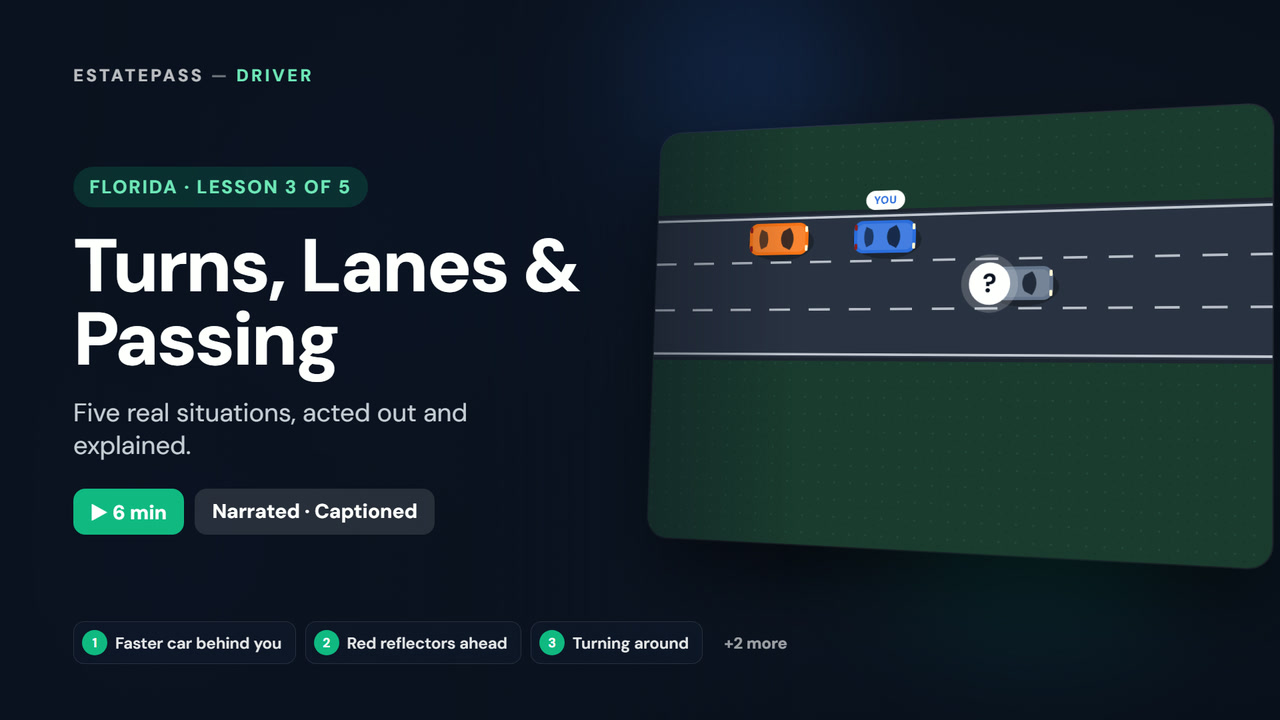
All five situations and their answers are below. To watch the lesson, create a free account.
In this video
- 0:00Intro
- 0:16You are in the left lane and a faster car comes up behind you. What does Florida law require?
- 1:12You see red reflectors facing you on the lane lines. What does it mean?
- 2:14Where should you never make a three-point turn?
- 3:07The center line is double yellow, broken on your side and solid on the other side. May you pass?
- 4:07You miss your exit on an interstate. What should you do?
- 5:01Recap
In short
Florida law states a driver must move out of the left lane when being overtaken by a faster vehicle. Red reflectors facing you mean you are facing traffic the wrong way and could have a head-on collision. Never make a three-point turn or U-turn on a curve, a hill, the highway, or where a sign prohibits U-turns.
The five situations
Pick an answer first, the way the video pauses for you. Each one cites The Official Florida Driver License Handbook.
Situation 1
You are in the left lane and a faster car comes up behind you. What does Florida law require?
Answer: A. Move out of the left lane. Florida law states a driver must move out of the left lane when being overtaken by a faster vehicle.
The Official Florida Driver License Handbook › Driving Safety › Being Passed
Situation 2
You see red reflectors facing you on the lane lines. What does it mean?
Answer: B. You are on the wrong side of the road; get into the proper lane immediately. Red reflectors facing you mean you are facing traffic the wrong way and could have a head-on collision.
The Official Florida Driver License Handbook › Red Reflectors on Lane Lines
Situation 3
Where should you never make a three-point turn?
Answer: B. On a curve or a hill. Never make a three-point turn or U-turn on a curve, a hill, the highway, or where a sign prohibits U-turns.
The Official Florida Driver License Handbook › Three-Point Turns
Situation 4
The center line is double yellow, broken on your side and solid on the other side. May you pass?
Answer: A. Yes, when it is safe. When the broken line is on your side and the solid line is on the left, passing is permitted in your lane when safe.
The Official Florida Driver License Handbook › Pavement Markings › Double Yellow Lines
Situation 5
You miss your exit on an interstate. What should you do?
Answer: C. Go on to the next exit. Don’t make last-minute turns into an exit. If you pass your exit, go to the next one.
The Official Florida Driver License Handbook › Entering & Leaving Limited Access Highways
Transcript
0:00Intro
Turning, changing lanes and passing are where small mistakes get expensive. Here are five situations from the Florida Driver License Handbook. For each one, pick your answer before I reveal it.
0:16Situation 1
You're cruising in the left lane, and a faster car comes up behind you. You are in the left lane and a faster car comes up behind you. What does Florida law require? The answer is A: Move out of the left lane. Florida law states a driver must move out of the left lane when being overtaken by a faster vehicle. In Florida, when a faster vehicle is overtaking you, move out of the left lane.
1:12Situation 2
At night, the reflectors on the lane lines ahead are shining red back at you. You see red reflectors facing you on the lane lines. What does it mean? The answer is B: You are on the wrong side of the road; get into the proper lane immediately. Red reflectors facing you mean you are facing traffic the wrong way and could have a head-on collision. Red reflectors facing you mean you're on the wrong side of the road. Get into the proper lane right away.
2:14Situation 3
You need to turn around, and you're on a curve near the top of a hill. Where should you never make a three-point turn? The answer is B: On a curve or a hill. Never make a three-point turn or U-turn on a curve, a hill, the highway, or where a sign prohibits U-turns. Never make a three-point turn or U-turn on a curve or a hill. Other drivers can't see you in time.
3:07Situation 4
You're behind a slow truck on a two-lane road. The center line is double yellow: broken on your side, solid on the other. The center line is double yellow, broken on your side and solid on the other side. May you pass? The answer is A: Yes, when it is safe. When the broken line is on your side and the solid line is on the left, passing is permitted in your lane when safe. When the broken line is on your side, you may pass when it's safe.
4:07Situation 5
You're on the interstate, and the exit you needed just went by. You miss your exit on an interstate. What should you do? The answer is C: Go on to the next exit. Don’t make last-minute turns into an exit. If you pass your exit, go to the next one. Don't back up or cut across the median. Go on to the next exit.
5:01Recap
Florida law states a driver must move out of the left lane when being overtaken by a faster vehicle. Red reflectors facing you mean you are facing traffic the wrong way and could have a head-on collision. Never make a three-point turn or U-turn on a curve, a hill, the highway, or where a sign prohibits U-turns. When the broken line is on your side and the solid line is on the left, passing is permitted in your lane when safe. Don’t make last-minute turns into an exit. Nice work. Try more turning and passing questions in Practice by Topic, then test yourself with a full mock exam.
The rules in this lesson
- Florida law states a driver must move out of the left lane when being overtaken by a faster vehicle.
- Red reflectors facing you mean you are facing traffic the wrong way and could have a head-on collision.
- Never make a three-point turn or U-turn on a curve, a hill, the highway, or where a sign prohibits U-turns.
- When the broken line is on your side and the solid line is on the left, passing is permitted in your lane when safe.
- Don’t make last-minute turns into an exit.
Original practice lesson written from The Official Florida Driver License Handbook. EstatePass is not affiliated with or endorsed by the Florida FLHSMV; these are not official test questions.