
Florida video lessons · Lesson 4 of 10
Florida Speed Limits and Parking: five situations explained
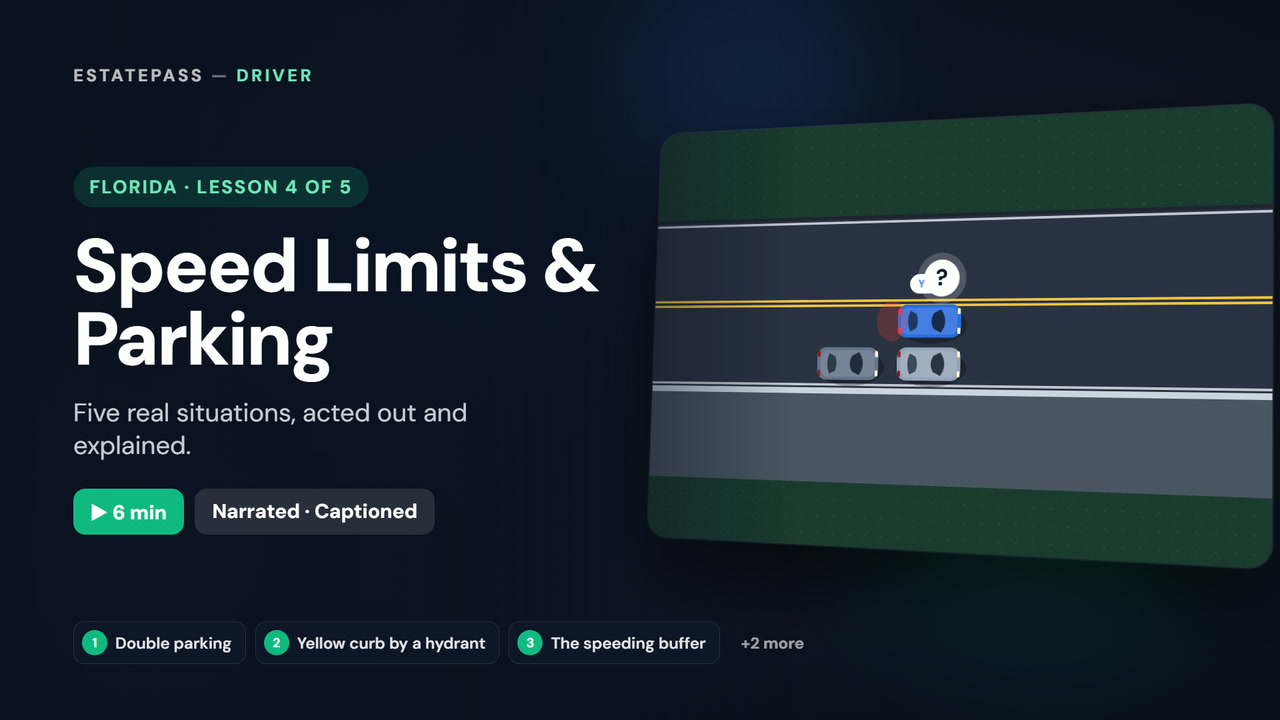
All five situations and their answers are below. To watch the lesson, create a free account.
In this video
- 0:00Intro
- 0:17What is double parking, and is it legal?
- 1:17What does a yellow-painted curb near a fire hydrant usually mean in Florida?
- 2:08Is it safe from a ticket to drive up to 10 mph over the limit in Florida?
- 3:06Unless posted otherwise, what is the maximum on Florida streets and highways outside towns?
- 4:00How close may you park to a stop sign or traffic signal?
- 4:53Recap
In short
It is against the law to park on the roadway side of another parked vehicle (double parking). Curbs are often marked yellow to indicate no-parking zones near fire hydrants or intersections. The “speeding buffer” is a myth.
The five situations
Pick an answer first, the way the video pauses for you. Each one cites The Official Florida Driver License Handbook.
Situation 1
What is double parking, and is it legal?
Answer: C. Parking on the roadway side of a parked car; it is illegal. It is against the law to park on the roadway side of another parked vehicle (double parking).
The Official Florida Driver License Handbook › Driving Safety › Parking
Situation 2
What does a yellow-painted curb near a fire hydrant usually mean in Florida?
Answer: C. No parking. Curbs are often marked yellow to indicate no-parking zones near fire hydrants or intersections.
The Official Florida Driver License Handbook › Other Markings
Situation 3
Is it safe from a ticket to drive up to 10 mph over the limit in Florida?
Answer: A. No; the “speeding buffer” is a myth. The “speeding buffer” is a myth. You may receive a citation for any speed over the limit.
The Official Florida Driver License Handbook › Driving Safety › Speed Limits
Situation 4
Unless posted otherwise, what is the maximum on Florida streets and highways outside towns?
Answer: A. 55 mph. The standard maximum on streets and highways is 55 mph unless otherwise posted.
The Official Florida Driver License Handbook › Florida Standard Speed Limits
Situation 5
How close may you park to a stop sign or traffic signal?
Answer: B. No closer than 30 feet. You may not park within 30 feet of any flashing signal, stop sign or traffic signal.
The Official Florida Driver License Handbook › It’s Against the Law to Park
Transcript
0:00Intro
Speed limits and parking rules are full of numbers the test loves to ask about. Let's lock in five of them from the Florida Driver License Handbook. For each one, pick your answer before I reveal it.
0:17Situation 1
The street is full, so you think about stopping in the travel lane right beside a parked car. What is double parking, and is it legal? The answer is C: Parking on the roadway side of a parked car; it is illegal. It is against the law to park on the roadway side of another parked vehicle (double parking). Parking on the roadway side of another parked vehicle is double parking, and it's against the law.
1:17Situation 2
There's an open stretch of curb painted yellow, right next to a fire hydrant. What does a yellow-painted curb near a fire hydrant usually mean in Florida? The answer is C: No parking. Curbs are often marked yellow to indicate no-parking zones near fire hydrants or intersections. In Florida, a yellow curb near a hydrant or intersection usually means no parking.
2:08Situation 3
A friend tells you police won't ticket anyone going less than 10 miles per hour over the limit. Is it safe from a ticket to drive up to 10 mph over the limit in Florida? The answer is A: No; the “speeding buffer” is a myth. The “speeding buffer” is a myth. You may receive a citation for any speed over the limit. There's no speeding buffer. You can get a ticket for any speed over the limit.
3:06Situation 4
You're on a Florida highway outside town, and there's no speed limit sign in sight. Unless posted otherwise, what is the maximum on Florida streets and highways outside towns? The answer is A: 55 mph. The standard maximum on streets and highways is 55 mph unless otherwise posted. Unless a different limit is posted, the maximum is 55 miles per hour.
4:00Situation 5
There's an open spot along the curb, just before a stop sign. How close may you park to a stop sign or traffic signal? The answer is B: No closer than 30 feet. You may not park within 30 feet of any flashing signal, stop sign or traffic signal. Stay at least 30 feet from any stop sign, flashing signal or traffic signal.
4:53Recap
It is against the law to park on the roadway side of another parked vehicle (double parking). Curbs are often marked yellow to indicate no-parking zones near fire hydrants or intersections. The “speeding buffer” is a myth. The standard maximum on streets and highways is 55 mph unless otherwise posted. You may not park within 30 feet of any flashing signal, stop sign or traffic signal. Nice work. Try more speed and parking questions in Practice by Topic, then test yourself with a full mock exam.
The rules in this lesson
- It is against the law to park on the roadway side of another parked vehicle (double parking).
- Curbs are often marked yellow to indicate no-parking zones near fire hydrants or intersections.
- The “speeding buffer” is a myth.
- The standard maximum on streets and highways is 55 mph unless otherwise posted.
- You may not park within 30 feet of any flashing signal, stop sign or traffic signal.
Original practice lesson written from The Official Florida Driver License Handbook. EstatePass is not affiliated with or endorsed by the Florida FLHSMV; these are not official test questions.