
Registration & Remote ID
~10 min read · Register, mark and broadcast: the ownership and Remote ID duties for every sUAS.
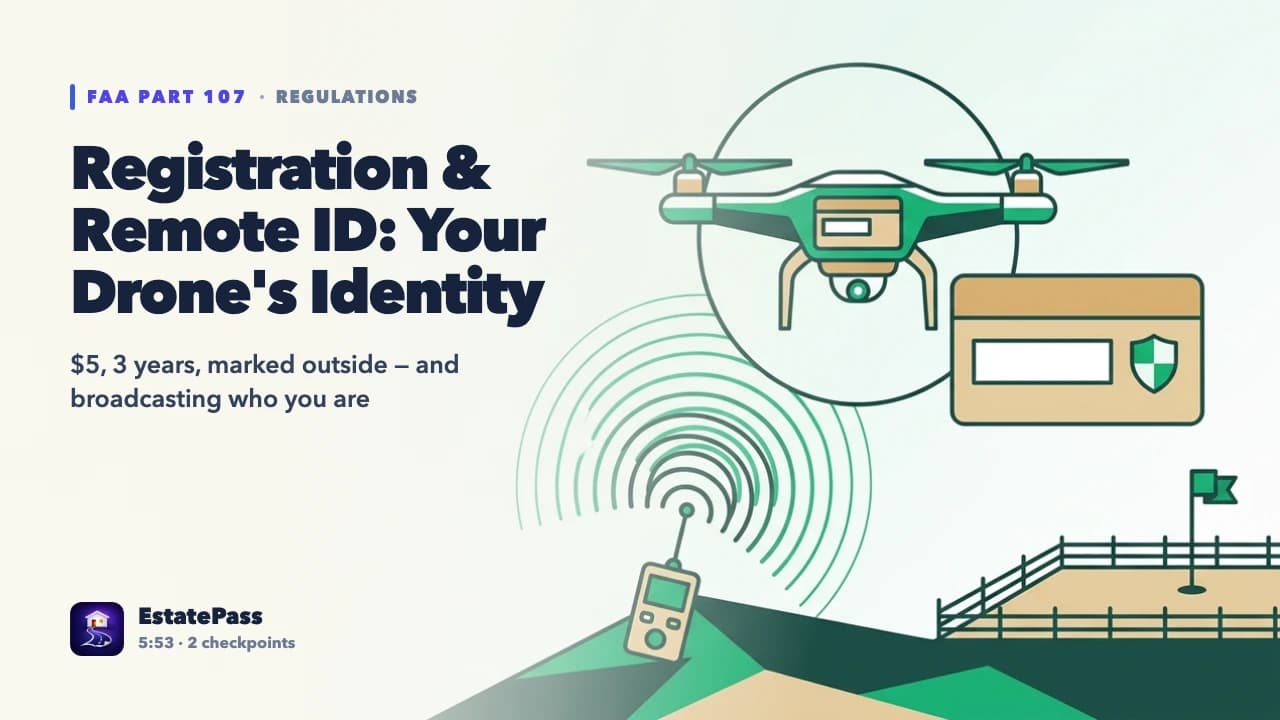
Two identity systems attach to every working drone: registration (who owns it) and Remote ID (who is flying it right now, broadcast live). The exam tests the weight threshold, the renewal clock, the marking rule, and the three ways to satisfy Remote ID.
Registration basics
Any sUAS operated under Part 107 must be registered — regardless of weight (the 0.55-lb/250-g exception applies only to recreational flyers). Registration is done online through the FAA DroneZone, costs $5 per aircraft, is valid for 3 years, and requires the owner to be at least 13 years old and a U.S. citizen or permanent resident (others register as a foreign-operator recordkeeping filing). The registration number must be marked on an external surface of the aircraft — legible, durable, no hiding it inside the battery bay.
- Part 107: registration required at ANY weight; $5, 3 years, per aircraft
- Recreational-only flyers: exempt under 0.55 lb (250 g)
- Number goes on an EXTERNAL surface (rule changed from interior marking)
- Carry proof of registration and produce it on request
Remote ID: the digital license plate
Since compliance became mandatory, an sUAS that must be registered must also broadcast Remote ID — identification and location data receivable by others. Three paths comply: (1) a Standard Remote ID aircraft broadcasting aircraft ID, location/altitude, control-station location, velocity, time, and emergency status; (2) a broadcast module added to an older aircraft, which broadcasts takeoff location instead of control-station location and restricts you to VLOS; (3) flying without Remote ID only inside a FRIA (FAA-Recognized Identification Area), within VLOS.
- Standard aircraft: broadcasts control station location
- Broadcast module: broadcasts takeoff location, VLOS only
- FRIA: no broadcast required, but must stay inside the area and VLOS
- Broadcast is direct radio (receivable by phones) — not a network subscription
Foreign and transfer details
Registration is not transferable between owners — a sold aircraft must be re-registered by the buyer. Operating an unregistered sUAS that requires registration exposes the operator to civil and criminal penalties. If the aircraft is destroyed, sold, or exported, the owner should cancel the registration.
Worked example
A photographer buys a 320-g drone to shoot listings for a realtor, and also owns a 2019-model 2-kg drone with no Remote ID hardware. What must be true before both fly legally on the job?
The 320-g drone: commercial use means Part 107, and under Part 107 every aircraft registers regardless of weight — the 250-g exemption is recreational-only. $5, DroneZone, number marked externally, and it must have Remote ID (a current production aircraft will have Standard Remote ID built in). The 2019 drone has no Remote ID: the owner attaches a broadcast module (accepting the VLOS restriction and takeoff-location broadcast) or flies it only inside a FRIA. Both aircraft each need their own registration.
Common exam pitfalls
Applying the 250-g registration exemption to commercial flights.
That exemption is recreational-only. Under Part 107, a 100-g drone still registers.
Thinking a broadcast module makes an aircraft equivalent to Standard Remote ID.
Modules broadcast the TAKEOFF location (not control station) and lock you to VLOS — no BVLOS waiver operations on a module.
Marking the registration number inside the battery compartment.
The number must be on an external surface, legible and durable.
5-3-E: five dollars, three years, External marking. Remote ID three ways: Standard, Strapped-on (module), or Sanctuary (FRIA).
Recap
- Part 107 aircraft register at any weight — $5, 3 years, per aircraft, DroneZone
- Registration number marked on an external surface; not transferable to a new owner
- Remote ID required for any aircraft that must register
- Standard RID broadcasts control-station location; module broadcasts takeoff location + VLOS only
- FRIA is the only no-broadcast option — inside the area, VLOS
- Recreational sub-250-g exemption never applies to commercial work
VIDEO LESSON
Watch this lesson on video — free
Prove it: 10 questions on this topic
Every lesson ends with a ten-question check in the free course — your progress syncs between the web and the EstatePass app.