
Operating Limits: 400 ft, 100 mph, 3 SM
~13 min read · Recite the core numbers — altitude, groundspeed, visibility, cloud clearance, daylight — and their exceptions.
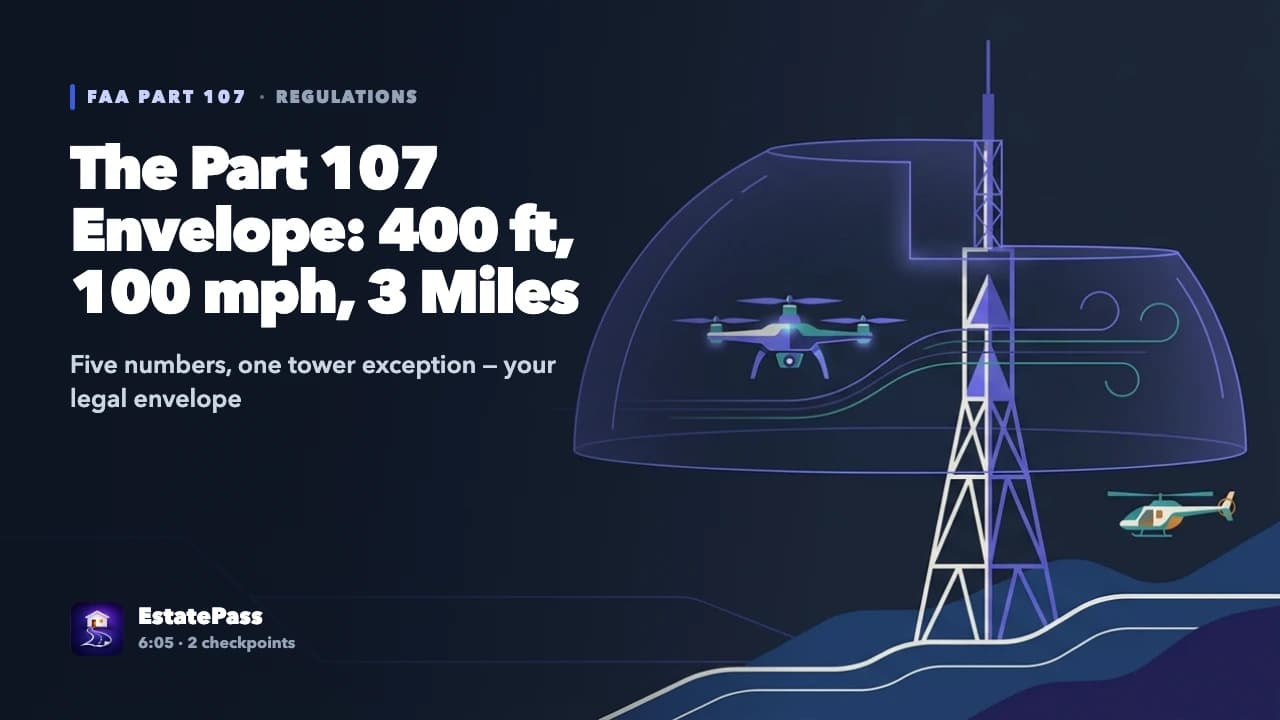
Five numbers define the legal envelope of every Part 107 flight: 400 feet, 100 mph, 3 statute miles, 500 below, and 2,000 horizontal. The exam tests them straight and in disguise — expect scenarios engineered to make you forget an exception.
Altitude: 400 ft AGL and the structure exception
Maximum altitude is 400 feet above ground level — not above sea level. The one exception: within a 400-foot radius of a structure, you may fly up to 400 feet above the structure's immediate uppermost limit. That is what makes tower and building inspections legal: beside a 1,000-ft tower you may fly at 1,400 ft AGL, provided you stay within 400 ft of the structure laterally.
- 400 ft AGL is the default ceiling
- Within 400 ft of a structure: up to 400 ft above the structure's top
- AGL, never MSL — terrain matters, sea level doesn't
Speed and visibility
Maximum groundspeed is 100 mph (87 knots) — groundspeed, so a tailwind counts against you. Minimum flight visibility is 3 statute miles from the control station. Minimum distance from clouds: 500 feet below and 2,000 feet horizontally. These cloud clearances exist so a manned aircraft popping out of a cloud has time to be seen and avoided.
- 100 mph (87 kt) groundspeed max — wind-adjusted, not airspeed
- 3 SM visibility measured from the control station
- Clouds: 500 ft below, 2,000 ft horizontal
Daylight, twilight, and night
Operations are allowed in daylight and in civil twilight (30 minutes before official sunrise to 30 minutes after official sunset) with lighted anti-collision lighting visible for at least 3 statute miles. Since the 2021 rule change, night operations are also allowed without a waiver, provided the remote PIC has completed current initial or recurrent training covering night subjects and the sUAS carries anti-collision lighting visible for 3 SM with a flash rate sufficient to avoid collision.
- Civil twilight: sunrise minus 30 / sunset plus 30 (longer in Alaska)
- Night ops legal since 2021: current training + 3 SM anti-collision lighting
- The light must be flashing/strobing, not merely a steady navigation light
The standing structural rules
Beyond the numbers: maintain visual line of sight (VLOS) unaided by anything other than corrective lenses (binoculars only for momentary situational awareness), one remote PIC per sUAS at a time, no operations from a moving aircraft, operations from a moving land/water vehicle only over sparsely populated areas (and never for hire across state lines), yield to all manned aircraft, and a maximum takeoff weight under 55 pounds including payload.
Worked example
You are inspecting a 900-ft broadcast antenna. The terrain at the base is 200 ft MSL. A 15-knot tailwind is blowing, and your drone cruises at 78 kt airspeed. How high may you fly, and are you speed-legal?
Altitude: within 400 ft laterally of the antenna you may fly 400 ft above its top: 900 + 400 = 1,300 ft AGL (MSL is irrelevant to the limit). Speed: groundspeed = 78 kt + 15 kt tailwind = 93 kt. The limit is 87 kt (100 mph) groundspeed — 93 kt exceeds it, so you must slow down even though the aircraft's airspeed is only 78 kt. Both traps in one scenario: the structure exception raises the ceiling, and the tailwind breaks the speed limit.
Common exam pitfalls
Reading 100 mph as airspeed.
It is groundspeed. Add tailwind to airspeed; a fast drone with a strong tailwind can be illegal while its airspeed indicator looks fine.
Applying the 400-ft structure exception anywhere near a structure.
The exception only applies within a 400-ft radius of the structure, and only up to 400 ft above its uppermost limit.
Believing night flight still requires a waiver.
Since April 2021, night operations need only current night training and 3-SM anti-collision lighting. Waivers are for other rules (like BVLOS).
400-100-3-500-2000: ceiling, speed, visibility, below clouds, beside clouds.
Recap
- 400 ft AGL max; within 400 ft of a structure, 400 ft above its top
- 100 mph / 87 kt groundspeed max — tailwind counts
- 3 SM minimum visibility from the control station
- Cloud clearance: 500 ft below, 2,000 ft horizontal
- Civil twilight and night ops require 3-SM anti-collision lighting (night also requires current training)
- VLOS, under 55 lbs, one sUAS per pilot, yield to all manned aircraft
VIDEO LESSON
Watch this lesson on video — free
Prove it: 10 questions on this topic
Every lesson ends with a ten-question check in the free course — your progress syncs between the web and the EstatePass app.