
Right of Way: Yield to Everything
~9 min read · Apply see-and-avoid: sUAS yield to all manned aircraft, always.
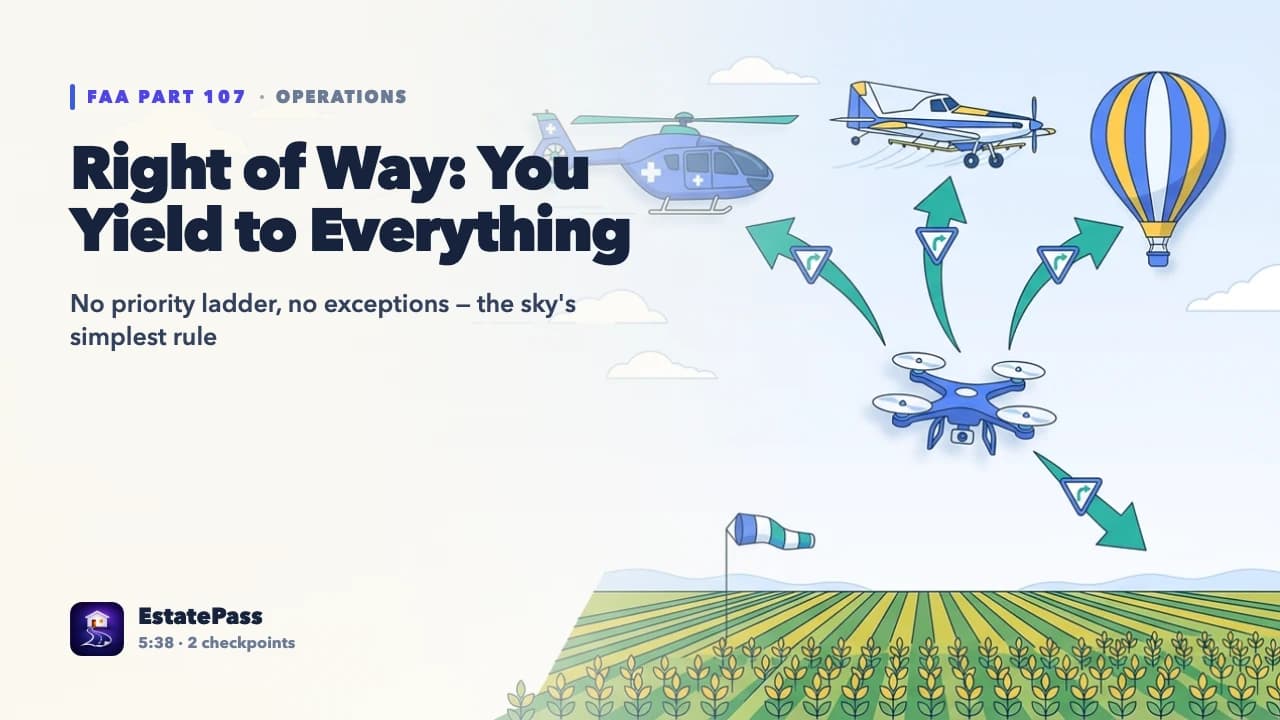
The right-of-way rule for drones has no nuance to memorize: an sUAS yields to every manned aircraft, every time, everywhere. The exam dresses this in scenarios — helicopters at 300 feet, crop dusters below you, balloons drifting through — and the answer never changes.
The rule
107.37: each sUAS must yield the right of way to all aircraft, airborne vehicles, and launch/reentry vehicles. Yielding means the sUAS gives way and may not pass over, under, or ahead of the other aircraft unless well clear. No manned aircraft ever has a duty to avoid you first — even when it is below 400 ft, even in Class G, even if you were there first. Additionally, no operation may create a collision hazard.
- Yield to ALL manned aircraft — no exceptions, no priority ladder
- Do not cross over, under, or ahead unless well clear
- Being there first grants nothing
Why manned traffic appears at your altitude
Low-altitude manned operations are routine: helicopters (EMS, news, pipeline patrol, law enforcement), agricultural aircraft working fields at 10–100 ft, banner tows, seaplanes, hot-air balloons, gliders near ridges, and military low-level routes. Agricultural and helicopter operations are the classic exam examples — they occupy exactly the sUAS altitude band, often with minimal warning.
- Helicopters, crop dusters, balloons, gliders live below 400 ft too
- MTR military traffic can be fast and low
- Expect traffic at your altitude even far from airports
Executing the yield
See-and-avoid at drone scale: maintain a continuous visual scan (the VO's core job), listen to CTAF where relevant, and when traffic appears, descend and give way early — a decisive altitude drop is the fastest, most visible deconfliction a multirotor can make. Land if the traffic is working your immediate area (agricultural passes, search patterns). Resume only when well clear.
Worked example
You are inspecting powerlines at 250 ft AGL in rural Class G when an agricultural helicopter begins spray runs on the adjacent field, working back and forth at 50–150 ft and occasionally crossing your line. Who yields, and what do you do?
You do — always. The helicopter is a manned aircraft; its spray pattern is dynamic and will cross your operating line repeatedly, so simply hovering clear of its current pass is not 'well clear' of its next one. The correct action: descend and land, secure the aircraft, and coordinate — wait until the helicopter finishes the field or make contact with the operator if possible. Any answer that has the drone continuing to work 'because it was there first' or 'because 250 ft is drone airspace' is wrong: there is no drone airspace, and priority never attaches to the sUAS.
Common exam pitfalls
Believing below-400-ft is drone territory.
No altitude band belongs to sUAS. Manned aircraft operate to the surface, and you yield there too.
Yielding by hovering in place near a working aircraft.
'Well clear' of a dynamic operation (spraying, searching) usually means landing until it finishes.
Passing under a slow aircraft to keep working.
The rule explicitly bars passing over, under, or ahead unless well clear.
If it carries a person, it owns the sky you're in.
Recap
- sUAS yield to all manned aircraft, airborne vehicles, and launch vehicles
- Never pass over, under, or ahead unless well clear
- No collision hazards, period
- Helicopters and ag aircraft routinely fly in the sUAS band
- Yield decisively: descend early, land for dynamic operations
- First-come, low-altitude, and mission importance grant no priority
VIDEO LESSON
Watch this lesson on video — free
Prove it: 10 questions on this topic
Every lesson ends with a ten-question check in the free course — your progress syncs between the web and the EstatePass app.