
ADM & Hazardous Attitudes
~12 min read · Name the five hazardous attitudes with antidotes and run a risk-assessment loop.
Most drone accidents are decided before takeoff — by a pilot who talked himself into flying. Aeronautical decision making gives that failure a vocabulary: five hazardous attitudes, each with a scripted antidote, plus checklists like IMSAFE and the 3P loop. The exam quotes a pilot's thought and asks you to name the attitude.
The five hazardous attitudes and antidotes
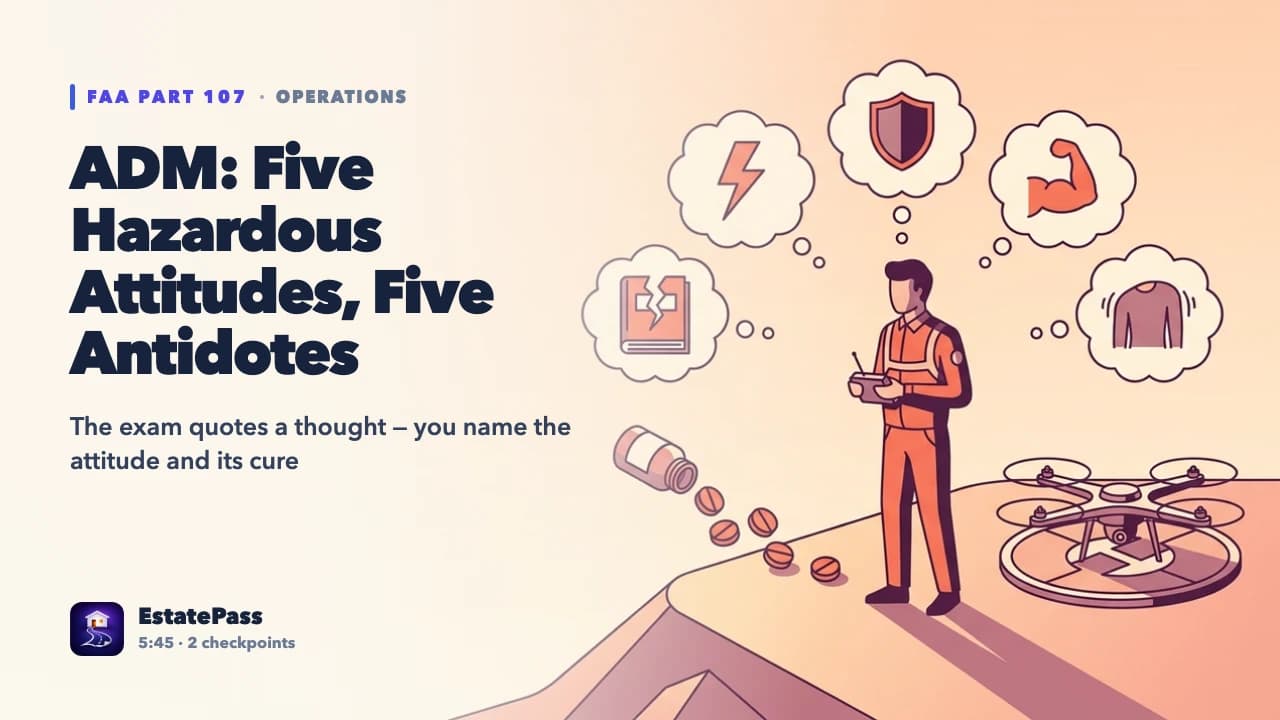
Anti-authority ('Don't tell me what to do') — antidote: *Follow the rules; they are usually right.* Impulsivity ('Do it quickly!') — *Not so fast; think first.* Invulnerability ('It won't happen to me') — *It could happen to me.* Macho ('I can do it') — *Taking chances is foolish.* Resignation ('What's the use?') — *I'm not helpless; I can make a difference.* The exam gives a quote and asks for the attitude, or the attitude and asks for the antidote — memorize the pairs verbatim.
- Anti-authority → follow the rules
- Impulsivity → not so fast, think first
- Invulnerability → it could happen to me
- Macho → taking chances is foolish
- Resignation → I'm not helpless
Structured decision tools
IMSAFE screens the pilot: Illness, Medication, Stress, Alcohol, Fatigue, Emotion — any red flag grounds you. The 3P model runs continuously: Perceive hazards, Process their risk, Perform the mitigation, then loop. PAVE frames preflight risk: Pilot, Aircraft, enVironment, External pressures. External pressure — the client on site, the paid deadline, the sunset shot — is the drone industry's signature risk multiplier.
- IMSAFE: the personal go/no-go checklist
- 3P: perceive → process → perform, repeatedly
- PAVE: pilot, aircraft, environment, external pressures
Risk management in practice
Set personal minimums stricter than the legal ones (wind, battery reserve, crowd distance) and hold them when a client pushes. Recognize get-there-itis (plan continuation bias) — pressing on as conditions decay because the mission is nearly done. The professional answer pattern on the exam: the pilot who declines, delays, or lands is right; the pilot who presses on for the shot is the case study.
Worked example
Wind is gusting past your personal 20-kt limit. The client, paying for the last golden-hour shoot of the trip, says: 'You've flown worse — you're the best pilot I know.' You think: 'I can handle it; nothing's ever happened before.' Name what is operating, and the correct response.
Diagnose in layers. The client is External pressure (PAVE). Your thought contains two hazardous attitudes: 'I can handle it' is Macho — antidote: taking chances is foolish; 'nothing's ever happened before' is Invulnerability — antidote: it could happen to me. The decision framework says personal minimums exist precisely for this moment: they were set in calm judgment to bind you under pressure. Correct response: decline the flight, offer the backup plan (tomorrow's dawn window), and log the decision. On the exam, any option resembling 'fly a shortened mission carefully' is the distractor — pressing into known-exceeded minimums is the failure pattern itself.
Common exam pitfalls
Matching quotes to attitudes loosely.
Learn the five canonical phrasings and antidotes verbatim — the exam quotes them nearly word for word.
Treating personal minimums as adjustable on site.
Minimums are set before pressure exists so they can't be negotiated under it.
Ignoring plan continuation bias.
'Almost done' is when get-there-itis peaks — re-run the 3P loop as conditions change, especially late in a mission.
AIIMR: Anti-authority, Impulsivity, Invulnerability, Macho, Resignation — five voices, five scripted replies.
Recap
- Five hazardous attitudes with fixed antidotes — memorize the pairs
- IMSAFE screens the pilot; PAVE screens the operation; 3P loops in flight
- External pressure is the drone industry's defining risk factor
- Personal minimums bind hardest exactly when clients push
- Get-there-itis = plan continuation bias; re-evaluate as conditions decay
- The declining pilot is the exam's right answer
VIDEO LESSON
Watch this lesson on video — free
Prove it: 10 questions on this topic
Every lesson ends with a ten-question check in the free course — your progress syncs between the web and the EstatePass app.