
Attic Ventilation & Net Free Area
~12 min read · Balance intake and exhaust, compute the 1/150–1/300 ratios, and spot short-circuited venting.
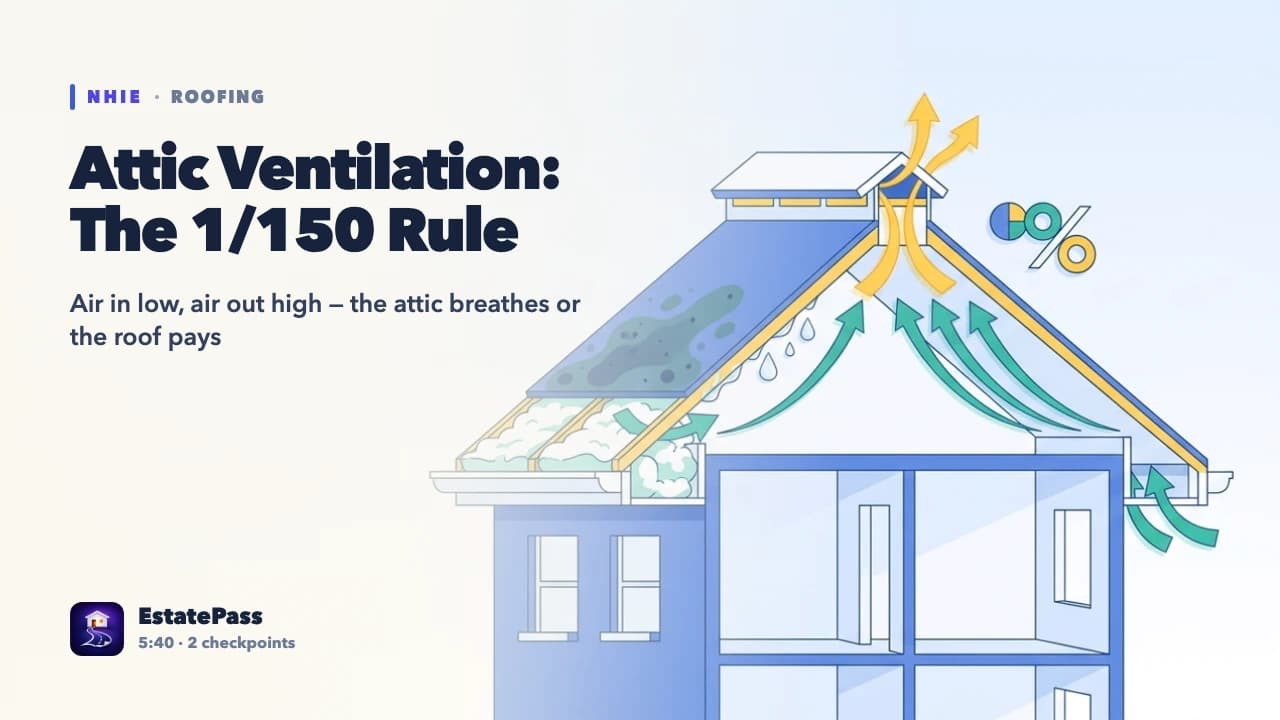
Attic ventilation runs on one ratio and one balance: 1/150 of the attic area in net free vent area, split roughly half intake (soffits) and half exhaust (ridge/upper), with air actually able to travel between them. Get the flow wrong and the house grows ice dams, cooked shingles, and wet sheathing.
The ratio and the balance
Base requirement: 1 square foot of net free area per 150 square feet of vented attic space (net free area = the vent's actual open area after screens/louvers, not its overall size). The 1/300 reduction is conditional, not a free choice — it requires a warm-side vapor retarder in the coldest climate zones AND 40–60% balance conditions; the safe teaching is the base ratio plus the balance principle: intake low (soffits), exhaust high (ridge, roof vents), roughly balanced, with slight intake excess preferred.
- 1/150 net free area is the base
- Intake at soffits + exhaust at ridge, balanced
- 1/300 only under specific vapor-retarder/balance conditions
Flow-path failures
Ventilation fails silently: soffit vents blocked by insulation (missing baffles), paint, or debris; short-circuiting — gable vents and ridge vents together, or a powered fan pulling from the nearest opening rather than the soffits; mixed exhaust types competing; bathroom/dryer ducts DUMPING INTO the attic (moisture injection, a separate defect); and cathedral/vaulted bays with no channel at all.
- Insulation-stuffed eaves need baffles
- Gable + ridge or fan + ridge = short circuits
- Exhaust ducts terminating in the attic are moisture injectors
Reading the symptoms
Under-ventilation writes on the attic: frost or condensation on nail tips and sheathing in winter, delaminating/darkened sheathing, compacted rusty nail lines, mold blooms on the north-facing underside, summer heat-soak (cooked shingles read from outside), and ice dams at the eaves (warm attic melts snow; refreeze at cold eaves). The inspection pairs the math (estimate vent area vs floor area) with the symptoms — symptoms outrank arithmetic.
Worked example
A 1,500 sq ft attic has a ridge vent plus two large gable vents; every soffit bay is packed with blown insulation; sheathing shows dark staining with rusty nail-tip rings; and the bath fan duct ends in the insulation. Compute the requirement and explain why the roof is wet anyway.
The math: 1,500 ÷ 150 = 10 sq ft of net free area, ideally ~5 intake + ~5 exhaust. On paper the ridge and gables might approach the number — but the FLOW is broken: packed soffits mean zero intake, so the ridge vent pulls its makeup air from the nearest opening — the gable vents — washing air across the attic's top while the lower attic sits stagnant (the short circuit). Add the bath fan injecting warm moist air directly into that stagnant zone: condensation on cold sheathing, the staining and rusty nail rings observed. Fix set: clear the soffits with baffles, duct the bath fan through the roof/wall to outside, and pick ONE exhaust strategy (close gables if the ridge is primary). The ratio was nearly satisfied; the SYSTEM was not — which is the entire lesson.
Common exam pitfalls
Quoting 1/300 as a free alternative.
The reduction has conditions (vapor retarder, climate, balance) — teach and apply the 1/150 base with balance.
Counting vent hardware instead of net free area.
Screens and louvers cut the effective opening — the rating, not the hole size, is the number.
Passing ventilation on arithmetic while symptoms disagree.
Frost, staining, mold, and ice dams overrule the math — the attic's condition is the verdict.
One-fifty, low-in, high-out, no shortcuts — and the sheathing tells the truth.
Recap
- 1/150 net free area base; balanced intake/exhaust
- 1/300 only with vapor-retarder and balance conditions
- Baffles keep soffit intake alive
- Gable+ridge and attic-dumping ducts break the system
- Symptoms: frost, staining, mold, ice dams, cooked shingles
- Condition evidence outranks vent arithmetic
VIDEO LESSON
Watch this lesson on video — free
Prove it: 10 questions on this topic
Every lesson ends with a ten-question check in the free course — your progress syncs between the web and the EstatePass app.