
Asphalt Shingles: Install & Aging
~13 min read · Judge exposure, nailing and aging indicators, and estimate remaining life of an asphalt roof.
Asphalt shingles cover most American roofs, and their story is told in granules, edges, and nails: aging shows as loss and curl, installation sins show at exposure and fastening, and the 2:12 slope line divides shingle territory from membrane territory.
Slope and underlayment rules
Asphalt shingles require at least 2:12 slope; from 2:12 up to 4:12, double underlayment is required (shallow slopes drain slowly and wind-driven rain backs up under laps). Below 2:12 is membrane country — shingles there are a wrong-material finding regardless of workmanship. Ice barrier membrane at eaves belongs in cold climates so melt water backing up under shingles meets waterproofing over heated space (the principle; its exact measurement reference varies by source).
- 2:12 minimum for shingles; 2:12–4:12 needs doubled underlayment
- Below 2:12: shingles are the defect, not the details
- Ice barrier must protect past the exterior wall line in cold climates
Aging indicators
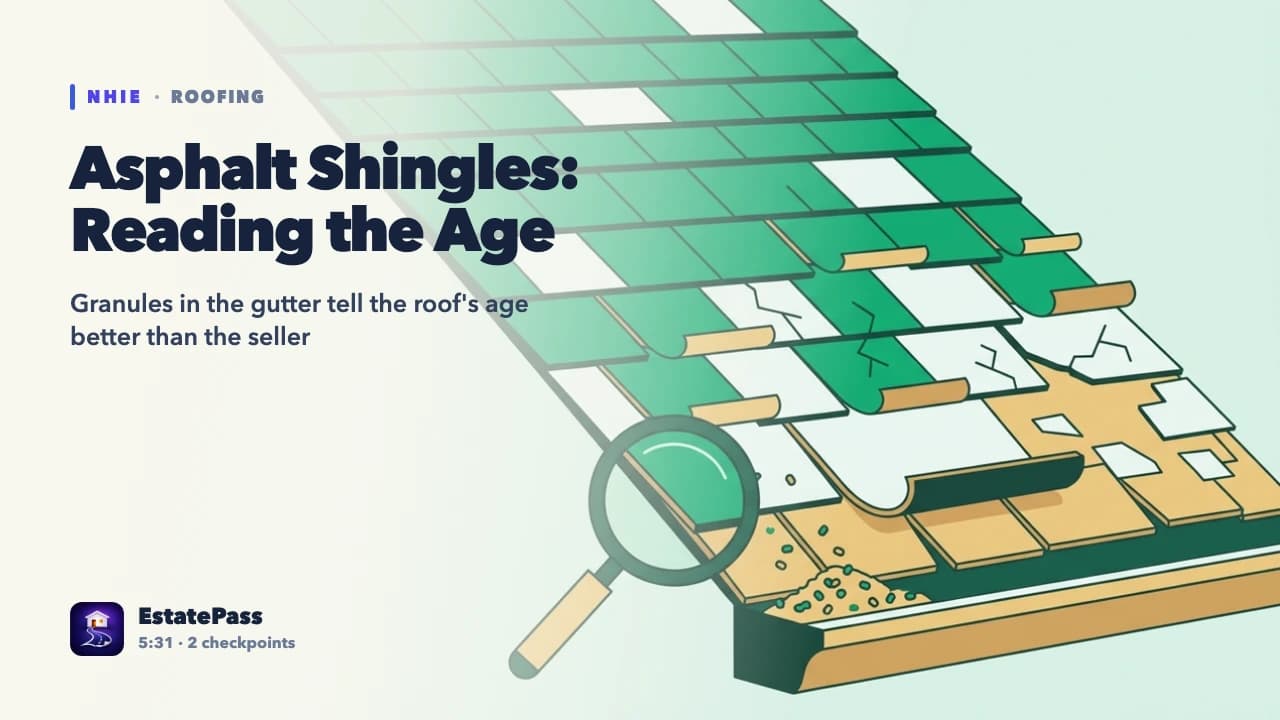
Shingles age in a known sequence: granule loss (check gutters for accumulations; shiny/bald spots expose asphalt to UV), curling and cupping at edges, cracking/crazing, brittleness, and finally exposed or deteriorated mats. Localized patterns diagnose causes: south-slope acceleration (UV), granules gone below downspout discharge from an upper roof (mechanical wash), moss growth holding moisture at shaded areas, and thermal cracking on poorly ventilated attics that cook the shingles from below.
- Granules in gutters = the odometer reading
- Curl, crack, brittle: the aging sequence
- Pattern location names the accelerant (UV, wash, moss, attic heat)
Installation defects
Fastening: high-nailed (above the nailing strip — courses can slide), overdriven (cut through the mat), underdriven/angled (bumps and punctures), or too few per shingle — wind lifts start here. Exposure: courses set wider than the design exposure shorten the water path across laps. Layering: a second layer over the first is common (weight, telegraphing, shortened life — and hides the deck); a THIRD layer is a standard remove-it finding. Missing starter courses and drip edge complete the checklist.
Worked example
A 16-year-old roof: gutters carry heavy granule sediment; south-slope shingles curl at the corners while the north slope grows moss; one section shows several shingle tabs slid out of line; and at the eaves, the deck's edge is visibly wavy with two shingle layers present. The buyer asks for 'how long it has left.'
Age reading: heavy granule loss plus corner curl at year 16 puts the roof in its final quartile — south slope leading (UV), consistent with a 20–25-year product; the moss on the north holds moisture and accelerates that slope its own way. The slid tabs: fastening defect — high nailing let courses creep; spot-repairable but a workmanship flag for the whole job. The wavy eave with two layers: layer two hid the deck's condition at installation, and the waviness suggests sheathing issues below (probe from the attic). The service-life answer: functional now, plan replacement within a few years, budget for possible deck repair discovered at tear-off — and treat any third layer proposal as a non-starter.
Common exam pitfalls
Quoting remaining life from age alone.
Read the shingles: granule loss, curl, and brittleness set the stage of life; slopes age at different rates.
Passing shingles on a low-slope porch.
Below 2:12, shingles are the wrong material — a defect finding even when newly installed.
Ignoring what a second layer conceals.
Overlays hide deck condition — report the layer count, the concealment, and the tear-off implications.
Two-twelve to live, four-twelve to double; granules are the gas gauge, nails are the workmanship, layers are the secrets.
Recap
- 2:12 minimum slope; doubled underlayment to 4:12
- Aging: granule loss → curl → crack → brittle
- Patterns name accelerants: UV, moss, wash, attic heat
- Fastening and exposure errors drive wind and slide failures
- Second layers conceal and shorten life; third layers get removed
- Report stage of life + defects + concealments
VIDEO LESSON
Watch this lesson on video — free
Prove it: 10 questions on this topic
Every lesson ends with a ten-question check in the free course — your progress syncs between the web and the EstatePass app.