
Mortgage exam diagrams · Chapter 13 of 15
Licensing and supervision
Decide who may take the next application, then trace what a state examiner can verify.
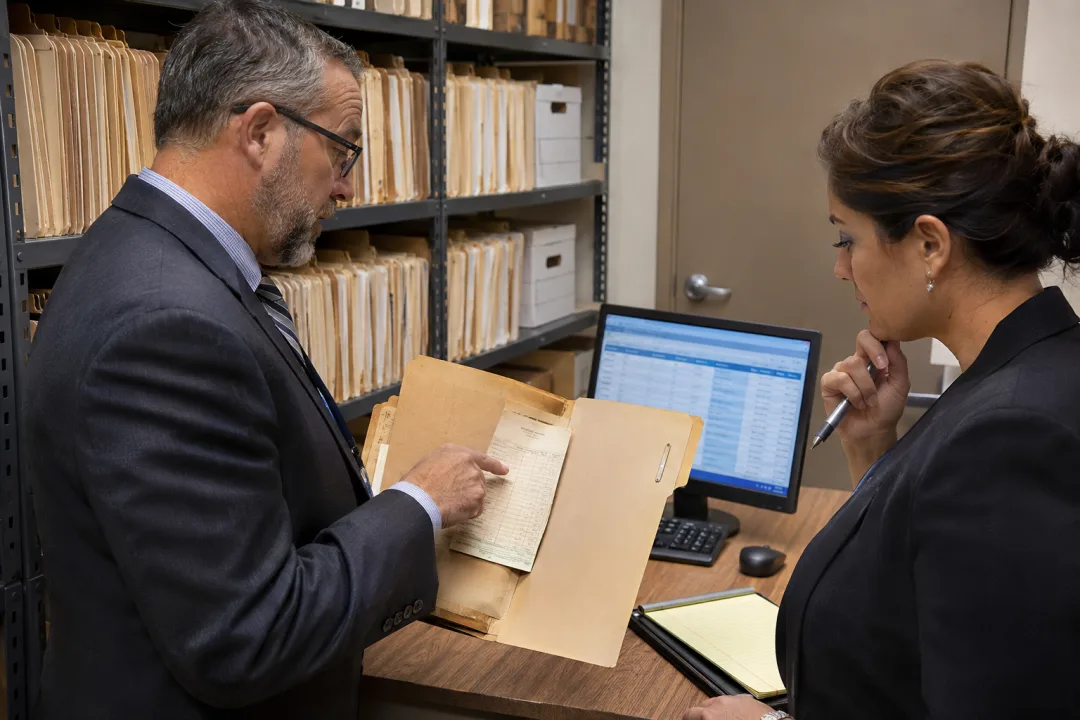
Inspect the file


Borrower file
Maya takes residential mortgage applications and offers terms for pay at a nonbank mortgage company. Eli, an employee working under supervision, gathers missing statements after application and never offers terms. Assume no temporary authority or other special exemption.
Illustrative photographs and simulated fileTest the diagram
Open each employment file. Look for the activity and relationship that control the result.
Work through the file
Identify the activities, employer and employment relationship. Maya is acting as an originator and needs the applicable state authority. Eli’s purely clerical work under supervision calls for a different analysis. Finally verify the individual’s status for the state involved.
Check the exam trap
An NMLS identifier follows the individual. Possessing the number does not establish active authority in a particular state.
Select a file detail to inspect its evidence.
- Classify the desk assignment
Compare a second file
Inspect the renewal record in order and identify what remains unresolved.
Select a file detail to inspect its evidence.
- Audit the renewal file
Read the regulator’s record
- Registry and regulator
- NMLS records applications, identifiers and status. The state licensing authority grants or denies the license. Check the state, effective status and any restrictions before assigning work.
- Renewal evidence
- Federal minimum renewal conditions include continuing to meet licensing standards, completing the required continuing education and paying the required fees. Check the state’s process and dates.
- Examiner access
- Preserve the file, communications and activity history. Follow the authorized examination request and document the response. Replacing the original would destroy the history the examiner needs.
A renewal receipt arrives before the first call
A nonbank originator returns after a lapse. The renewal fee receipt is in the branch inbox. The state record still shows an inactive license and no temporary authority applies.
Which record establishes the effective date?
Read the evidence
A submission receipt shows that an item was filed. Verify the regulator’s effective status for the individual, state and assignment before permitting origination.
- Match the jurisdiction
Confirm the individual, state and activity. An active license in another state cannot settle this assignment.
- Read the status
The receipt proves payment. The state record still shows inactive status. Route questions about reinstatement to the licensing authority.
- Assign the work
Give origination duties to an authorized individual. Keep the dated status check and the branch assignment so a reviewer can reconstruct the decision.
Make the decision
Change the facts
Practice by exam topic
Open a file, trace the decision rule and test it against the facts.
State regulators and the NMLS registry
- File evidence
- An applicant has an NMLS account and has filed the individual application.
- Decision rule
- The registry tracks applications, unique identifiers, employment and status. State licensing authorities decide applications and supervise licensees. Public access to licensing and disciplinary information supports accountability.
A unique identifier and public licensing or enforcement history support consumer verification. Distinguish information available through public access from confidential background or examination records. Federal originator compensation restrictions still apply to state licensees.
Regulator authority to examine books and records
- File evidence
- A state examiner requests a licensee’s records and an interview with the employee who processed the file.
- Decision rule
- Regulators can investigate, examine records and interview personnel under applicable authority. Preserve original files and check the state’s examination schedule and response requirements.
Who must be licensed; definition of MLO
- File evidence
- A paid nonbank employee regularly takes residential applications and negotiates mortgage terms.
- Decision rule
- Consider actual services, compensation, employer and jurisdiction. A company license does not confer individual authority. Check applicable exclusions and any statutory temporary authority before assignment.
Who need not be licensed (processors, underwriters, depositories)
- File evidence
- A supervised employee only assembles documents. A different worker independently contracts to process residential loans.
- Decision rule
- Pure clerical work under qualifying supervision and independent contractor processing have different licensing treatment. Covered depository MLO employees generally use federal registration.
Licensing qualifications, background, education
- File evidence
- A nonbank applicant completes the national test but omits background information.
- Decision rule
- Minimum licensing requirements include education, testing, background review, financial responsibility and other criteria. Generally a felony conviction within seven years is disqualifying; fraud, dishonesty, breach of trust or money laundering felonies have a longer statutory bar, subject to applicable exceptions such as a pardon.
The federal prelicensing minimum is 20 hours, including 3 federal law, 3 ethics and 2 nontraditional mortgage lending. Check state-specific hours, fingerprints, criminal background, credit history, prior revocation and financial responsibility. The lifetime felony categories include fraud, dishonesty, breach of trust and money laundering.
12 CFR § 1008.105 ↗Test retake waiting periods
- File evidence
- An applicant fails the national test on three consecutive attempts.
- Decision rule
- Ordinarily wait at least 30 days between unsuccessful attempts. After every third consecutive failure the statutory interval is at least six months. Keep the failure sequence distinct from the license renewal period.
The national test minimum is 75%. A formerly state-licensed originator who goes five years or longer without maintaining a valid license must retest under the federal rule, excluding qualifying time as a registered originator.
12 CFR § 1008.105 ↗License maintenance, renewal, continuing education
- File evidence
- A state-licensed MLO completes eight hours of qualifying annual CE and pays a renewal fee.
- Decision rule
- The federal minimum CE mix is 3 hours federal law, 2 ethics, 2 nontraditional lending and 1 elective. Check state additions, renewal status and sponsorship. A long lapse can also trigger retesting; exclude qualifying time as a registered MLO when applying the five-year test.
NMLS identifiers, notifications and disclosures
- File evidence
- An originator joins a different nonbank lender and prepares a new advertisement.
- Decision rule
- The individual retains the assigned identifier. Update required employment information, verify sponsorship and include required identifiers in applicable advertising and loan documents. Follow jurisdiction-specific filing deadlines.
Temporary authority to originate
- File evidence
- A registered bank MLO moves to a state-licensed company and files a state application.
- Decision rule
- Temporary authority is a conditional statutory route for certain eligible transitioning MLOs. Verify prior registration or licensing history, employment, filing and disqualifying events. Track the statutory end events, including an incomplete application at the 120-day point.
Prohibited acts
- File evidence
- An originator knows of a borrower debt absent from the credit report. A manager offers to submit the file under a supervisor’s ID.
- Decision rule
- Report material liabilities accurately, use the responsible originator’s identifier and reject misleading bait-and-switch offers. Payments for an agent’s advertising tied to referrals warrant separate RESPA review.
Required conduct, records, advertising
- File evidence
- A licensing authority asks for records after a borrower complains about a changed offer.
- Decision rule
- Preserve original offers, communications and later revisions. Provide responsive records under applicable retention and examination requirements. State enforcement can include fines, suspension or revocation.
Check the particular jurisdiction’s retention period, advertising requirements, examination schedule and sanctions. Examine any assumption according to the actual loan terms; an MLO cannot promise a release of the seller without lender approval.
12 CFR § 1008.111 ↗Licensing and supervision · Continue to RESPA and TILA in practice →
Explore learning paths →