
Ohio video lessons · Lesson 3 of 10
Ohio Turns, Lanes and Passing: five situations explained
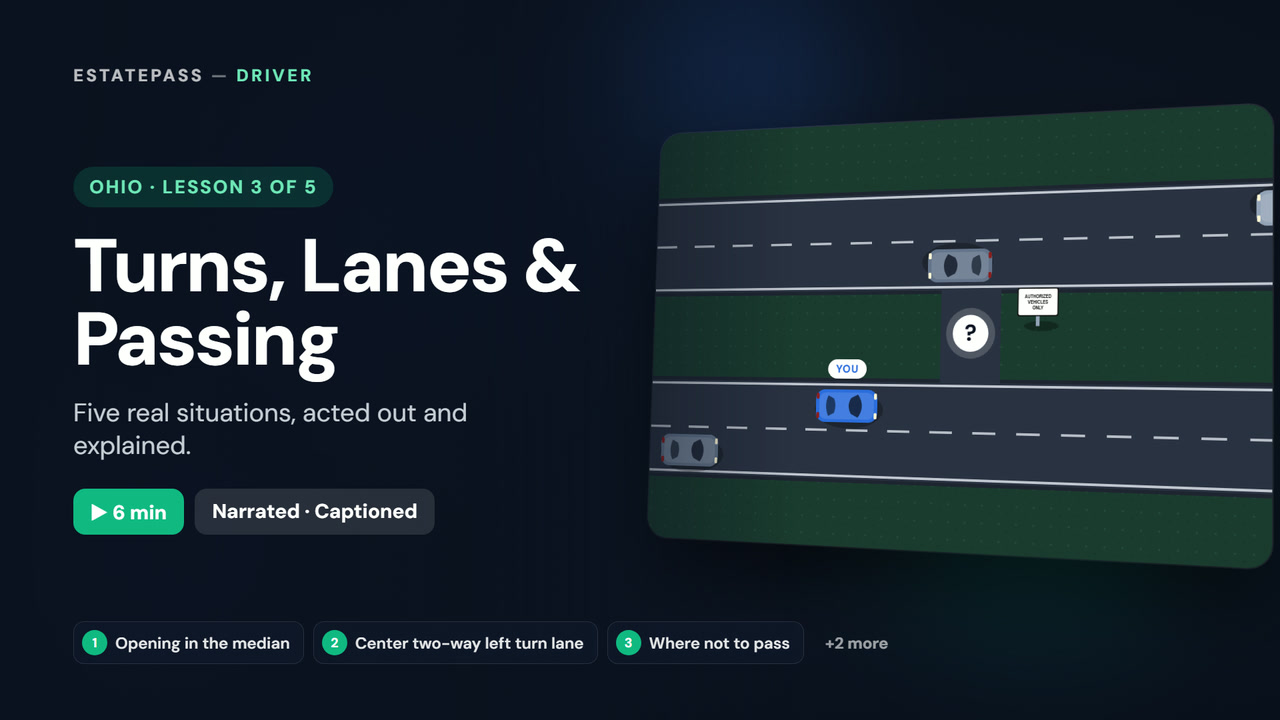
All five situations and their answers are below. To watch the lesson, create a free account.
In this video
- 0:00Intro
- 0:17Who may use the openings through a highway median?
- 1:15What may a center two-way left turn lane be used for?
- 2:16Where does the Digest say not to attempt to pass?
- 3:18When should you use your turn signal before reducing speed?
- 4:18May you pass on a paved shoulder in Ohio?
- 5:08Recap
In short
Do not use the opening through the median, which is for use only by emergency and public safety vehicles. The marked center lane is for left turns only; vehicles from either direction may use it immediately before turning. Do not pass when an oncoming vehicle approaches, your view is blocked, at intersections, or before a railroad crossing or bridge.
The five situations
Pick an answer first, the way the video pauses for you. Each one cites the Digest of Ohio Motor Vehicle Laws.
Situation 1
Who may use the openings through a highway median?
Answer: A. Only emergency and public safety vehicles. Do not use the opening through the median, which is for use only by emergency and public safety vehicles.
Digest of Ohio Motor Vehicle Laws › Section 5: Learning to Drive › Exiting a Roadway
Situation 2
What may a center two-way left turn lane be used for?
Answer: B. Left turns only, just before turning. The marked center lane is for left turns only; vehicles from either direction may use it immediately before turning. It is not for traveling or passing.
Digest of Ohio Motor Vehicle Laws › Section 4 › Two-way Left Turn Only Lane
Situation 3
Where does the Digest say not to attempt to pass?
Answer: C. At intersections, and before a railroad crossing or bridge. Do not pass when an oncoming vehicle approaches, your view is blocked, at intersections, or before a railroad crossing or bridge.
Digest of Ohio Motor Vehicle Laws › Section 5: Learning to Drive › Passing
Situation 4
When should you use your turn signal before reducing speed?
Answer: A. Turning off a road without a separate turn lane, or parking before an intersection. Signal before slowing when turning off a road without separate turn lanes, or when parking or turning before an intersection.
Digest of Ohio Motor Vehicle Laws › Section 8 › Signal When Reducing Speed
Situation 5
May you pass on a paved shoulder in Ohio?
Answer: B. No; never pass on the shoulder, paved or not. Never pass on the shoulder, whether it is paved or not.
Digest of Ohio Motor Vehicle Laws › Section 5: Learning to Drive › Multi-Lane, Two-Way Roadway
Transcript
0:00Intro
Turning, changing lanes and passing are where small mistakes get expensive. Here are five situations from the Digest of Ohio Motor Vehicle Laws. For each one, pick your answer before I reveal it.
0:17Situation 1
You see a gap through the median of a highway, just past where you meant to exit. Who may use the openings through a highway median? The answer is A: Only emergency and public safety vehicles. Do not use the opening through the median, which is for use only by emergency and public safety vehicles. Median openings are for emergency and public safety vehicles only. Keep going to the next exit.
1:15Situation 2
A marked center lane runs between the two directions of traffic. What may a center two-way left turn lane be used for? The answer is B: Left turns only, just before turning. The marked center lane is for left turns only; vehicles from either direction may use it immediately before turning. It is not for traveling or passing. Use it for left turns only, and only right before you turn. It's not a travel or passing lane.
2:16Situation 3
You're behind a slow vehicle, and a railroad crossing is coming up. Where does the Digest say not to attempt to pass? The answer is C: At intersections, and before a railroad crossing or bridge. Do not pass when an oncoming vehicle approaches, your view is blocked, at intersections, or before a railroad crossing or bridge. Don't pass at intersections, or before a railroad crossing or a bridge. Wait for a clear, open stretch.
3:18Situation 4
You're about to turn into a side street on a road with no separate turn lane. When should you use your turn signal before reducing speed? The answer is A: Turning off a road without a separate turn lane, or parking before an intersection. Signal before slowing when turning off a road without separate turn lanes, or when parking or turning before an intersection. Signal before you start slowing, so drivers behind know why you're braking.
4:18Situation 5
Traffic is slow, and there's a wide paved shoulder on your right. May you pass on a paved shoulder in Ohio? The answer is B: No; never pass on the shoulder, paved or not. Never pass on the shoulder, whether it is paved or not. Never pass on the shoulder, paved or not.
5:08Recap
Do not use the opening through the median, which is for use only by emergency and public safety vehicles. The marked center lane is for left turns only; vehicles from either direction may use it immediately before turning. Do not pass when an oncoming vehicle approaches, your view is blocked, at intersections, or before a railroad crossing or bridge. Signal before slowing when turning off a road without separate turn lanes, or when parking or turning before an intersection. Never pass on the shoulder, whether it is paved or not. Nice work. Try more turning and passing questions in Practice by Topic, then test yourself with a full mock exam.
The rules in this lesson
- Do not use the opening through the median, which is for use only by emergency and public safety vehicles.
- The marked center lane is for left turns only; vehicles from either direction may use it immediately before turning.
- Do not pass when an oncoming vehicle approaches, your view is blocked, at intersections, or before a railroad crossing or bridge.
- Signal before slowing when turning off a road without separate turn lanes, or when parking or turning before an intersection.
- Never pass on the shoulder, whether it is paved or not.
Original practice lesson written from the Digest of Ohio Motor Vehicle Laws. EstatePass is not affiliated with or endorsed by the Ohio BMV; these are not official test questions.