
Ohio video lessons · Lesson 6 of 10
Ohio Sharing the Road: five situations explained
All five situations and their answers are below. To watch the lesson, create a free account.
In this video
- 0:00Intro
- 0:18Why use extra care passing farm machinery?
- 1:13How far does a loaded truck at 55 mph need to stop, under ideal conditions?
- 2:16How do drivers of school buses and hazardous cargo vehicles check a railroad crossing?
- 3:22A truck is making a wide right turn from the left lane. What should you do?
- 4:17What safety zone must you keep between your car and a bicycle in Ohio?
- 5:05Recap
In short
Pass with caution; the operator of farm machinery cannot hear approaching vehicles. A loaded truck at 55 mph needs at least 335 feet to stop — more than 1½ times a passenger vehicle. They are required to stop, listen through an open door or window, look in both directions, and then proceed with care.
The five situations
Pick an answer first, the way the video pauses for you. Each one cites the Digest of Ohio Motor Vehicle Laws.
Situation 1
Why use extra care passing farm machinery?
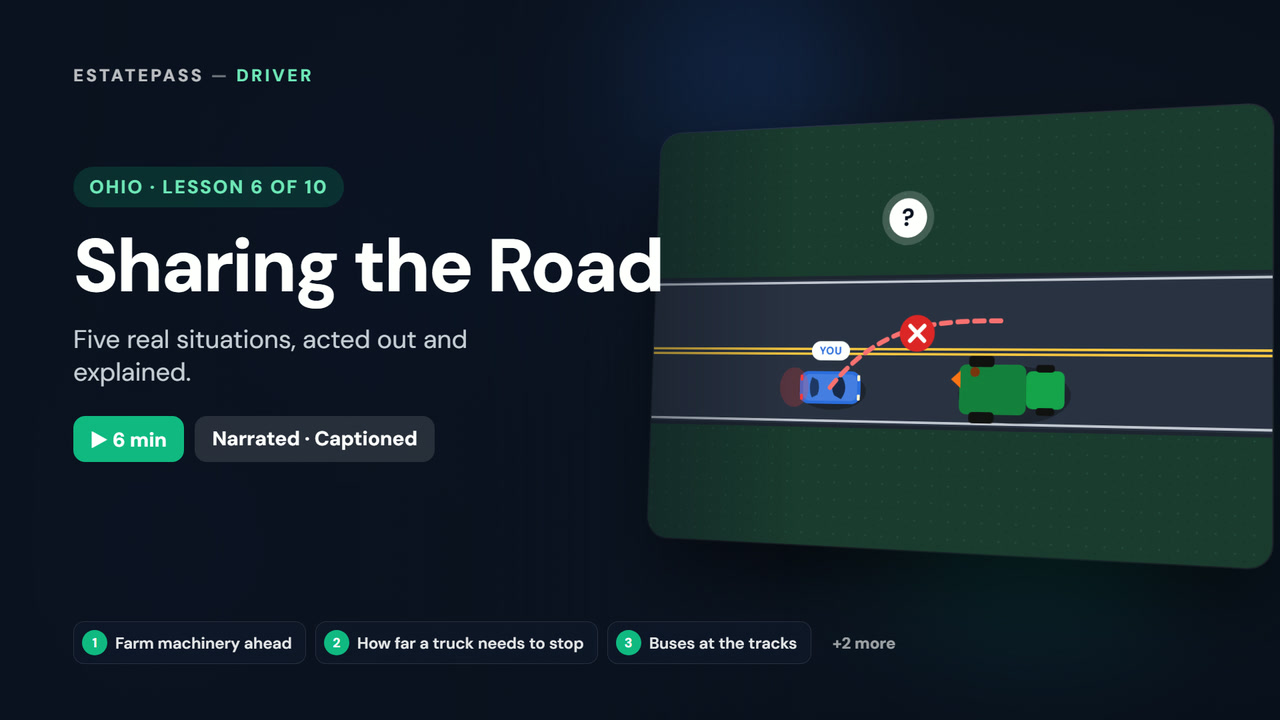
Answer: B. The operator may not hear approaching vehicles. Pass with caution; the operator of farm machinery cannot hear approaching vehicles.
Digest of Ohio Motor Vehicle Laws › Section 9 › Farm Machinery
Situation 2
How far does a loaded truck at 55 mph need to stop, under ideal conditions?
Answer: B. At least 335 feet. A loaded truck at 55 mph needs at least 335 feet to stop — more than 1½ times a passenger vehicle.
Digest of Ohio Motor Vehicle Laws › Section 9 › Front No Zones
Situation 3
How do drivers of school buses and hazardous cargo vehicles check a railroad crossing?
Answer: B. They stop, listen through an open door or window, and look both ways. They are required to stop, listen through an open door or window, look in both directions, and then proceed with care.
Digest of Ohio Motor Vehicle Laws › Section 5: Learning to Drive › Railroad Crossings
Situation 4
A truck is making a wide right turn from the left lane. What should you do?
Answer: B. Wait; do not squeeze between it and the curb. Do not squeeze between the large vehicle and the curb; let it make its turn first.
Digest of Ohio Motor Vehicle Laws › Section 9 › Turning
Situation 5
What safety zone must you keep between your car and a bicycle in Ohio?
Answer: B. At least three feet. Maintain a safety zone of at least three feet between a motor vehicle and a bicycle.
Digest of Ohio Motor Vehicle Laws › Section 9 › Bicyclists
Transcript
0:00Intro
You share the road with trucks, bikes, buses and more, and each one changes how you drive. Here are five situations from the Digest of Ohio Motor Vehicle Laws. For each one, pick your answer before I reveal it.
0:18Situation 1
A slow tractor is rolling along the two-lane road in front of you. Why use extra care passing farm machinery? The answer is B: The operator may not hear approaching vehicles. Pass with caution; the operator of farm machinery cannot hear approaching vehicles. If you pass, do it with caution. The operator may not hear vehicles coming up behind.
1:13Situation 2
A loaded truck is traveling at 55 miles per hour on a dry road. How far does a loaded truck at 55 mph need to stop, under ideal conditions? The answer is B: At least 335 feet. A loaded truck at 55 mph needs at least 335 feet to stop — more than 1½ times a passenger vehicle. Even in ideal conditions it needs at least 335 feet to stop, more than one and a half times a passenger car.
2:16Situation 3
A school bus ahead of you slows down as it comes to a railroad crossing. How do drivers of school buses and hazardous cargo vehicles check a railroad crossing? The answer is B: They stop, listen through an open door or window, and look both ways. They are required to stop, listen through an open door or window, look in both directions, and then proceed with care. School buses and hazardous cargo vehicles must stop, listen through an open door or window, look both ways, and then go carefully.
3:22Situation 4
A truck ahead swings out to the left before it turns right. A truck is making a wide right turn from the left lane. What should you do? The answer is B: Wait; do not squeeze between it and the curb. Do not squeeze between the large vehicle and the curb; let it make its turn first. Don't squeeze between it and the curb. Wait and let it finish its turn.
4:17Situation 5
You're about to pass a cyclist on a two-lane road. What safety zone must you keep between your car and a bicycle in Ohio? The answer is B: At least three feet. Maintain a safety zone of at least three feet between a motor vehicle and a bicycle. Keep a safety zone of at least three feet between your car and the bicycle.
5:05Recap
Pass with caution; the operator of farm machinery cannot hear approaching vehicles. A loaded truck at 55 mph needs at least 335 feet to stop — more than 1½ times a passenger vehicle. They are required to stop, listen through an open door or window, look in both directions, and then proceed with care. Do not squeeze between the large vehicle and the curb; let it make its turn first. Maintain a safety zone of at least three feet between a motor vehicle and a bicycle. Nice work. Try more sharing the road questions in Practice by Topic, then test yourself with a full mock exam.
The rules in this lesson
- Pass with caution; the operator of farm machinery cannot hear approaching vehicles.
- A loaded truck at 55 mph needs at least 335 feet to stop — more than 1½ times a passenger vehicle.
- They are required to stop, listen through an open door or window, look in both directions, and then proceed with care.
- Do not squeeze between the large vehicle and the curb; let it make its turn first.
- Maintain a safety zone of at least three feet between a motor vehicle and a bicycle.
Original practice lesson written from the Digest of Ohio Motor Vehicle Laws. EstatePass is not affiliated with or endorsed by the Ohio BMV; these are not official test questions.