
Products & Amortization
~12 min read · Distinguish fixed, balloon, interest-only, reverse and construction loans and their amortization.
Beyond the 30-year fixed lives a product zoo — balloons, interest-only periods, reverse mortgages, construction loans, HELOCs — and the exam tests each one's defining mechanic and its danger. Amortization math is the thread: what each payment does to the balance.
Amortization and its absence
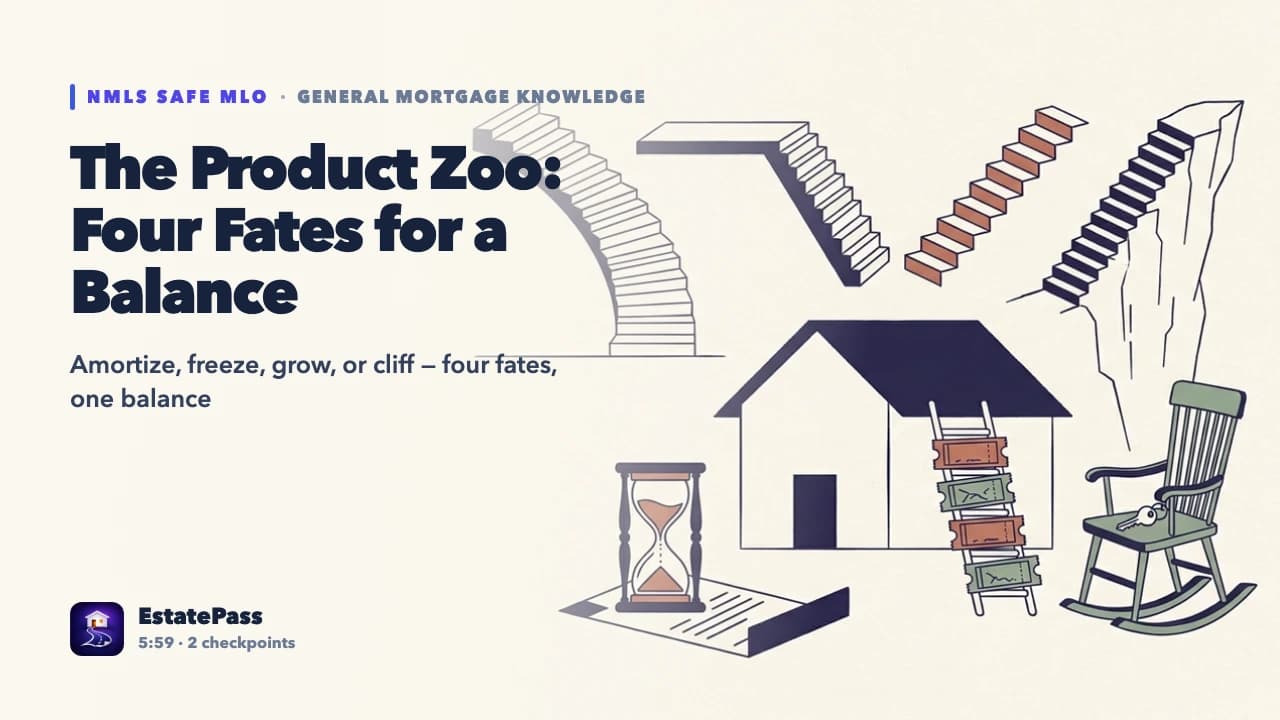
A fully amortizing payment covers accruing interest plus enough principal to zero the balance at term's end — early payments are interest-heavy, late payments principal-heavy. Interest-only periods pay interest alone: the balance stands still, and when the IO period ends the payment leaps to amortize the full balance over the shortened remainder. Negative amortization (payment-option legacy products) lets payments fall below accruing interest, GROWING the balance — capped by a recast trigger. Balloon loans amortize on a long schedule but mature early: a 30/7 balloon computes payments on 30 years and demands the entire remaining balance in year 7.
- Amortizing: interest first, principal share grows over time
- IO: balance frozen, payment shock at rollover
- NegAm: balance grows; recast when it hits the cap
- Balloon: long-schedule payments, early lump-sum maturity
Reverse mortgages
A reverse mortgage (HECM, the FHA-insured standard) lets homeowners 62+ convert equity to cash — lump sum, tenure payments, or line of credit — with no monthly repayment; the balance grows with accrued interest and comes due when the borrower dies, sells, or ceases to occupy the home as principal residence. Borrower duties continue: taxes, insurance, and maintenance — default on those forecloses. HUD-approved counseling is mandatory before application. Non-recourse: the home satisfies the debt even if the balance exceeds value.
- 62+, principal residence, mandatory counseling
- No monthly P&I; balance grows; due on death/sale/move-out
- Taxes-insurance-maintenance defaults still foreclose
- Non-recourse to heirs
Construction loans and HELOCs
Construction loans: short-term, draw-disbursed against completed work with inspections, interest-only on drawn amounts, then either refinanced or converted at completion — construction-to-permanent products close once and convert automatically. HELOCs: open-end revolving credit secured by the home — a draw period (borrow, repay, reborrow; often IO minimums) followed by a repayment period amortizing the frozen balance; variable rates off Prime are standard, and TILA's open-end rules (not TRID's closed-end forms) govern disclosures.
Worked example
A 68-year-old widow with a paid-off home wants monthly income but fears 'the bank taking the house.' Her son suggests she instead take a 30/5 balloon loan because 'the payment is lower than a 15-year fixed.' Sort the products honestly.
The reverse mortgage (HECM) fits her facts: 62+, principal residence, equity-rich — tenure payments give lifetime monthly income with NO required monthly repayment; she keeps title, and the loan comes due only at death, sale, or move-out. Her real risks are the ongoing duties: property taxes, insurance, upkeep — failing those, not the structure itself, is how reverse borrowers lose homes; mandatory HUD counseling will walk her through exactly this. The balloon suggestion misfits entirely: low payments now, but the ENTIRE balance due in year 5 — a 73-year-old on fixed income facing a refinance-or-sell cliff is the textbook balloon casualty. Product suitability is the exam skill: match the mechanic to the borrower's horizon and capacity.
Common exam pitfalls
Believing reverse-mortgage borrowers can't lose the home.
Tax, insurance, and maintenance defaults foreclose. The waived obligation is monthly P&I — nothing else.
Reading a 30/7 balloon as a 30-year loan.
Payments are computed on 30 years; the debt matures in 7 with the balance due in full.
Expecting a HELOC's draw-period payment to persist.
When the draw period ends, IO minimums become full amortization of the balance — the payment jump is built in.
Amortize, freeze, grow, or cliff — every product is just a different fate for the balance.
Recap
- Fully amortizing payments retire the balance; IO freezes it; NegAm grows it; balloons call it early
- HECM: 62+, counseling required, no monthly P&I, due at death/sale/move-out, non-recourse
- Reverse borrowers still owe taxes, insurance, maintenance
- Construction: draws + inspections, IO on drawn funds, convert or refinance at completion
- HELOC: draw then repayment period, variable rate, open-end TILA rules
- Suitability = borrower horizon vs product mechanic
VIDEO LESSON
Watch this lesson on video — free
Prove it: 10 questions on this topic
Every lesson ends with a ten-question check in the free course — your progress syncs between the web and the EstatePass app.