
ARMs: Index, Margin & Caps
~12 min read · Compute a fully indexed rate and apply initial/periodic/lifetime caps.
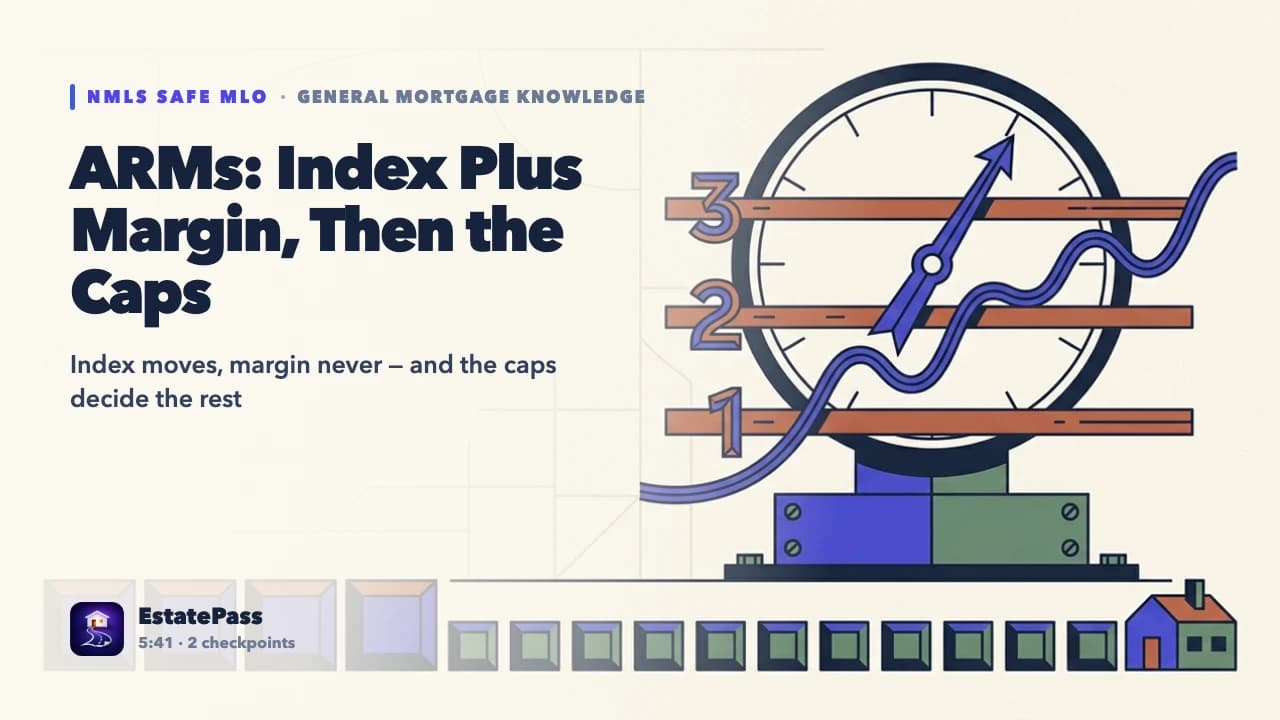
Every ARM question is the same machine with different numbers: fully indexed rate = index + margin, adjustments bounded by the cap structure, all advertised as a 3/1, 5/6, or 7/1 label you must decode. Master the machine and the exam hands you points.
Index, margin, fully indexed rate
An ARM's rate is rebuilt at each adjustment from two parts: the index — a published market rate that moves (SOFR is the post-LIBOR standard; Treasury CMT and others persist) — plus the margin, the lender's fixed add-on that never changes for the life of the loan. Fully indexed rate = current index + margin, then rounded per the note and squeezed by any applicable cap. The initial rate is often a discounted teaser below the fully indexed rate — which is why the first adjustment usually rises even in flat markets.
- Index moves; margin is fixed forever
- Fully indexed rate = index + margin
- Teaser below fully indexed → expect payment shock at first reset
Labels and caps
A 5/1 ARM: fixed 5 years, then adjusts every 1 year; a 5/6 adjusts every 6 months after the fixed period. Cap structures read as three numbers, e.g. 2/2/5: the initial adjustment cap (first reset), the periodic cap (each later reset), and the lifetime cap (total above the start rate). Caps bind the fully indexed calculation: the rate is the LESSER of index+margin and the cap-permitted maximum. Payment caps (rare, on payment-option products) limit payment, not rate — the negative-amortization trap.
- 5/1, 7/1, 5/6: fixed period / adjustment frequency
- 2/2/5 = first-reset cap / periodic cap / lifetime cap
- Rate = min(index + margin, cap ceiling) at each reset
Disclosure and suitability
ARM programs require the CHARM booklet and program disclosures at application, and advance notices before each adjustment. Suitability logic the exam rewards: ARMs fit borrowers whose horizon ends before the fixed period does (planned sale, certain relocation) or who can absorb worst-case payments; qualifying underwriting for many ARMs uses a rate above the teaser precisely to test that capacity.
Worked example
A 5/1 ARM starts at 5.00% with margin 2.75, caps 2/2/5. At the first reset the index is 5.10; a year later the index is 8.00. Compute both new rates.
Reset 1: fully indexed = 5.10 + 2.75 = 7.85%. Caps: initial adjustment limited to 2 above the 5.00 start → ceiling 7.00%. Rate = min(7.85, 7.00) = 7.00%. Reset 2: fully indexed = 8.00 + 2.75 = 10.75%. Periodic cap: 2 above the current 7.00 → 9.00%. Lifetime cap: 5 above 5.00 → 10.00%. Rate = min(10.75, 9.00, 10.00) = 9.00%. Note the machine's behavior: the borrower is capped below the fully indexed rate at both resets — 'carryover' pressure that keeps future resets pinned at their caps while the index stays high. The exam's favorite errors are applying the lifetime cap to reset 1 or forgetting the margin entirely.
Common exam pitfalls
Adjusting the margin as markets move.
Only the index moves. The margin is contractual and constant for the loan's life.
Reading 2/2/5 as percentages of anything.
They are absolute rate caps in percentage points: first reset +2 max, each later reset +2 max, lifetime +5 above start.
Comparing ARMs by teaser rate.
Compare margin, caps, and fully indexed rate — the teaser is marketing; the machine is the loan.
Index rides the market, margin rides forever; caps are the fences — first, each, and ever.
Recap
- Fully indexed rate = index + margin; SOFR is the modern index
- Margin never changes; teaser start rates sit below fully indexed
- 5/1, 5/6 labels: fixed years / adjustment frequency
- Cap trio: initial / periodic / lifetime (e.g., 2/2/5)
- Each reset: lesser of fully indexed and cap ceiling
- CHARM booklet + program disclosure at application; notices before resets
VIDEO LESSON
Watch this lesson on video — free
Prove it: 10 questions on this topic
Every lesson ends with a ten-question check in the free course — your progress syncs between the web and the EstatePass app.