
The Note & Security Instrument
~10 min read · Separate the promise to pay from the lien, and lien theory from title theory states.
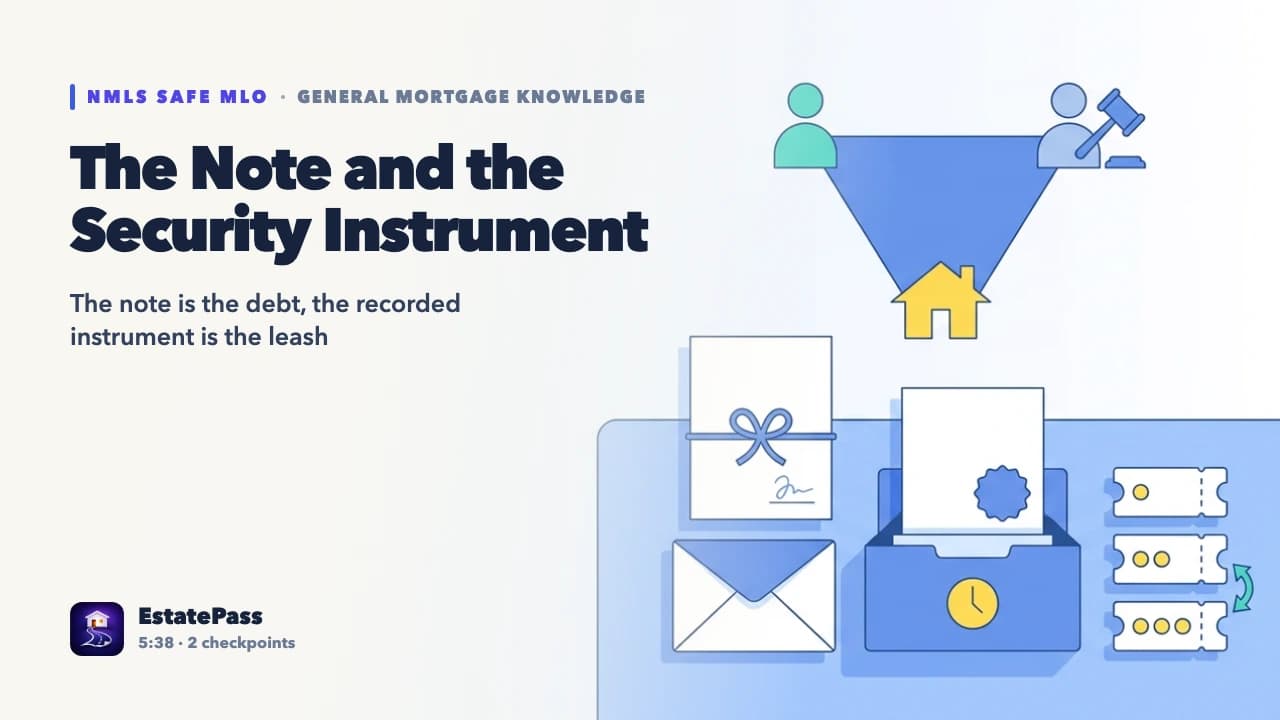
Two documents make a mortgage loan: the note (the debt) and the security instrument (the collateral claim). Around them orbit the concepts exams love — lien vs title theory, the trust deed's three parties, assumptions, subordination, and what recording actually does.
The note
The promissory note is the borrower's unconditional written promise to repay — amount, rate, payment schedule, late charges, default and acceleration terms. It is a negotiable instrument: endorsed and sold on the secondary market, which is why 'who owns my loan' changes while servicing rights move separately. The note is signed, typically NOT recorded and NOT notarized. Losing it triggers lost-note affidavits — the debt survives the paper.
- The debt itself: promise + terms + acceleration clause
- Negotiable — sold and endorsed like commercial paper
- Not recorded; the security instrument is the public half
Mortgage vs deed of trust
The security instrument pledges the home as collateral and is recorded. A mortgage involves two parties — mortgagor (borrower) and mortgagee (lender) — and generally forecloses judicially. A deed of trust adds a third: the trustor (borrower) conveys bare legal title to a neutral trustee for the beneficiary (lender); the trustee's power of sale enables faster nonjudicial foreclosure. Lien-theory states treat the borrower as titleholder with the lender holding a lien; title-theory states treat the lender/trustee as holding legal title until payoff — the practical differences surface in foreclosure procedure.
- Mortgage: 2 parties, judicial track
- Deed of trust: trustor/trustee/beneficiary, power of sale, nonjudicial track
- Lien theory vs title theory: who formally holds title during the loan
Clauses that move the exam needle
Acceleration: on default, the entire balance becomes due — the clause that makes foreclosure possible. Due-on-sale (alienation): transfer of the property lets the lender call the loan — why conventional loans aren't assumable (FHA/VA loans ARE assumable with approval). Prepayment clauses set any penalty. Subordination: a lien agrees to junior priority — essential when refinancing a first with a HELOC in place. Release/reconveyance: at payoff, a mortgage is satisfied of record; a deed of trust is reconveyed by the trustee. Recording establishes priority by time and gives constructive notice.
Worked example
A homeowner with a first deed of trust and a $60,000 HELOC in second position refinances the first. The new lender demands to stay in first position. Meanwhile her buyer-cousin asks to 'take over' her FHA loan on another property. Untangle both.
The refinance: paying off the old first would normally promote the HELOC to first priority (priority runs by recording time, and the new deed of trust records today). The cure is a subordination agreement: the HELOC lender consents to remain junior to the new first — no subordination, no refinance (or the HELOC gets paid off/closed). The cousin: FHA loans are assumable — with lender approval and a creditworthiness review, the cousin can assume the existing note's rate and terms; contrast a conventional loan, where the due-on-sale clause lets the lender accelerate upon transfer, making informal 'takeovers' a default trigger. Two clauses — subordination and due-on-sale/assumption — doing exactly what they exist to do.
Common exam pitfalls
Recording (or notarizing) the note.
The note stays private and unrecorded; the security instrument is the recorded, acknowledged document.
Mixing up the trust deed's three parties.
TrustOR owes (borrower), beneficiary is owed (lender), trustee holds power of sale neutrally.
Assuming assumability is universal.
FHA and VA: assumable with approval. Conventional: due-on-sale clauses block assumption.
Note = the promise, kept private; deed of trust = the pledge, made public; trustee holds the trigger.
Recap
- Note: negotiable promise to pay; unrecorded, sold on the secondary market
- Security instrument: recorded collateral pledge — mortgage (2-party) or deed of trust (3-party)
- Power of sale → nonjudicial foreclosure; mortgages → judicial
- Acceleration and due-on-sale drive default and transfer outcomes
- FHA/VA assumable with approval; conventional blocked by due-on-sale
- Priority by recording time; subordination rearranges it; payoff ends in satisfaction/reconveyance
VIDEO LESSON
Watch this lesson on video — free
Prove it: 10 questions on this topic
Every lesson ends with a ten-question check in the free course — your progress syncs between the web and the EstatePass app.