
The SAFE Act & Licensing
~11 min read · Know MLO licensing triggers, unique identifier rules, and the 20-hour/8-hour education math.
The SAFE Act built the licensing system you are testing into: NMLS registration, the unique identifier that follows you forever, and the 20-hour/8-hour education math. Expect direct questions on who needs a license, what the identifier must appear on, and the exact course-hour breakdowns.
Who is an MLO
A mortgage loan originator is an individual who, for compensation or gain, takes a residential mortgage loan application or offers or negotiates terms of one. State-licensed MLOs register through NMLS with testing, education, and background requirements; depository-institution employees are registered (federal registry) rather than state-licensed. Exempt from licensure: purely clerical/administrative staff, licensed attorneys doing incidental work, seller financers within limits, and loan servicers' modification staff under state rules.
- Take an application OR offer/negotiate terms + compensation = MLO
- State-licensed vs federally registered (bank employees)
- Clerical staff and incidental-attorney work: exempt
Getting and keeping the license
Licensure requires: 20 hours of NMLS-approved pre-licensure education — including 3 hours federal law, 3 hours ethics (fraud, consumer protection, fair lending), and 2 hours nontraditional mortgage products — plus passing the SAFE test, fingerprints/criminal background check, credit review, and no disqualifying record: never any felony involving fraud, dishonesty, breach of trust, or money laundering; no felony of any kind in the 7 years before application. Annually: 8 hours of continuing education — 3 federal law, 2 ethics, 2 nontraditional, 1 elective — with no course repeated in successive years.
- Pre-licensure 20 hours: 3 fed / 3 ethics / 2 nontraditional (+12 general)
- CE 8 hours: 3 fed / 2 ethics / 2 nontraditional / 1 elective
- Financial-crime felonies bar forever; any felony bars 7 years
- Test, fingerprints, credit check, surety bonding per state
The unique identifier
Every MLO carries an NMLS unique identifier for life — one number across states and employers. It must appear on applications, solicitations, advertisements (business cards, websites, social media used for origination), and be provided to consumers on request and before acting as an MLO. The public checks it on NMLS Consumer Access. Advertising without the identifier is among the most-cited routine violations.
Worked example
A brokerage hires three people: (a) a receptionist who schedules appointments and collects completed paperwork; (b) a 'consultant' paid per closed loan who discusses rates with applicants but 'never signs anything'; (c) an applicant for licensure with a 2019 DUI felony and a 2010 misdemeanor theft. Who needs a license, and who can get one?
(a) Purely clerical duties — scheduling, collecting, forwarding — no license needed; the moment she discusses terms or takes application information substantively, that changes. (b) Discussing rates with applicants for per-loan compensation IS offering/negotiating terms for gain — the absence of a signature is irrelevant; unlicensed origination, a serious violation for consultant and employer both. (c) Timeline math: the DUI felony is within 7 years of (say, 2026) application? 2019 → seven years runs to 2026 — right at the boundary; once 7 full years pass it no longer bars (DUI is not a financial-trust felony, so no lifetime bar). The 2010 THEFT: if it had been a felony, dishonesty means lifetime bar; as a misdemeanor it is weighed in character review, not an absolute bar. Answer: (a) exempt, (b) must be licensed now, (c) eligible once the 7-year window clears, subject to character findings.
Common exam pitfalls
Assuming no-signature means no-origination.
Offering or negotiating terms for compensation is origination — paperwork signatures are irrelevant.
Blurring the two felony rules.
Fraud/dishonesty/breach-of-trust/money-laundering felonies: barred forever. Any other felony: barred 7 years.
Scrambling the education splits.
Pre-licensure 20: 3/3/2. Annual CE 8: 3/2/2/1. The exam asks the numbers cold.
Twenty in, eight a year; three-three-two, then three-two-two-one — and your number goes on everything.
Recap
- MLO = takes applications or offers/negotiates terms for compensation
- 20-hour pre-licensure (3 fed/3 ethics/2 nontraditional); SAFE test; background/credit
- Financial felonies: lifetime bar; any felony: 7-year bar
- 8-hour annual CE (3/2/2/1), no repeats in successive years
- Unique identifier on all applications, ads, and solicitations
- NMLS Consumer Access is the public lookup
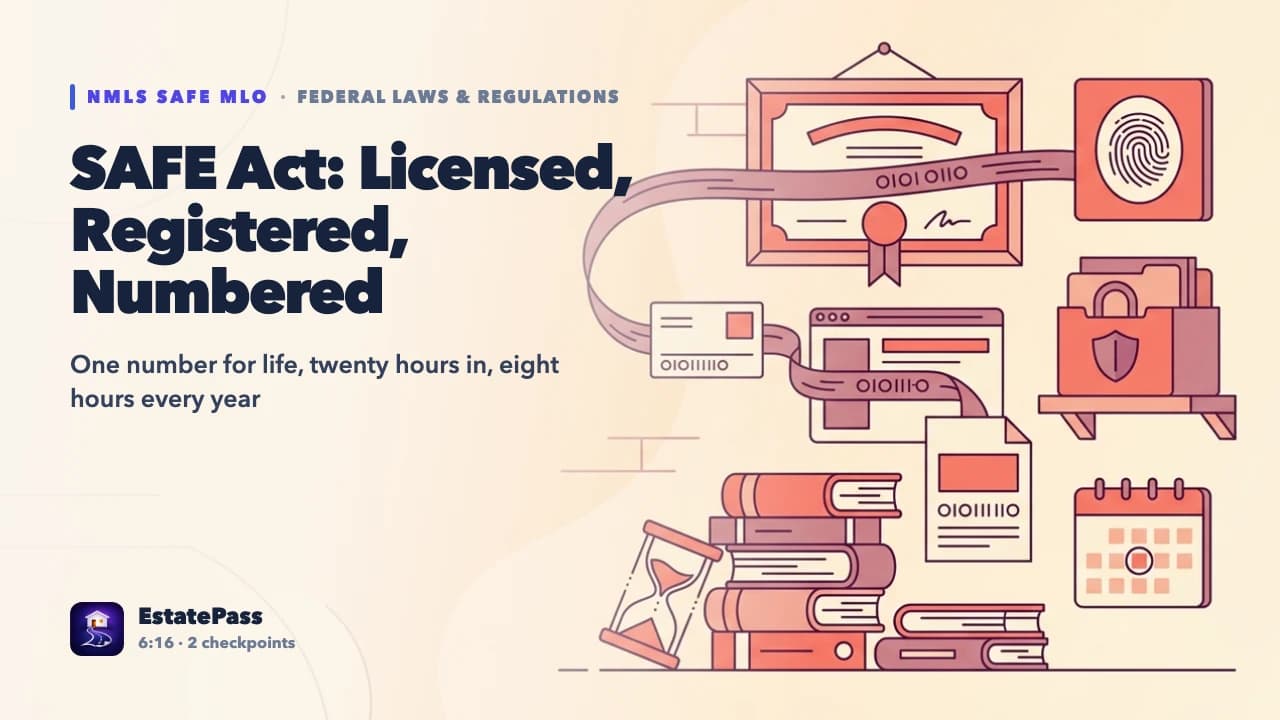
VIDEO LESSON
Watch this lesson on video — free
Prove it: 10 questions on this topic
Every lesson ends with a ten-question check in the free course — your progress syncs between the web and the EstatePass app.