
ECOA & Reg B
~12 min read · Name every protected class, the 30-day notice rules, and what may never be asked.
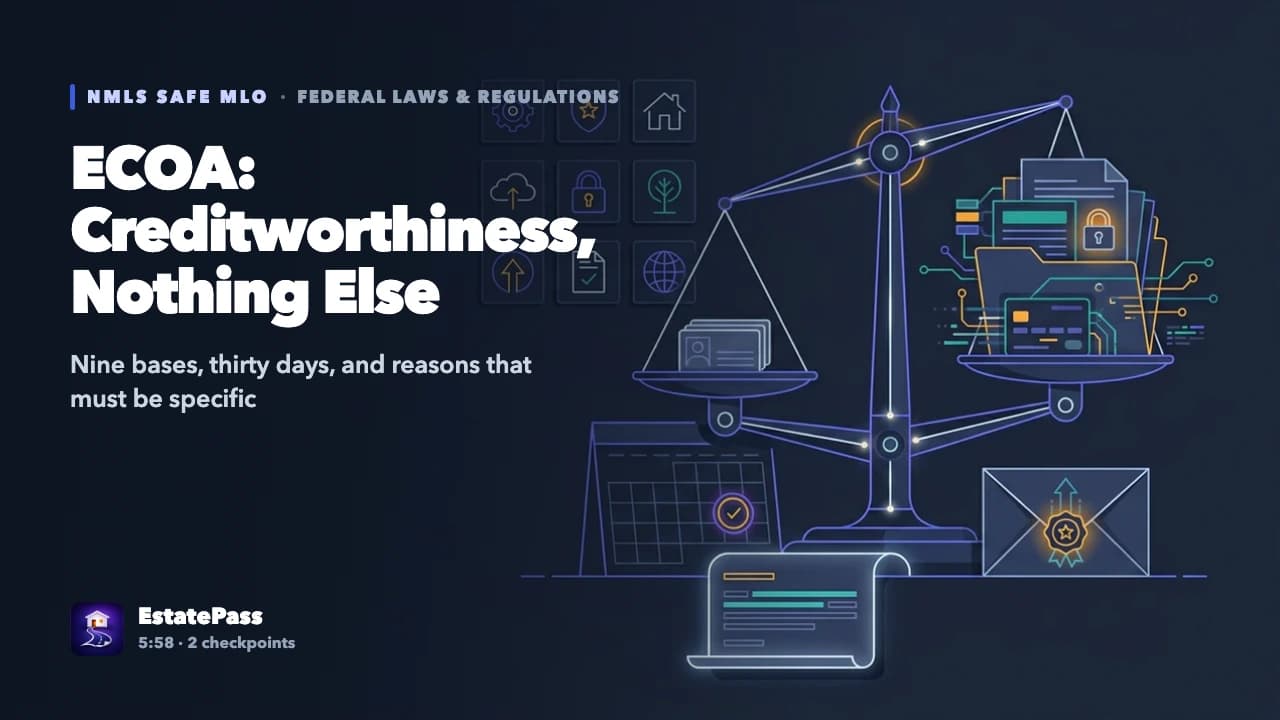
ECOA and Regulation B guarantee that credit decisions ride on creditworthiness alone. The exam drills the nine protected bases, the 30-day notice clock, the specific-reasons rule for adverse action, and the short list of questions an MLO may never ask.
The protected bases
A creditor may not discriminate on: race, color, religion, national origin, sex (including sexual orientation and gender identity), marital status, age (provided capacity to contract), receipt of public assistance income, or good-faith exercise of rights under consumer-credit laws. Note the pairs the exam swaps: marital status and public assistance are ECOA bases that fair-housing law words differently; familial status and disability are Fair Housing Act language, not ECOA's.
- Nine bases — memorize them as ECOA's own list
- Age protected once the applicant can contract
- Public-assistance income cannot be discounted for its source
Forbidden and restricted inquiries
An MLO may not ask about childbearing intentions or birth control, may not discount income because it is part-time, alimony, child support, or public assistance (only for its likelihood of continuation), and may not require a spouse's signature on the note when the applicant qualifies individually (security instruments in community/homestead states are the narrow exception). Alimony/child-support income need be disclosed only if the applicant wants it considered. Marital-status inquiries are restricted to permitted forms (married / unmarried / separated) and permitted contexts (secured credit, community-property states).
- Never: family-planning questions
- Income is weighed for continuance, never for source
- No spouse signature on the NOTE for individually qualified applicants
- Alimony/child support: volunteer-to-count only
Notification clocks and appraisal rights
Within 30 days of a completed application, the creditor must notify: approval, counteroffer, or adverse action — and an adverse-action notice must state specific reasons (or offer them on request within 60 days), plus ECOA and FCRA disclosures. Incomplete applications get a notice of incompleteness. Reg B also requires providing copies of appraisals and written valuations for first-lien dwelling loans promptly, and no later than 3 business days before consummation. Record retention: 25 months.
Worked example
An underwriter tells an MLO: 'Decline this one — she's 24, recently married, and half her income is child support, which always dries up. Just send a notice saying it didn't meet our standards.' Count the violations before the notice even goes out.
Age: 24 with contractual capacity is a protected basis — 'too young' is discrimination. Marital status: 'recently married' as a decision factor is a second basis. Child support: discounting it categorically for its SOURCE violates the income rule — the underwriter may evaluate only its likelihood of continuation (payment history, order terms), individually. The proposed notice: 'didn't meet our standards' fails the specific-reasons requirement — adverse action must state the actual principal reasons (e.g., insufficient continuance documentation for support income) or offer them within the request window. Four violations: three substantive bases plus a defective notice — each independently actionable.
Common exam pitfalls
Blending ECOA's list with the Fair Housing Act's.
ECOA: marital status, age, public assistance. FHA: familial status, disability. The exam swaps them deliberately.
Requiring a spouse to co-sign for strength.
If the applicant qualifies alone, the spouse's signature on the note cannot be required — collateral documents in community-property states are the only carve-out.
Sending vague adverse-action notices.
Specific principal reasons, or a statement of the right to learn them within 60 days — 'internal standards' is a violation.
ECOA's nine: Race, Color, Religion, Nation, Sex, Marriage, Age, Assistance, Assertion of rights.
Recap
- Nine protected bases; know them as distinct from Fair Housing's list
- No family-planning questions; no income-source discounting
- Alimony/child support counted only if volunteered
- No spouse signature on the note for qualified individual applicants
- 30-day decision notice; adverse action with specific reasons
- Appraisal copies promptly, ≥3 business days pre-consummation; 25-month records
VIDEO LESSON
Watch this lesson on video — free
Prove it: 10 questions on this topic
Every lesson ends with a ten-question check in the free course — your progress syncs between the web and the EstatePass app.