
RESPA: Reg X Essentials
~13 min read · Apply Section 8 kickback rules, the $50 gift cap logic, and escrow/servicing disclosures.
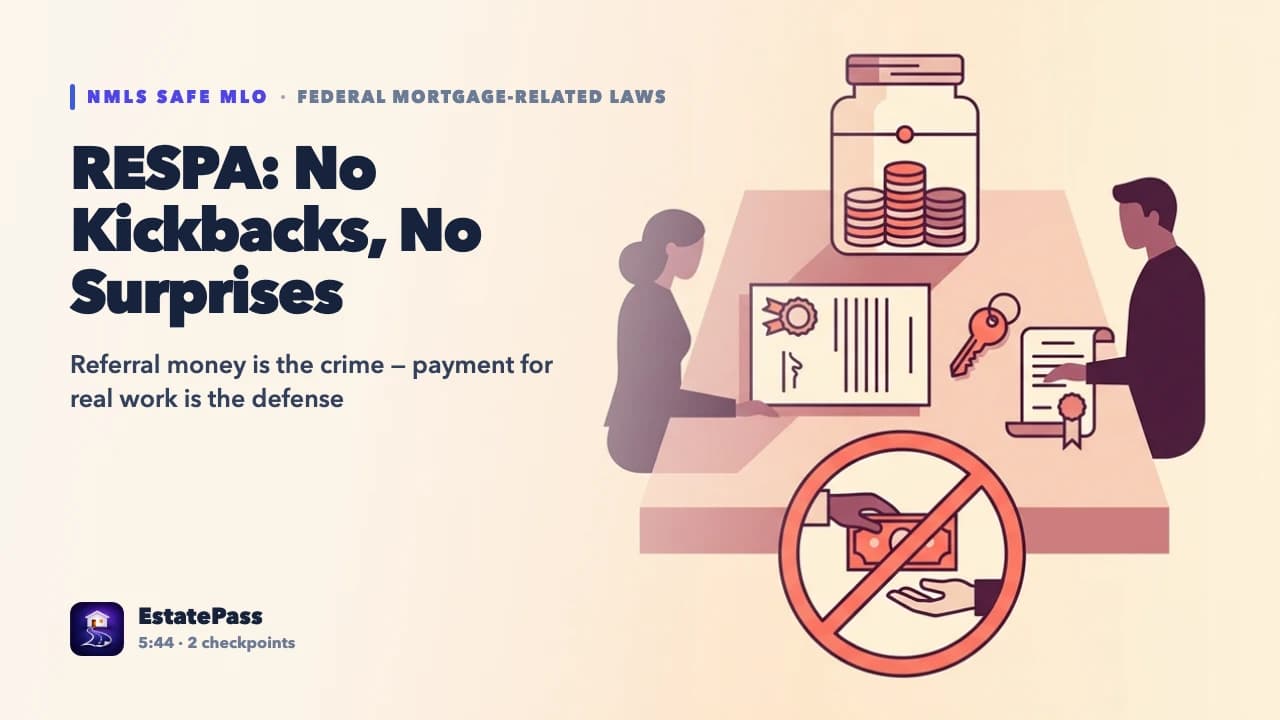
RESPA — the Real Estate Settlement Procedures Act, implemented by Regulation X — polices the settlement process itself: who can pay whom for referrals (almost no one), what servicers must disclose, and how escrow accounts are limited. Section 8's kickback prohibition is the most-tested provision in the entire federal-law domain.
Coverage and purpose
RESPA applies to federally related mortgage loans — essentially all residential loans secured by a dwelling of one to four units made by regulated lenders. Its twin goals: eliminate kickbacks and referral fees that inflate settlement costs, and give borrowers timely disclosures about settlement services and servicing. It does not set interest rates or fees themselves — it regulates the machinery around closing.
- Covers 1–4 unit residential federally related loans
- Targets settlement-cost inflation, not rates
- Enforced by the CFPB
Section 8: kickbacks and unearned fees
Section 8(a) prohibits giving or accepting any thing of value pursuant to an agreement to refer settlement service business — cash, trips, marketing subsidies, discounted rent, event tickets. Section 8(b) bans fee splitting: accepting any portion of a charge for settlement services other than for services actually performed. Violations carry serious teeth: fines up to $10,000 and up to one year imprisonment, plus civil liability. The permitted zone: payments for goods actually furnished or services actually performed at fair market value, employer payments to employees, and affiliated business arrangements that are disclosed, leave the consumer free to shop, and pay nothing beyond an ownership return.
- No thing of value for referrals — cash, trips, tickets, subsidies all count
- No splitting fees without work actually performed
- Up to $10,000 fine + 1 year prison per violation
- AfBAs legal only with disclosure, freedom to choose, and returns limited to ownership share
Servicing and escrow rules
RESPA also governs life after closing: servicing-transfer notices, prompt crediting, and escrow account limits — a servicer may hold a cushion of at most one-sixth of annual disbursements (two months), with an annual escrow analysis and refunds of surpluses of $50 or more. Borrower inquiries travel as qualified written requests, with acknowledgment and resolution timelines the servicer must meet.
Worked example
A title company offers an MLO $150 per closed referral, dressed up as a 'marketing services agreement' under which the MLO's only duty is a monthly social-media post. Separately, the MLO's brokerage owns 40% of the title company and wants to steer clients there. What does RESPA allow?
The $150 arrangement: Section 8 looks through labels to substance. A monthly post worth a few dollars cannot support $150 per CLOSED LOAN — compensation tied to referral volume for nominal services is a disguised referral fee; both payer and recipient face the $10,000/one-year exposure. The ownership route: an affiliated business arrangement CAN be legal — but only with the written AfBA disclosure at referral time, no requirement to use the affiliate (consumer stays free to shop), and the brokerage receiving nothing beyond its proportional ownership return — no per-referral bonuses on top. Steering with disclosure and choice: legal; compensating per referral in any costume: not.
Common exam pitfalls
Believing non-cash perks escape Section 8.
'Thing of value' reaches trips, tickets, subsidized rent, marketing spend — anything of worth given for referrals.
Assuming a services agreement legalizes referral pay.
Payment must match services ACTUALLY performed at market value — volume-based pay for token work is a kickback in costume.
Confusing RESPA's escrow cushion with tax rules.
The cushion cap is two months (1/6 of annual disbursements), tested with the annual analysis.
RESPA: Referrals Earn Serious Penalties — Actual services only.
Recap
- RESPA/Reg X covers settlement practices on 1–4 unit residential loans
- Section 8(a): no thing of value for referrals
- Section 8(b): no unearned fee splitting
- Penalties: up to $10,000 and one year per violation
- AfBAs: disclose, keep choice free, ownership returns only
- Escrow: two-month cushion cap, annual analysis, surplus refunds
VIDEO LESSON
Watch this lesson on video — free
Prove it: 10 questions on this topic
Every lesson ends with a ten-question check in the free course — your progress syncs between the web and the EstatePass app.