
Foundations & Crack Patterns
~14 min read · Match crack patterns to their causes and separate normal shrinkage from differential settlement.
Foundation inspection is crack forensics: pattern, direction, width, and displacement separate concrete's normal shrinkage from differential settlement and lateral pressure. The inspector's product is a mechanism hypothesis and the right referral threshold.
Foundation types
Slab-on-grade (no access below; cracks read through floors), crawl space on stem walls or piers, full basement (poured concrete, block, or older stone/brick) — each with signature issues: slabs heave and settle with soil moisture; crawl piers settle individually; basements add lateral soil pressure to the load story. Soil is the real subject: expansive clays swell and shrink with moisture, fill compresses, and moisture changes (new drainage patterns, big tree removal) restart movement in old houses.
- Slab / crawl / basement — access dictates evidence
- Soil behavior (clay, fill, moisture) drives movement
- Water management findings and foundation findings travel together
Crack forensics
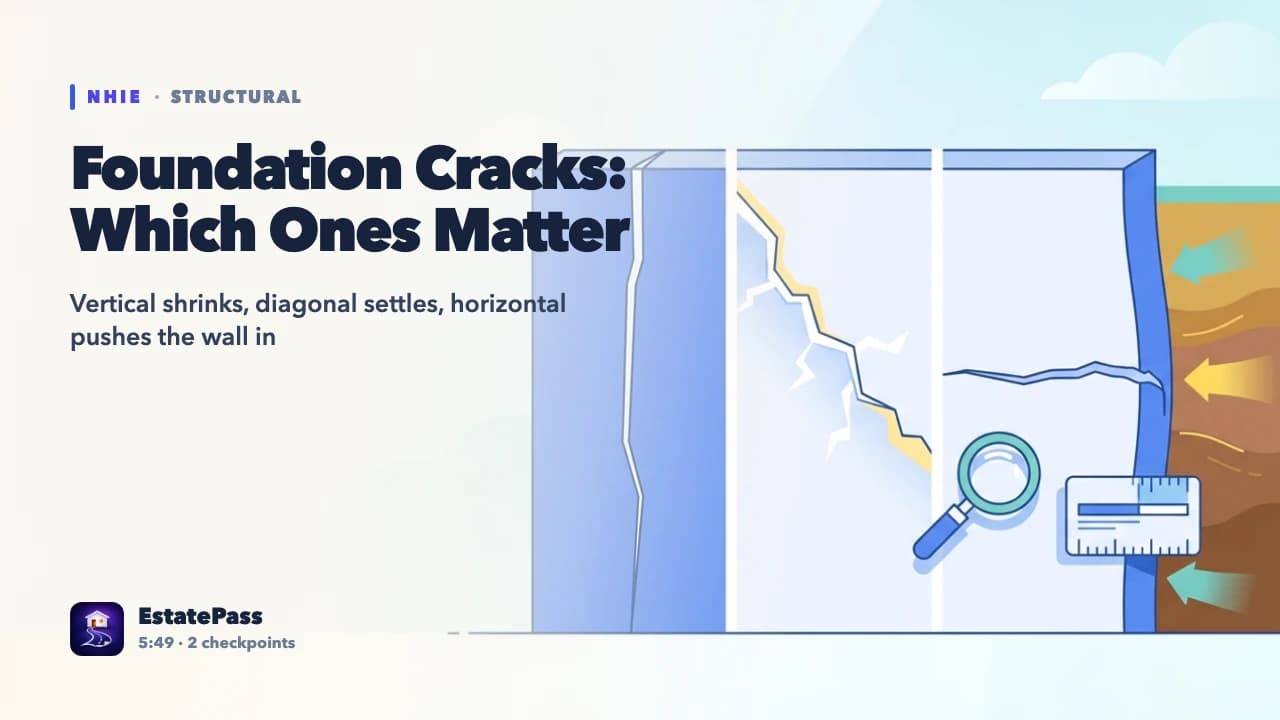
Shrinkage cracks: hairline, vertical or random, uniform width, no displacement — normal curing, note only. Settlement cracks: wider, often diagonal from corners of openings, WIDER AT ONE END (rotation), possibly with vertical displacement — differential movement. Stair-step cracks in block/brick follow mortar joints — settlement or lateral pressure depending on location and bulge. Horizontal cracks in basement walls, especially mid-height with inward bowing: lateral soil/hydrostatic pressure — the most serious wall finding. Width benchmarks help framing (hairline vs ~1/4-inch-plus), but pattern + displacement + freshness (clean vs dirty/painted crack faces) outrank width alone.
- Vertical hairline, uniform: shrinkage — normal
- Diagonal, tapered, displaced: differential settlement
- Horizontal + bowing: lateral pressure — top-severity finding
- Fresh vs weathered crack faces date the movement
Corroborating evidence and referral
Movement echoes upstairs: doors racking, drywall cracks at opening corners, sloped floors (marble test/level), separated trim, chimneys leaning away. ACTIVE movement (fresh cracks, monitoring tell-tales broken, progressive reports) versus historic-and-stable is the key judgment. The referral line: displacement, horizontal cracking with bow, widespread pattern evidence, or active movement → structural engineer evaluation — the inspector identifies and describes; the engineer prescribes.
Worked example
A 1970s block basement: a horizontal crack runs mid-height along the driveway-side wall, which bows inward noticeably against a straightedge; stair-step cracks radiate near that wall's corners; upstairs, the door over that side sticks and drywall shows corner cracks. The driveway slopes toward the house. Build the finding.
Assemble the mechanism: the driveway delivers water to that wall's backfill; saturated soil (plus possible frost) pushes laterally; the block wall answers with the classic horizontal mid-height crack and inward bow — the highest-severity basement-wall pattern; stair-steps at the corners and the racking door upstairs corroborate distress concentrated on that side. This is not crack-filler territory: report lateral pressure failure in progress (condition), structural risk plus continuing water contribution (implication), and require structural engineer evaluation with drainage correction — regrade/redirect the driveway water — as the companion fix (action). Pattern → mechanism → referral: the whole method in one wall.
Common exam pitfalls
Grading cracks by width alone.
A hairline HORIZONTAL crack with bow outranks a fat vertical shrinkage crack — pattern and displacement carry the diagnosis.
Diagnosing without the water story.
Most foundation movement is a moisture story — pair every crack pattern with the grading/drainage evidence.
Prescribing repairs.
The inspector describes and refers; scope of repair (piers, bracing, drainage) belongs to the engineer.
Vertical shrinks, diagonal settles, horizontal pushes — and water is usually holding the crowbar.
Recap
- Types: slab, crawl, basement; soils drive behavior
- Shrinkage: hairline, uniform, undisplaced — normal
- Settlement: diagonal, tapered, displaced
- Horizontal + bow = lateral pressure — top severity
- Corroborate upstairs: doors, drywall, floors
- Displacement/active movement → engineer referral
VIDEO LESSON
Watch this lesson on video — free
Prove it: 10 questions on this topic
Every lesson ends with a ten-question check in the free course — your progress syncs between the web and the EstatePass app.