
Decks, Porches & Balconies
~13 min read · Inspect ledger attachment, guards, stairs and footings — the deck-collapse checklist.
Deck collapses are the deadliest residential structural failure, and nearly all share one autopsy: the ledger tore off the house. Ledger attachment and flashing, guards, stairs, and footings — inspected in that order of consequence.
The ledger: attachment and flashing
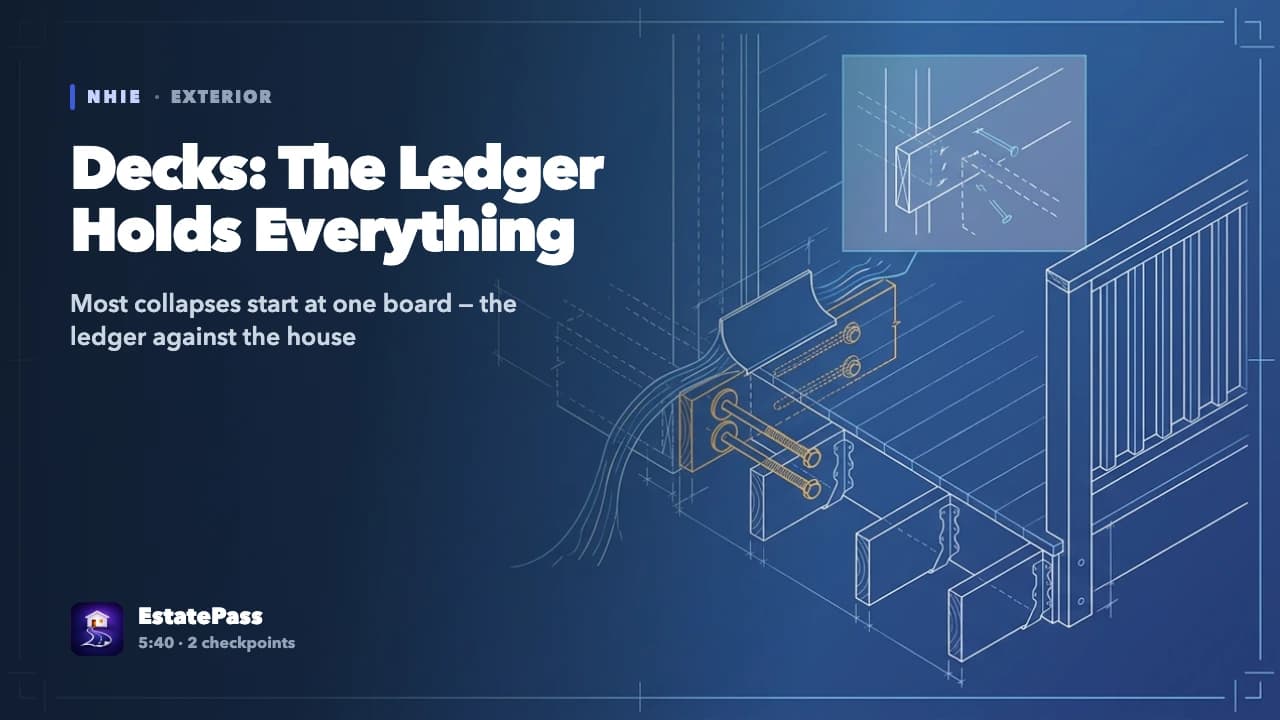
The ledger is the deck's house-side beam. Failure mode one: nails instead of bolts — ledgers must be positively fastened (lag screws/through-bolts in a proper pattern into the rim); nailed ledgers withdraw under load and drop the deck. Failure mode two: missing ledger flashing — water runs down the wall, sits on the ledger, rots ledger and rim invisibly, and the 'well-bolted' connection fails in punk wood. Inspect: fastener type/pattern, flashing presence, probe the ledger and the siding above it, and look from below for water staining. (Prescriptive fastener tables are code-cycle territory — the finding is the principle: positive attachment plus flashing.)
- Nailed ledger = the collapse signature — report it hard
- No flashing = rot at the connection that matters most
- Probe wood, read stains, check from underneath
Guards, stairs, and rails
Elevated decks need guards — the stable residential benchmarks: 36-inch minimum height with openings that reject a 4-inch sphere; guards must resist lateral load, so grab and push them (loose posts notched over the rim and bolted through the notch are a known weak detail). Stairs inherit the geometry rules — risers ≤7¾, treads ≥10, uniformity within ⅜ — plus a graspable handrail at four or more risers (34–38 inches). Open risers and ladder-effect details get safety notes.
- Guards: 36 in min, 4-in sphere rule, solid under load
- Stairs: 7¾ / 10 / ⅜ uniformity; handrail at 4+ risers
- Shake the guardrail — attachment is the finding
Structure below
Footings and posts: posts should bear on footings above soil (buried untreated posts rot at grade), with positive post-to-beam connections (metal hardware, not toenails); look for post bases rusted through, beams over-spanned or over-notched, joists with proper hangers (all nail holes filled, correct hanger nails — not deck screws), and hardware corrosion, especially with the older CCA-replacement preservatives that eat standard fasteners. Wobble tests and sighting for sag complete it.
Worked example
A 9-foot-high deck: the ledger is attached with nails only, no flashing visible, and the siding above shows staining; a guard post moves two inches under a firm push; joist hangers are fastened with drywall screws; the stairs measure risers of 7, 8¼, and 7½ inches in one flight. Prioritize the report.
Order by consequence. (1) The ledger: nails-only PLUS no flashing at 9 feet of fall height — the collapse recipe; report as a safety hazard requiring prompt evaluation/repair by a qualified contractor (positive fastening + flashing + assessment of concealed rot behind the staining). (2) The loose guard post at 9 feet: a fall-protection failure — safety item. (3) Drywall screws in hangers: brittle, not structural fasteners — hidden but real; hangers need proper nails. (4) The stairs: 8¼ exceeds 7¾ and the flight varies 1¼ inches against the ⅜ uniformity rule — trip machine; note handrail status too. Everything on this deck is a safety line, but the ledger leads because its failure kills groups, not individuals.
Common exam pitfalls
Judging the deck from its surface boards.
Decking is cosmetic; the ledger, hardware, and posts below are the structure — get under it.
Accepting screws as hanger fasteners.
Standard screws are brittle in shear — hangers take specified hanger nails; report substitutes.
Skipping the push test on guards.
Guard geometry means nothing if the post rotates — load them by hand and report movement.
Bolted and flashed at the house, guarded at the edge, uniform on the way down, footed at the ground.
Recap
- Ledger: positive fastening + flashing — the collapse-critical detail
- Probe for rot behind and below the ledger
- Guards: 36 in, 4-in sphere, load-resistant attachment
- Stairs: ≤7¾ risers, ≥10 treads, ⅜ uniformity, handrail at 4+ risers
- Hangers with proper nails; posts on footings with hardware
- Prioritize findings by failure consequence
VIDEO LESSON
Watch this lesson on video — free
Prove it: 10 questions on this topic
Every lesson ends with a ten-question check in the free course — your progress syncs between the web and the EstatePass app.