
Adjustment Sequence & Mechanics
~13 min read · Adjust the comp toward the subject, in the required order, watching net/gross ratios.
Adjustment mechanics are pure procedure: adjust the comp toward the subject (CBS — comp better, subtract), run the adjustments in the prescribed sequence, and audit reliability with net and gross percentages. Procedure is exactly what the exam can test — so it does.
Direction and target
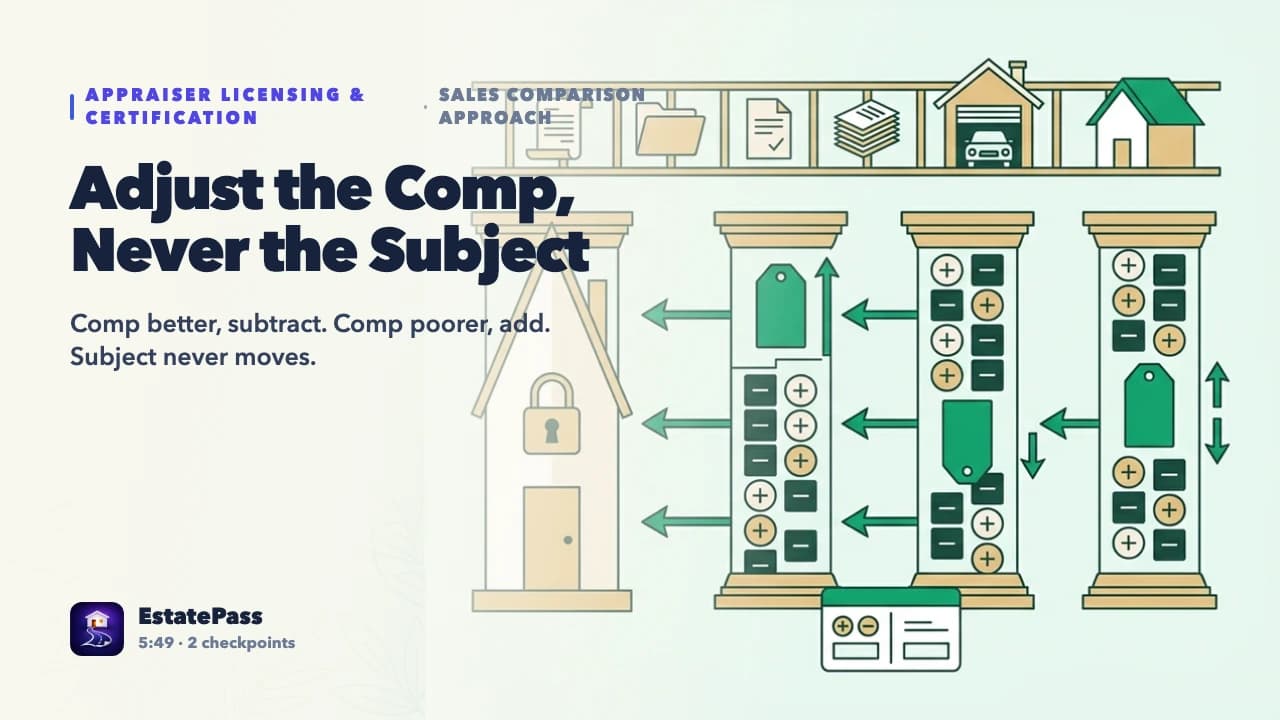
All adjustments modify the comparable's price — the subject has no price to adjust. Direction: comp superior → subtract the superiority's value; comp inferior → add. The logic: strip the comp's advantages (they inflated its price) and compensate its deficits, until its adjusted price says what the SUBJECT should bring. Dollar adjustments come from paired data; percentage adjustments apply to the price as sequenced.
- Adjust comps only, toward the subject
- CBS: Comp Better Subtract; CPA: Comp Poorer Add
- Amounts from paired-data contribution, not cost
The sequence
Standard order — because each adjustment re-bases the next: (1) property rights conveyed, (2) financing terms (cash-equivalency of favorable financing), (3) conditions of sale (atypical motivation), (4) expenditures immediately after sale, (5) market conditions (time) — these transactional adjustments often run as percentages sequentially — then (6) location and (7) physical characteristics (site, view, quality, age, condition, GLA, garages, amenities), commonly in dollars on the time-adjusted price.
- Rights → financing → conditions → expenditures → time → location → physical
- Transactional adjustments first, sequentially
- Physical dollars apply to the time-adjusted base
Net, gross, and reliability
Net adjustment = algebraic sum (signs count); gross adjustment = sum of absolute values. Their percentages of the comp's sale price gauge similarity — guideline conventions (net ~15%, gross ~25%, line ~10%) are underwriting norms, not USPAP law, but big gross percentages mean the comp barely resembles the subject. Reconciliation weights the comps with the smallest gross adjustments and best data. Consistency check: the same feature difference gets the same dollar treatment across the grid.
Worked example
Comp sold at $500,000. Adjustments: seller paid $10,000 in atypical concessions (financing/concession item); market up 2% since its contract (time); its location is superior by $15,000; the subject has a $12,000-value garage the comp lacks; the comp's condition is superior by $8,000. Run the grid in order and compute net and gross percentages.
(1) Concessions: −10,000 → 490,000. (2) Time on the concession-corrected price: +2% × 490,000 = +9,800 → 499,800. (3) Location, comp superior: −15,000 → 484,800. (4) Garage, comp inferior: +12,000 → 496,800. (5) Condition, comp superior: −8,000 → $488,800 adjusted price. Net = −10,000 + 9,800 − 15,000 + 12,000 − 8,000 = −11,200 → net 2.2% of 500,000. Gross = 10,000 + 9,800 + 15,000 + 12,000 + 8,000 = 54,800 → 11.0% — comfortably similar by any convention. The sequenced base mattered: time ran on 490,000, not 500,000. Direction mattered five times. That is the whole skill.
Common exam pitfalls
Running time before concessions.
The sequence exists because each step re-bases the next — transactional order first, physical last.
Netting instead of grossing for reliability.
Net hides offsetting distortion — a +30,000/−28,000 grid nets 2,000 but grosses 58,000; gross tells the truth about similarity.
Flipping a direction under pressure.
Speak it every line: 'comp is better here, its price got help, subtract.'
Strip what helped it, pay what hurt it, in order — then let gross percentage confess how comparable it really was.
Recap
- Adjust comps toward the subject; CBS/CPA directions
- Sequence: rights, financing, conditions, expenditures, time, location, physical
- Percentages sequentially on the running base; dollars on time-adjusted price
- Net = signed sum; gross = absolute sum
- Gross percentage gauges similarity; smallest-gross comps weigh most
- Same difference, same dollars, every line
VIDEO LESSON
Watch this lesson on video — free
Prove it: 10 questions on this topic
Every lesson ends with a ten-question check in the free course — your progress syncs between the web and the EstatePass app.