
Physical Deterioration
~12 min read · Split curable from incurable, short-lived from long-lived, and cost each correctly.
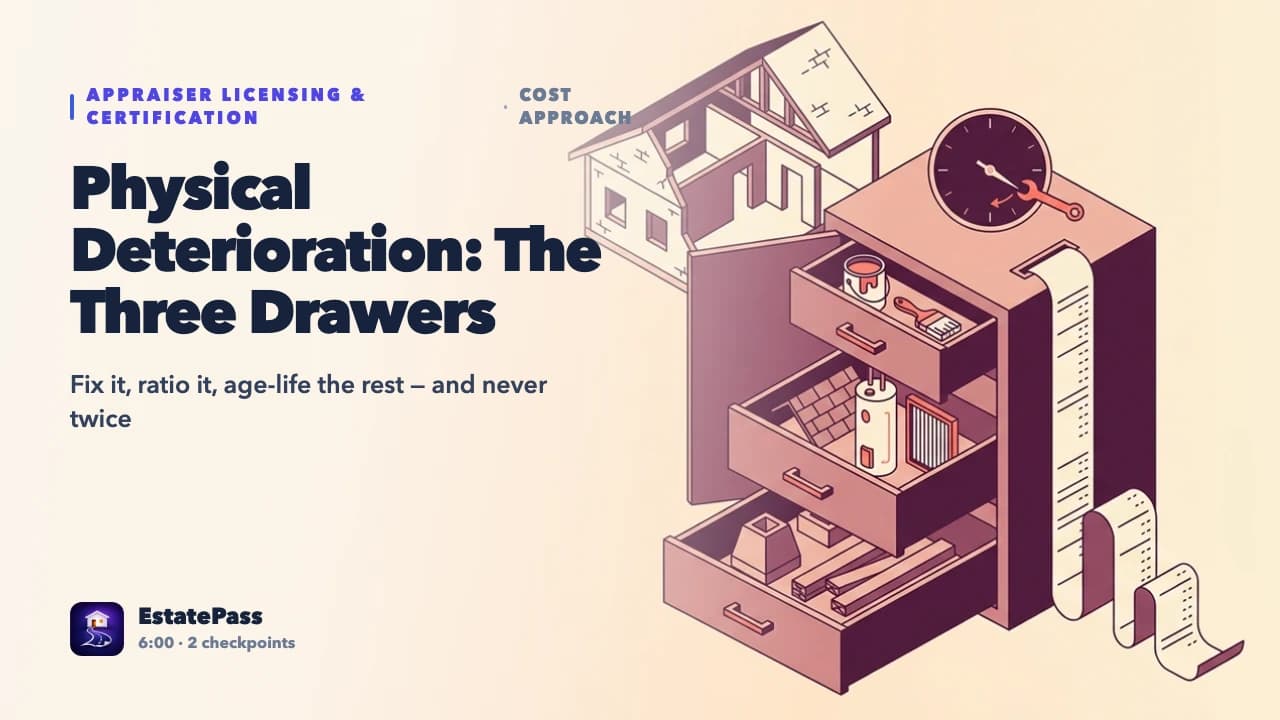
Physical deterioration is wear-and-tear accounting with three drawers: curable items (fix now, cost to cure), incurable short-lived components (age-ratio their replacement cost), and incurable long-lived structure (age-life the rest). The exam tests the sorting and the arithmetic.
Curable physical
Curable deterioration is economically sensible to fix NOW: cost to cure ≤ value added. Deferred maintenance is the category — peeling paint, broken windows, the leaking faucet. Measure: cost to cure. In the workflow it is deducted first, and the components cured are excluded from further depreciation math (you can't depreciate what you just restored).
- Test: cure cost ≤ value gained
- Deferred maintenance = the classic contents
- Measured at cost to cure; deducted first
Incurable short-lived
Short-lived components wear out before the building does — roof cover, water heater, HVAC, flooring, appliances. 'Incurable' here means not economical to replace TODAY (still functioning), but partially used up. Measure each: (effective age ÷ total life) × replacement cost of the component. A 15-year roof at age 9: 60% of its replacement cost is gone. Sum the component depreciations.
- Components with lives shorter than the structure's
- Each: age/life ratio × component cost
- Working-but-worn is the drawer's definition
Incurable long-lived
The long-lived bone structure — foundation, framing, main systems' cores — depreciates via the age-life (economic age-life) method on the REMAINDER: (effective age ÷ total economic life) × (cost new − curable items − short-lived components' cost). Using the remainder prevents double-counting components already depreciated in their own drawers. Effective age (condition-based), not chronological age, drives the ratio; renovation resets it downward.
Worked example
Cost new $500,000. Deferred maintenance (paint, gutter repairs): $8,000 to cure. Short-lived components: roof (replacement $24,000, life 20, effective age 10) and HVAC (replacement $16,000, life 15, effective age 12). Long-lived: effective age 15, total economic life 60. Compute total physical deterioration.
Curable: $8,000. Short-lived: roof 10/20 × 24,000 = $12,000; HVAC 12/15 × 16,000 = $12,800 → $24,800. Long-lived basis: 500,000 − 8,000 (cured) − 40,000 (both components' FULL replacement costs, removed so they aren't depreciated twice) = $452,000; ratio 15/60 = 25% → $113,000. Total physical deterioration = 8,000 + 24,800 + 113,000 = $145,800. The two tested moves: each drawer measured its own way, and the long-lived base EXCLUDED what the other drawers already handled.
Common exam pitfalls
Age-lifing the whole cost new.
The long-lived ratio applies to cost new MINUS cured items and short-lived component costs — the remainder only.
Depreciating cured items.
Once the cure cost is deducted, those components are new — they exit the depreciation math.
Using chronological age in the ratios.
Effective age — condition-driven, renovation-reset — is the numerator throughout.
Fix it, ratio it, age-life the rest — and never let one nail depreciate twice.
Recap
- Curable: cost to cure, deducted first
- Short-lived incurable: age/life × component replacement cost, each
- Long-lived incurable: age-life ratio on the remainder
- Remainder excludes cured and short-lived costs
- Effective age drives every ratio
- Sum the three drawers for total physical deterioration
VIDEO LESSON
Watch this lesson on video — free
Prove it: 10 questions on this topic
Every lesson ends with a ten-question check in the free course — your progress syncs between the web and the EstatePass app.