
Functional Obsolescence
~12 min read · Work superadequacy and deficiency problems, including cost-to-cure logic.
Functional obsolescence is the building arguing with the market: deficiencies the design lacks, superadequacies it over-delivers. The exam tests the curable test (value added vs cost to cure) and the deficiency/superadequacy procedures — including why excess cost does not equal excess value.
The two species
A deficiency is something the market expects that the property lacks or does badly: one bathroom in a four-bedroom house, no closets, a chopped floor plan, 7-foot ceilings. A superadequacy is over-provision the market won't pay for: the $60,000 commercial kitchen in a starter home, oversized structural members, the indoor pool in a modest tract. Both are FUNCTIONAL — flaws of design relative to market standards, distinct from wear (physical) and from outside forces (external).
- Deficiency: missing or substandard versus market expectations
- Superadequacy: over-built beyond what the market rewards
- Design-vs-market problems, not wear problems
Curable or incurable
The universal test: curable if the cost to cure ≤ the value added by curing. A missing second bath costing $30,000 to add that returns $45,000: curable. A poor floor plan needing $150,000 of structural surgery returning $60,000: incurable. Superadequacies are usually incurable (you can't un-build the pool economically) — their penalty runs through excess costs, not removal.
- Cure ≤ value added → curable
- Measure curable items by cost to cure (plus any excess-cost premium)
- Most superadequacies: incurable by economics
Measurement procedures
Curable deficiency (an addition the design should have had): cost to cure — with the classic refinement that the deduction is the excess of curing now over having built it new (retrofit premium). Incurable deficiency: capitalize or extract the value loss (paired sales: plan-flawed vs normal homes; rent loss capitalized for income property). Incurable superadequacy on a REPRODUCTION basis: the reproduction cost includes the item, so deduct its excess cost less already-charged physical depreciation, plus any added ownership burden (heating the pool); on a REPLACEMENT basis the excess construction never entered cost, so only the ownership-burden piece remains.
Worked example
A reproduction-basis appraisal of a home with (a) no half-bath where the market demands one — adding now costs $18,000; had it been built originally it would have cost $12,000; paired sales show half-baths contribute $20,000; and (b) an indoor pool: reproduction cost $80,000, physical depreciation already charged on it $20,000, contribution to value per paired sales just $15,000. Compute both functional deductions.
(a) Deficiency, curable? Cure $18,000 ≤ value added $20,000 → curable. Deduction: the retrofit premium — curing now ($18,000) versus building it new ($12,000) = $6,000 of functional obsolescence (the $12,000 'should-have-been' cost isn't obsolescence; the design's penalty is the extra $6,000). (b) Superadequacy, incurable: reproduction cost included the pool at $80,000; physical depreciation already took $20,000, leaving $60,000 of undepreciated cost in the number — but the market pays only $15,000 → deduct $45,000 (60,000 − 15,000) as functional obsolescence (plus capitalized operating burden if analyzed). Replacement basis would have skipped the pool's excess entirely. Excess cost is not excess value — that sentence is the whole lesson.
Common exam pitfalls
Deducting the full retrofit cost for a curable deficiency.
The obsolescence is the EXCESS of curing now over building it originally — the base cost belongs in cost new.
Valuing superadequacies at cost.
Contribution rules: deduct undepreciated excess cost down to what the market actually pays.
Double-counting under a replacement basis.
Replacement cost never built the superadequacy — deducting its excess again subtracts a cost that isn't there.
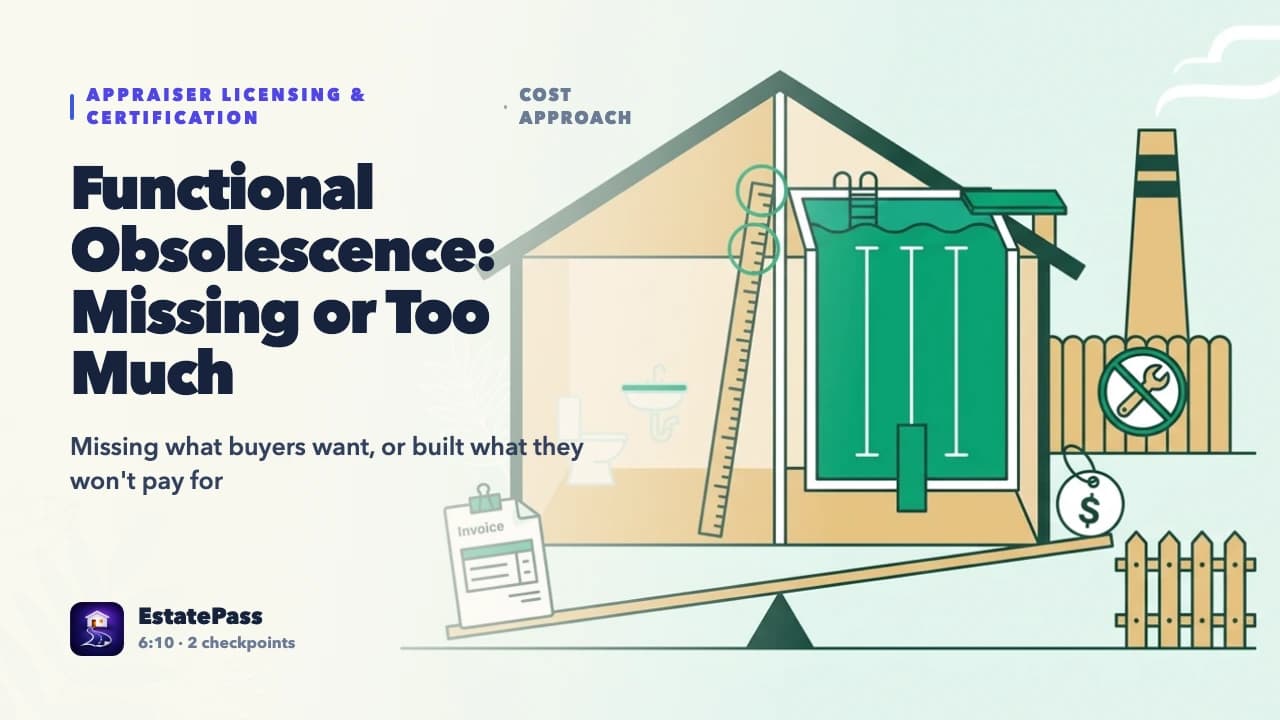
Missing what buyers want, or built what they won't pay for — cure it if it pays, and never confuse the invoice with the value.
Recap
- Deficiency vs superadequacy — both market-vs-design failures
- Curable test: cost to cure ≤ value added
- Curable deficiency: retrofit premium over as-built cost
- Incurable deficiency: capitalized or paired-sales value loss
- Superadequacy (reproduction basis): undepreciated excess cost minus contribution
- Replacement basis pre-excludes superadequacy construction
VIDEO LESSON
Watch this lesson on video — free
Prove it: 10 questions on this topic
Every lesson ends with a ten-question check in the free course — your progress syncs between the web and the EstatePass app.