
Move the background check without confusing it for the exam.
What is the latest CBC step you can see?
Choose a focus to see the next checks and relevant sources. This tool does not determine eligibility, compliance or authority to work.
Where the background check sits
A fingerprint-based criminal background check is part of the individual record in NMLS for state licensing and, on a different filing, for federal registration. It is not the SAFE exam, not pre-licensing education, and not the company’s sponsorship request. People often meet it late, after they have been studying or after an employer asks for the MU4 to move. The check can also be underway while education and testing are still unfinished. The order on a particular file is the order NMLS and the employer show you. This page is the fingerprint step only.
NMLS’s Completing the Criminal Background Check Process page, checked November 4, 2026, describes the state individual MU4. It says the CBC is a required component of individual licensing in NMLS, that applicants authorize the check in NMLS, and that fingerprinting is scheduled through Fieldprint. It also says successful completion of the CBC is required before a license can be approved. Completion is a prerequisite the page names. It is not itself the approval. Sponsorship, testing, education, and the state agency’s review remain separate. Read company sponsorship and Temporary Authority for those steps instead of repeating them here.
Federal registration uses a different help page and a different form, the MU4R. The steps below label which page a rule came from so a state applicant does not treat a federal fee table as the only number, and a federal registrant does not ignore the MU4R instructions.
Authorize, then capture or reuse prints
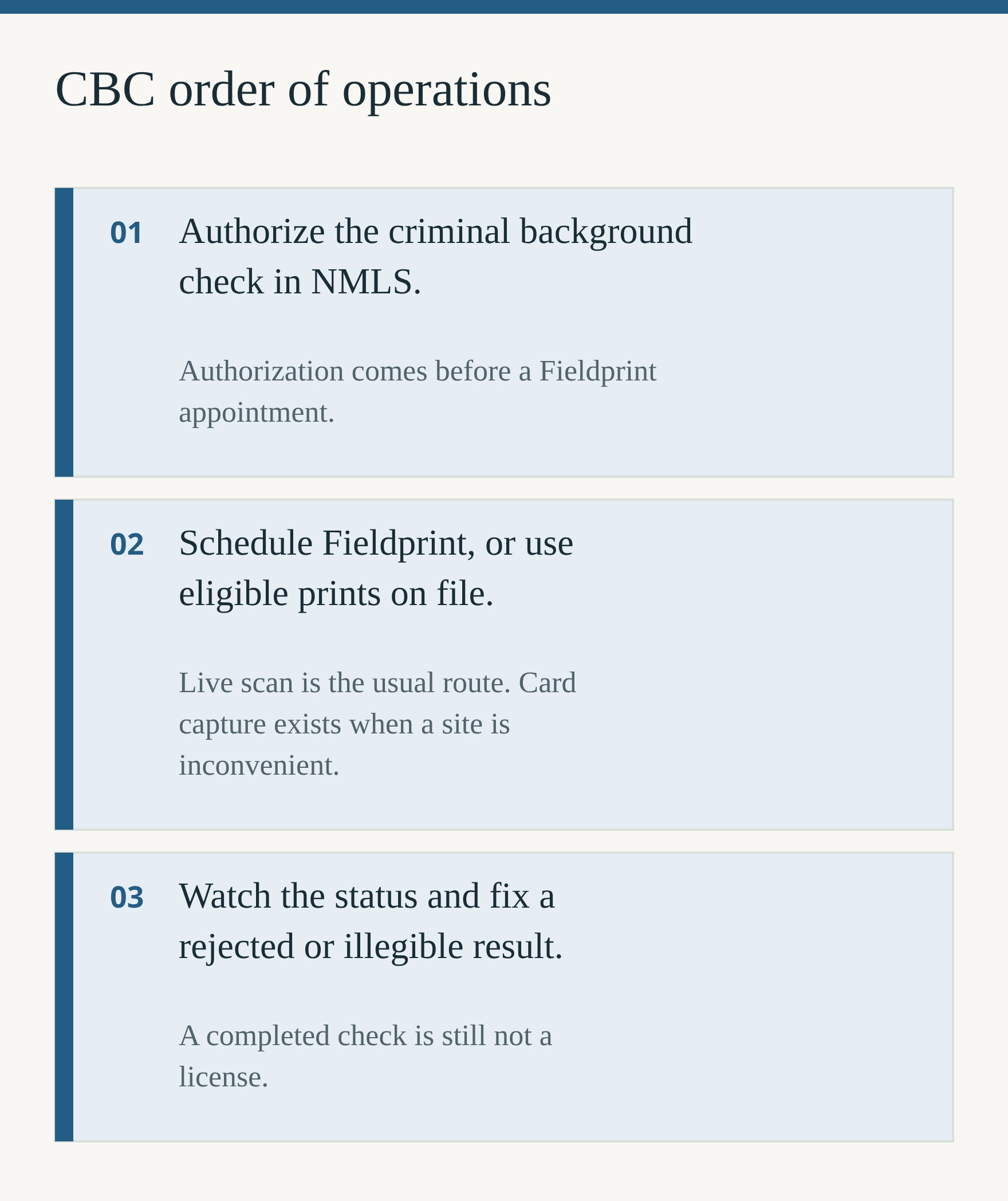
Authorize and pay in NMLS
The state page says applicants must authorize a CBC in NMLS and schedule fingerprinting through Fieldprint. The federal registration CBC page, also checked November 4, 2026, is explicit about sequence: a CBC authorization is completed before a fingerprint appointment is scheduled, and the appointment can be scheduled once the individual or employer has paid for the request. On the federal side, either the individual or the institution may submit the MU4R. Ask the employer who is filing before you assume the button is yours.
Do not schedule Fieldprint first and hope the authorization catches up. If the system will not offer an appointment, the usual reason is that the authorization and payment step is not finished.
New prints through Fieldprint, or prints already on file
Fieldprint is the fingerprint vendor NMLS describes. The federal page says NMLS uses a nationwide network of live-scan and card sites administered by Fieldprint. After the demographic information, authorization, and payment, the MLO is directed to Fieldprint to schedule one of the live-scan locations. If none of those sites is practical, a card can be taken at a local police department on cards Fieldprint provides and mailed back for scanning. That card path is an official alternative for inconvenient geography, not a different background check.
The same page says an individual who has held a state license or federal registration in the past year may already have prints on file, and that “use existing prints” can be chosen on the MU4R when it is offered. It also says that option appears only if the records on file are less than three years old. If the prints are more than three years old, FBI rules as described there require new fingerprints for a new CBC.
The state MU4 page states the reuse rule in its own words: if fingerprints were submitted for another NMLS-related process within the past three years and there has been no break in licensure or registration, the system may reuse those prints. Otherwise new fingerprints are required. “May” and “no break in licensure or registration” are part of that sentence. Do not assume a print from three years ago is eligible, and do not assume a print from last year is eligible if the filing does not offer reuse. Use the control NMLS shows.
Institutions with very large MLO populations can ask Fieldprint about a direct connection. The federal page limits that arrangement, including a minimum of 1,500 MLOs registered in NMLS. An individual applicant does not set that up. You use Fieldprint or the existing-print choice on your filing.
Status, illegible prints, and what you do next
The federal page’s status chart is the clearest official list we could read on November 4, 2026. Pending Fingerprint means you still need to schedule Fieldprint. Processing Fingerprints means prints were taken and the check is underway, with no action from you. Processing Name Check means a name-check method is underway, again with no action from you. The page says results are usually reported within 48 hours, and that a name check can take up to 90 days. Expired means a new CBC has to be authorized if a CBC is still required, including when prints were not taken within 180 days. The chart notes that an expired status does not by itself prove new prints are required; it tells you to ask the employer whether a new CBC is required. Closed with reason “illegible” means a new CBC must be authorized to schedule again, and the chart says payment is not required for that authorization. Closed with reason “received” means the process is complete.
State filings may label status differently. Read the status on your own record and the help topic NMLS links from it. A completed receipt is still not a license.
The 180-day window and the three-year reuse clock
These are different timers. Mixing them up is how people either wait too long to be printed or demand new prints the filing is not asking for.
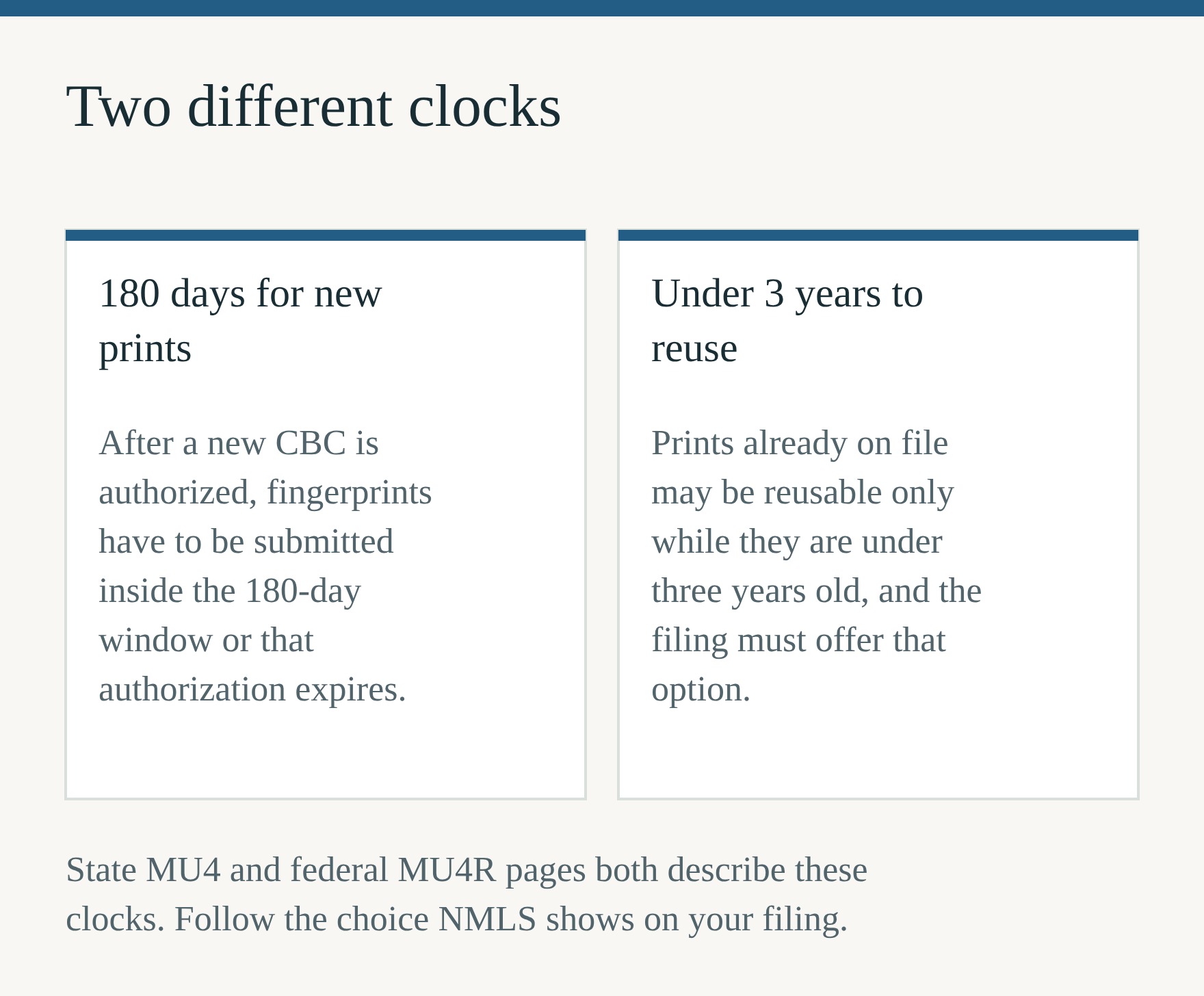
The state page says CBC authorization is valid for 180 days and that fingerprints must be submitted within that period. The federal page says that after you authorize a new CBC and choose to submit new fingerprints, the fingerprints must be taken within 180 days. If they are not, the background-check window expires and a new CBC must be authorized and the fees paid. Schedule promptly after authorization. Do not treat 180 days as a study calendar.
Reuse is the other clock. Federal language: existing prints can be used only when they are less than three years old, and prints older than three years mean new fingerprinting. State language: reuse may be available when prints were submitted for another NMLS process within the past three years and there has been no break in licensure or registration. If you are unsure which sentence applies, open the filing. The button you are offered is the operative rule.
The federal help page also publishes a fee summary for that registration path: a live-scan CBC processing fee of $36.25, and, if a paper card is used instead, that $36.25 plus a $10 card-packet fee, $46.25 total. Payments collected through NMLS are described there as non-refundable and non-transferable. Those amounts are the figures on the federal page checked November 4, 2026, not a number invented for this article and not a promise that every state MU4 screen shows the same line items. The amount to rely on is the amount NMLS displays when you authorize your CBC. This page does not add a state-by-state fee chart.
The NMLS Policy Guidebook PDF for licensees did not load during this check, so this article does not quote it. The two help pages above are the sources for the clocks and the Fieldprint steps.
What the background check is not
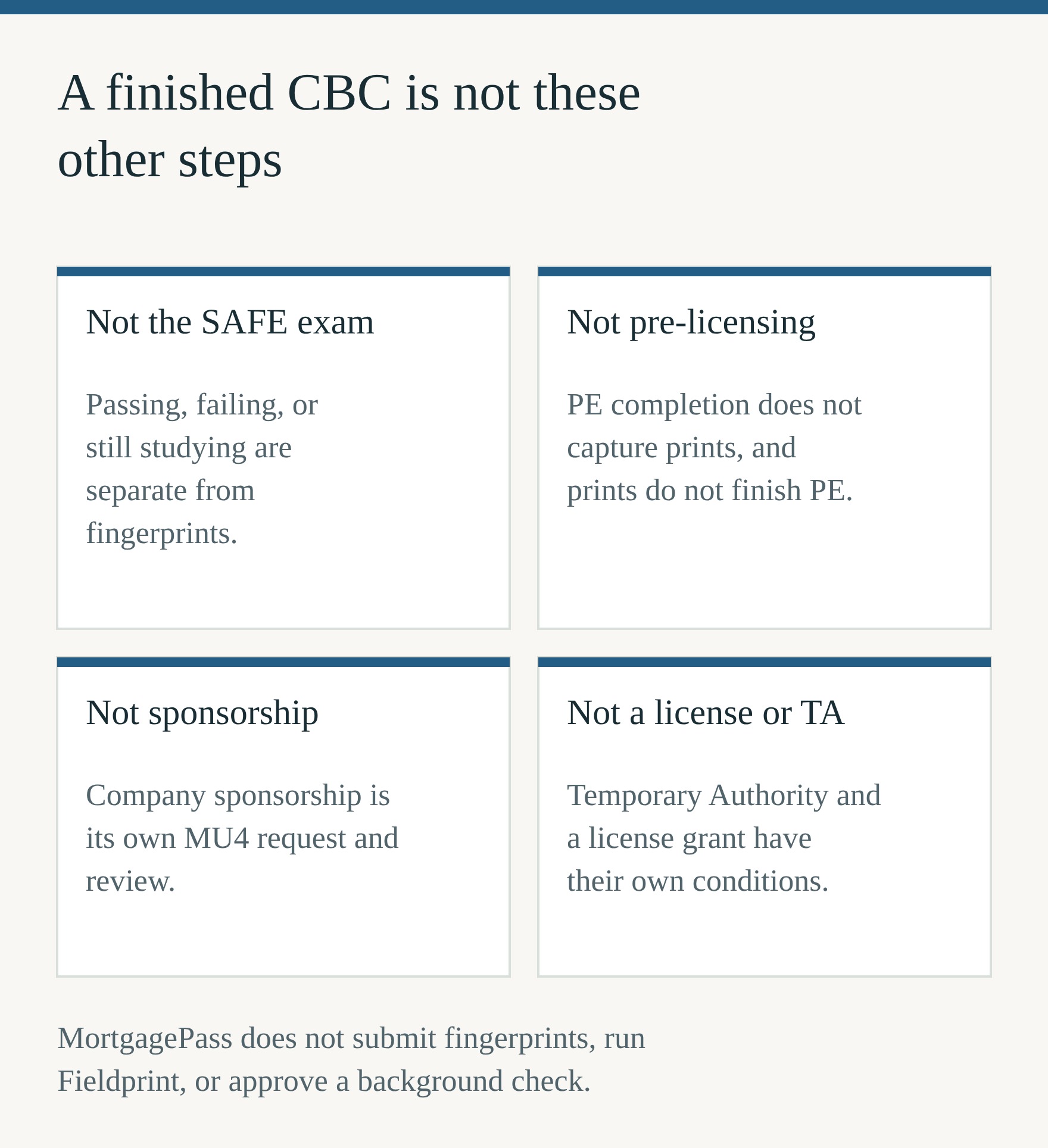
A finished CBC does not mean you passed the SAFE exam. It does not mean you finished pre-licensing. It does not create company sponsorship, and sponsorship does not capture your fingerprints. It does not grant Temporary Authority, and it does not issue a state license or a federal registration by itself. The state page’s statement that the check must be complete before a license can be approved is a sequencing rule, not a prediction that approval will follow.
If you are still deciding whether you are on a registered or a state-licensed path, use registered vs state-licensed before you treat one CBC article as both processes. Temporary Authority has its own eligibility conditions; the fingerprint step can be one ingredient and still not be the whole test. Sponsorship has its own request and a regulator’s response. Keep those guides next to this one rather than folding them into a single checklist with a yes/no at the bottom.
This page also does not interpret a criminal history record, predict whether a state will find you fit to be licensed, or tell you to disclose or withhold anything. Those questions belong to the MU4 instructions, the state agency, and a qualified advisor. MortgagePass will not review them.
Where MortgagePass fits
MortgagePass is practice for the SAFE MLO exam. It is not NMLS, not Fieldprint, and not an approved pre-licensing course. It cannot authorize a CBC, book a fingerprint appointment, reuse prints, or clear a background check. Use it only if you still need exam practice.
If you are still separating the 20-hour course from practice, read PE vs exam prep. For the exam itself, how hard the SAFE exam is and where the exam is delivered are the study pages. The MortgagePass page describes the product, and the mortgage hub collects the surrounding guides.
Authorize the CBC on the NMLS filing you actually have. Use Fieldprint or the existing-print option that filing offers. Watch the 180-day window if the prints are new. Then finish sponsorship and the state or federal steps that are still open. If the only remaining work is exam practice, that is the only part MortgagePass can help with.
Pause. Apply. Understand.
Make the next call.
Original learning scenarios. Choose an answer, then explore the reasoning. These are not official examination questions or a scored readiness assessment.
From reading to doing
Your next three moves.
A personal planning checklist. Tick off each step as you finish it; progress lasts until you leave or reload this page.
A little more clarity
Questions, answered.
What is an NMLS criminal background check?
It is the fingerprint-based check NMLS describes as a required part of individual licensing. Completing it is necessary before a license can be approved. Completion is not the approval itself.
What does Fieldprint do?
Fieldprint is the fingerprint vendor NMLS uses. After you authorize and pay, you schedule a live-scan appointment, or a card capture if a live-scan site is not practical.
How long do I have to submit new fingerprints?
The state help page says the authorization is valid for 180 days. The federal help page says new fingerprints must be taken within 180 days of authorizing a new check and choosing new prints, or the window expires and a new check must be authorized.
Can I reuse fingerprints already on file?
Only when NMLS offers that option. Federal instructions limit it to prints less than three years old. The state page also says there must have been no break in licensure or registration. Older prints mean a new capture.
Do I authorize the check before scheduling?
Yes. Both help pages put authorization, and payment where a fee is due, before the Fieldprint appointment.
What if my prints are illegible?
The federal status chart says a closed illegible result requires a new authorization so you can schedule again, and that payment is not required for that re-authorization. Follow the status on your own filing.
Is the background check the same as passing SAFE or getting sponsored?
No. The exam, pre-licensing, company sponsorship, Temporary Authority, and the license grant are separate steps. Fingerprints do not finish any of them.
Does MortgagePass handle fingerprints?
No. MortgagePass is SAFE exam practice. It is not NMLS, not Fieldprint, and not an approved pre-licensing course. It cannot authorize a background check or book an appointment.
Put your next step into focus.
Take what you have learned into your next study session. Use the linked practice and resources to decide where to focus.
Find your next stepEducational information and independent practice. Confirm current examination, education and licensing requirements with the linked official sources. Practice results do not guarantee an examination result or eligibility.