
Separate the required course from practice.
What have you confirmed with the DOI?
Choose a focus to see the next checks and relevant sources. This tool does not determine eligibility, compliance or authority to work.
Two different purchases
Insurance prelicensing and exam prep answer different questions. Prelicensing, where a state requires it, is an education or attendance step tied to a license. Someone finishes an approved course, receives whatever certificate that state uses, and meets a condition to sit for the exam or to be issued a license. The condition is not the same in every state. Exam prep is practice: timed questions, explanations, and a record of what you miss. It does not complete a prelicensing hour, and a prelicensing certificate does not show that you can apply the exam outline under a clock.
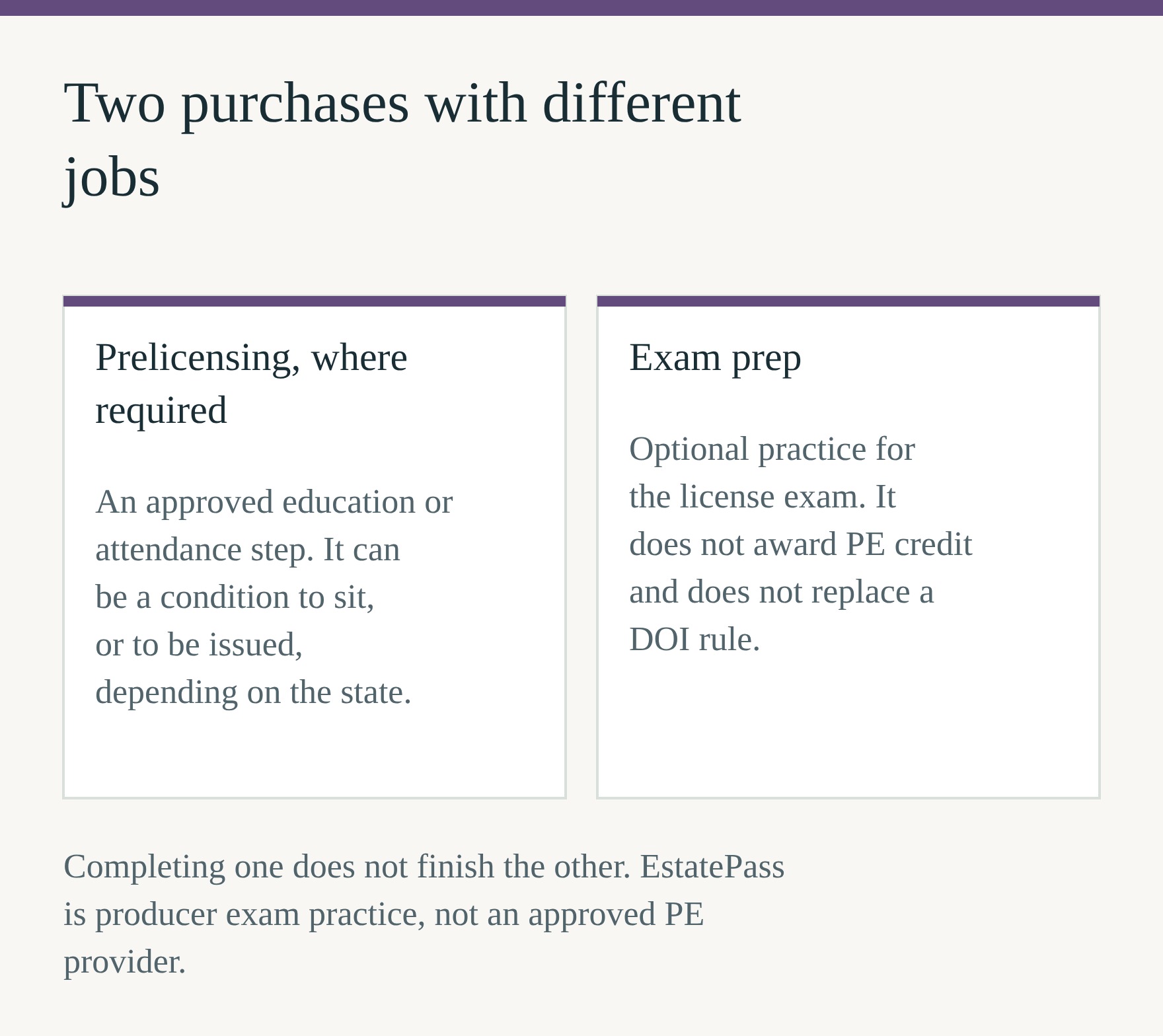
| Decision | Prelicensing, where required | Exam prep |
|---|---|---|
| Main job | Meet that state’s education or attendance rule | Practice the exam you still have to take |
| What to verify | Approved provider, required hours, and whether the certificate gates the exam or issuance | That the product matches your line and does not pretend to be PE |
| What completion proves | The education step that state describes | Where your reasoning or timing broke down |
| What it does not prove | That you will pass, or that every state uses the same hours | Education credit, a license, or a waiver |
Finishing PE is not mastery. A state with no PE requirement has not promised an easy exam. This page does not rank providers, and it does not turn a course quiz into an official result.
EstatePass insurance practice is producer exam practice for the lines it actually offers. It is not an approved prelicensing provider and not a department of insurance. It does not issue PE certificates.
How to check your state
Do not start with a national hour chart. Start with the license you are actually seeking.
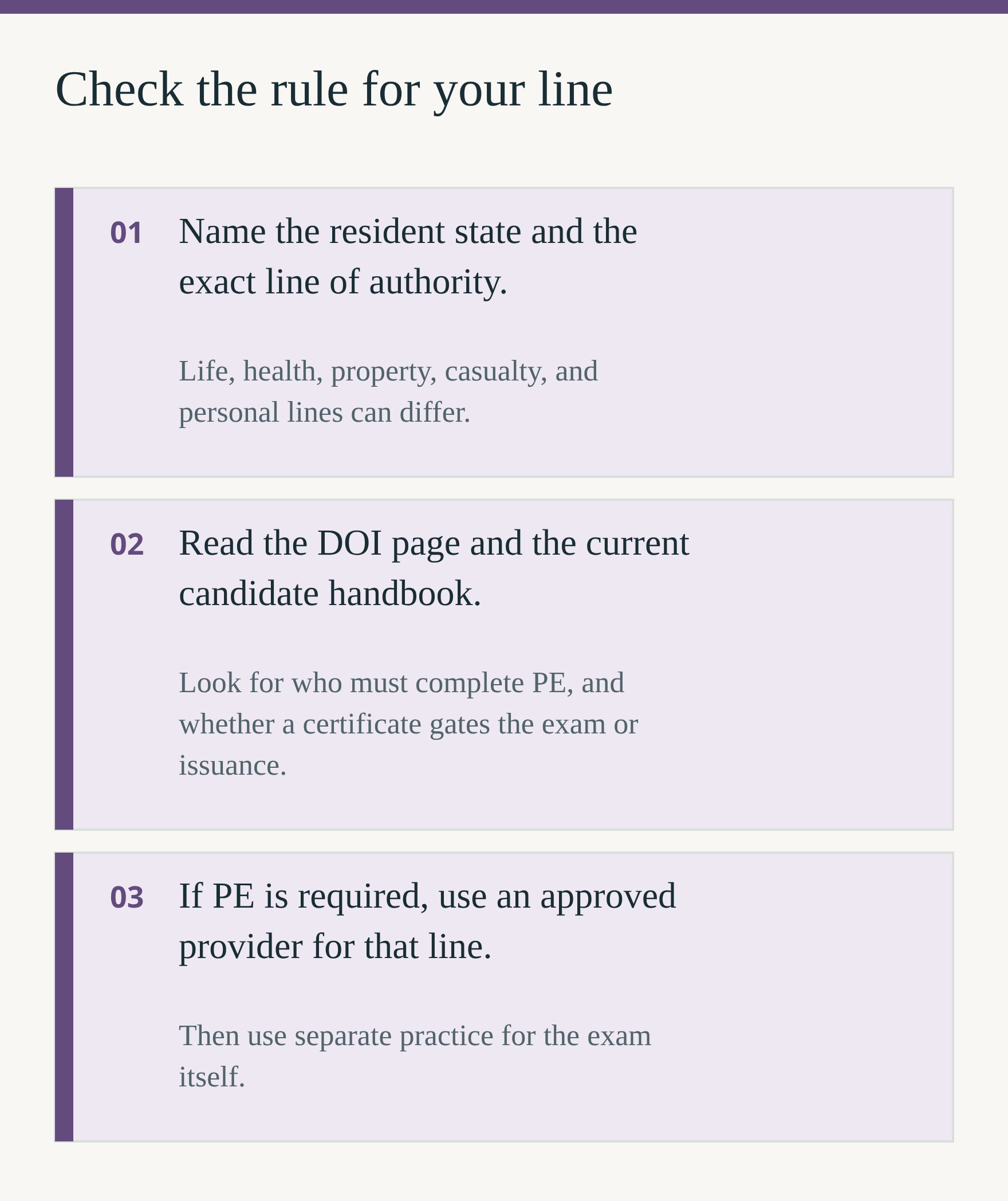
Name the resident state and the exact line of authority. Life, accident and health, property, casualty, personal lines, and a combined exam can carry different hour rules, and some license types on the same department site have no PE requirement at all. Then read the department of insurance page for prelicensing and the current candidate handbook. Look for three sentences: who must complete PE, how many hours, and whether you need the certificate in hand to be admitted to the exam or only before the license is issued. If a waiver exists, read the waiver form. A degree or a designation is a specific process, not a rumor that “experience counts.”
If PE is required, complete it with a provider that state approves for that line. Keep the certificate, the completion date, and any expiration the state prints on it. Use practice after that, or alongside it, to find gaps the course did not test. If PE is not required, skip the PE purchase and study the exam outline. Do not buy a prelicensing course in another state’s pattern “just in case,” and do not treat a practice app as the course your handbook requires.
Continuing education is a later question for people who already hold a license. A new applicant who is asking about hours before the first exam is usually asking about prelicensing, not CE. Confirm which word the DOI page uses.
Three official samples
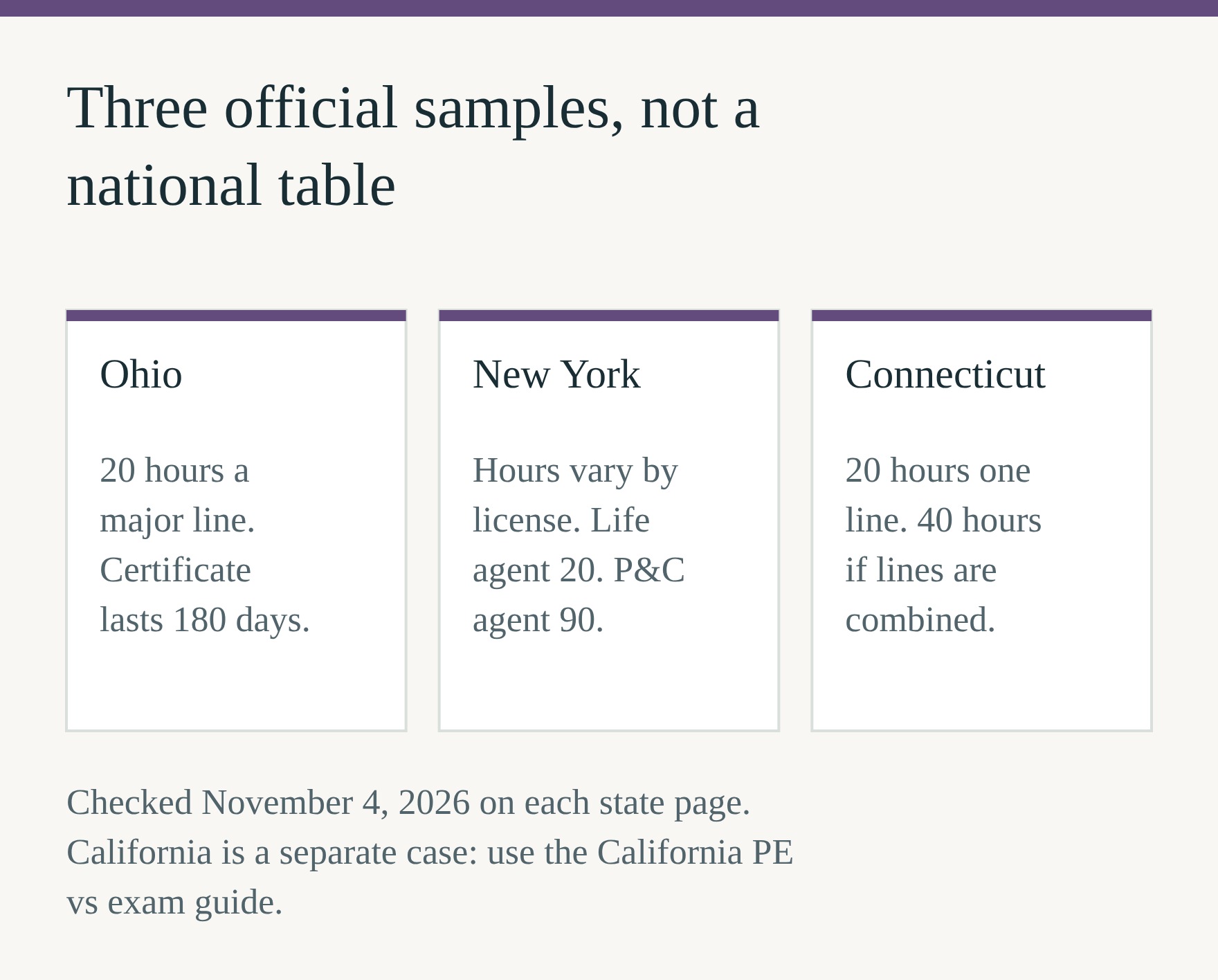
These are illustrations from pages checked November 4, 2026. They are not a fifty-state table, and they are not your result if your line or your residency differs.
Ohio, New York, and Connecticut
Ohio’s pre-licensing education page says resident applicants complete a 20-hour classroom, distance-learning, or self-study course from an Ohio-approved provider for Life, Accident and Health, Property, Casualty, Personal Lines, and Surety Bail Bond. The course-completion certificate is valid for 180 calendar days, and the corresponding exam must be completed in that window. Applicants are not admitted without the original, unaltered certificate. A combined exam needs two certificates, one for each line. Public insurance adjuster and title applicants are not required to complete that pre-license education. Ohio also describes an education waiver for certain degrees and designations, using its INS3276 process, with its own 180-day window. Read that waiver before you assume a diploma skips the course.
New York’s agent and broker prelicensing page says Insurance Law requires an approved prelicensing course for an individual seeking an agent, broker, or public adjuster license. The published minimums differ by license: Life, Accident and Health agent, 40 hours; Life agent only, 20; Accident and Health agent only, 20; Personal Lines agent, 40; Property/Casualty agent, 90; Property/Casualty broker, 90; Personal Lines broker, 40; Life, Accident and Health broker, 40; Life broker only, 20; Life Settlement broker, 20; Accident and Health broker only, 20; public adjusters, 40. Broker or public adjuster applicants may be exempt under the cited employer-experience statement, and listed designations can exempt an agent or broker applicant. PSI administers the New York exams. Use the DFS hour line that matches the license type, not a neighboring row.
Connecticut’s exam and pre-licensing article, dated April 6, 2026, says insurance producer and public adjuster licenses have a prelicensing requirement, and casualty adjuster, certified insurance consultant, MVPD appraiser, and surplus lines broker licenses do not. Each listed single line — Life, Accident and Health or Sickness, Property for producers, Casualty, and Personal Lines — is 20 hours. Life / Accident and Health or Sickness, and Property and Casualty, are 40 hours. Property for a public adjuster is 40 hours. The same article says Connecticut discontinued online exams on August 1, 2025, and that exams are taken at Pearson physical centers. That delivery note is a reason to read the handbook, not a full Connecticut exam guide.
California is a separate page
California is not one more row in that sample. The CDI FAQ on 12 hours of ethics and the California Insurance Code, checked November 4, 2026, says Assembly Bill 943 repeals the 20-hour producer prelicensing requirement effective January 1, 2026, for the producer lines named there. The same FAQ says the 12-hour ethics and California Insurance Code course is not required in order to schedule the exam, and that it is still required before the license can be issued. Bail agents and public insurance adjusters keep a 20-hour prelicensing course. Do not rebuild that article here. Use California insurance PE vs exam prep for the Ethics and CIC sequencing, and use this page for the national distinction.
Required spend versus optional practice
Make two lists. On the first, put only what the DOI says you must finish: an approved course, a certificate, a waiver application, or nothing. On the second, put optional practice you will use to prepare for the outline. Pay the first list because the handbook requires it. Pay the second only if you want structured practice and the product covers your line.
A school bundle can put a PE course and a question bank behind one login. The shared login does not make them one product. Ask which piece is approved education and which piece is practice. If you are in a state that does not require PE for your line, the education half of a bundle is not a requirement you must buy.
Adjusting is a different license path. If the job is claims work, use producer vs adjuster and the DOI’s adjuster instructions. EstatePass does not prepare adjuster exams. If you are choosing among producer lines, use which insurance license first. Difficulty and a missed attempt belong in how hard the insurance exam is and the failed-exam guide. The same PE-versus-practice split shows up in mortgage prelicensing vs exam prep and real estate prelicensing vs exam prep. Those professions have their own hour rules. Do not copy an insurance sample onto a mortgage or real estate application.
A week-of-purchase check
Before you pay anyone, save the DOI page you relied on and the date you read it. Write the license name exactly as that page prints it, the hour figure if there is one, and whether the certificate is required to book the exam or only to be issued. If the page describes a waiver, save that form too and do not mark the course “done” until the waiver is actually granted. If two lines are combined, note whether you need one course or two certificates. Ohio’s combined-exam rule is an example of why that note matters, not a rule to export.
Then decide the practice separately. Look at the exam content outline in the candidate handbook and compare it with what the course actually drills. A shortfall is a reason to practice, not evidence the course was worthless and not evidence you are ready. Keep course scores and practice scores in different notes so a high course quiz cannot be mistaken for a licensing result.
If you are helping someone else choose, ask which state will be the resident license and which line the employer named. A multi-state move does not average the hour rules. The new resident state is the one to read. Nonresident licensing is often a different application, and this page does not turn a resident PE example into a nonresident exemption.
Where EstatePass fits
After the DOI rule for your line is clear, EstatePass is a place to practice producer exams it offers. It is not the approved PE course, it does not file your application, and it is not the department of insurance. The insurance license hub is the index of those guides. A practice result is feedback. It is not a promise that you will pass, and it is not a substitute for the certificate your state still requires.
Verify the hours on the official page for your state and line. Complete approved prelicensing if that page requires it. Then practice the exam. If you are a California producer applicant, leave this overview and use the California guide for the 12-hour course.
Pause. Apply. Understand.
Make the next call.
Original learning scenarios. Choose an answer, then explore the reasoning. These are not official examination questions or a scored readiness assessment.
From reading to doing
Your next three moves.
A personal planning checklist. Tick off each step as you finish it; progress lasts until you leave or reload this page.
A little more clarity
Questions, answered.
What is the difference between insurance prelicensing and exam prep?
Prelicensing, where a state requires it, meets an education or attendance rule. Exam prep is optional practice for the exam. One can be required when the other is not, and neither one is a license.
Do I need prelicensing before I can take the exam?
It depends on the state and the line. Some rules require a certificate before you are admitted. California’s 12-hour ethics course is required before license issuance, not before you schedule the exam. Read the DOI page for your line.
Is prelicensing enough to pass?
No. A completed course shows that the education step was finished. It does not measure whether you can apply the exam outline under timed conditions, A course quiz is not an official result.
What if my state does not require PE?
Then do not buy a prelicensing course to satisfy a rule you do not have. Study the candidate handbook and use practice if it helps. The absence of a course requirement is not evidence the exam is easy.
How do I verify the hours?
Use the resident-state department of insurance page and the current candidate handbook for the exact line. The Ohio, New York, and Connecticut figures on this page are samples checked November 4, 2026, not a national chart.
What is different about California?
CDI’s FAQ says the 20-hour producer prelicensing requirement is repealed effective January 1, 2026, while the 12-hour Ethics and California Insurance Code course remains required before issuance. Use the California PE vs exam guide for that sequencing.
Does this apply to adjusters?
Not as a producer shortcut. Producer and adjuster paths differ, and some states require adjuster prelicensing while others do not. Use the producer-versus-adjuster guide and the DOI’s adjuster instructions.
Is EstatePass an approved prelicensing provider?
No. EstatePass insurance practice is producer exam practice. It is not an approved prelicensing provider, not a department of insurance, and not a source of PE credit.
Put your next step into focus.
Take what you have learned into your next study session. Use the linked practice and resources to decide where to focus.
Find your next stepEducational information and independent practice. Confirm current examination, education and licensing requirements with the linked official sources. Practice results do not guarantee an examination result or eligibility.