EstatePass

Right-of-Way & Pedestrians — Florida Practice Questions

29 questions in this content area. 6 are published in full below with worked explanations.

3. When may oncoming traffic pass a stopped school bus in Florida?

  • AWhen the road has four lanes separated by a double yellow line.
  • BWhenever no children are visible near the bus or the roadside.
  • When a raised barrier or 5-foot unpaved median divides the road.

Why C is correct

You do not have to stop when going the opposite direction on a highway divided by a raised barrier or an unpaved median at least five feet wide. Painted lines are not barriers.

5. You are pulling out of a driveway onto a road. Who must you yield to?

  • AOnly cars on the road.
  • Vehicles on the road, and pedestrians and cyclists on the sidewalk or in bike lanes.
  • CNo one, if you signal.

Why B is correct

Drivers entering from a driveway, alley or roadside yield to vehicles on the main road and to pedestrians and cyclists on the sidewalk or in bike lanes.

6. You stop at a red light. Where must your car be?

  • APartly in the crosswalk if you want to turn right.
  • BAnywhere, as long as you stopped.
  • Fully behind the crosswalk, not overhanging it.

Why C is correct

Never block the crosswalk at a red light. Do not stop with any part of your vehicle overhanging it.

23 more Right-of-way questions

Answers and explanations for these are in the study app.

  • A city bus has signaled and is pulling back into traffic from a bus pullout bay ahead of you. What must you do?
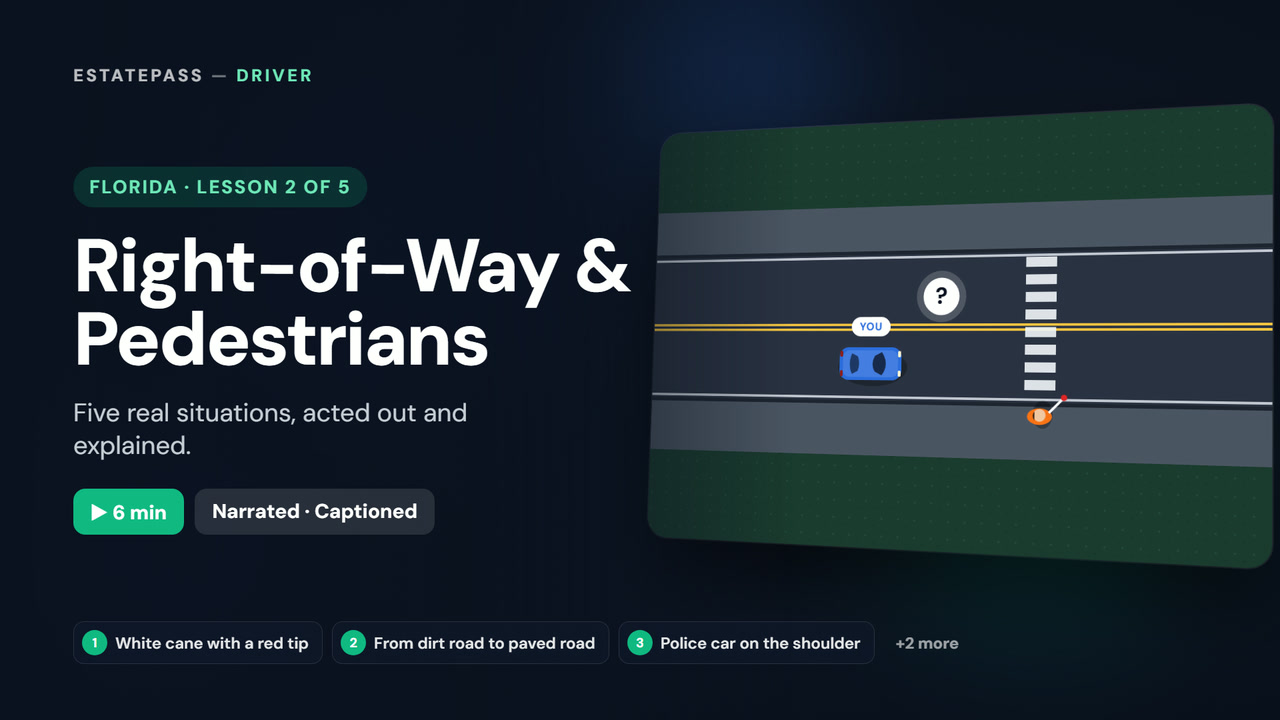
  • A pedestrian carrying a white cane with a red tip is about to cross. What must you do?
  • A pedestrian crosses mid-block, not in a crosswalk. Who must yield?
  • A pedestrian is crossing at a marked crosswalk ahead. What must you do?
  • A pedestrian is in the crosswalk while the signal shows DON’T WALK. Who must yield?
  • A transit bus has signaled and is re-entering traffic from a bus pullout bay. What must you do?
  • An ambulance with lights and siren approaches from behind. What must you do?
  • At a two-way stop, you and a car across from you stop at the same time. You are turning; they are going straight. Who goes first?
  • At an open intersection, a car is already in the intersection when you arrive. What must you do?
  • At an open intersection (no signs or signals), you are crossing a state highway from a secondary road. Who has the right-of-way?
  • At an open intersection, you are entering a paved road from an unpaved road. Who has the right-of-way?
  • At an open intersection you plan to turn left, and a car approaches from the opposite direction. Who yields?
  • Children and a crossing guard are in the crosswalk. Where must you stop?
  • Does Florida’s Move Over Law apply to a disabled car stopped with its hazard lights on?
  • How close may you follow a fire truck responding to an emergency?
  • On a two-lane road with a 45 mph limit, a police car is stopped on the shoulder with lights flashing. How fast may you pass?
  • The lead car of a funeral procession has entered an intersection on a green light, which then turns red. What may the rest of the procession do?
  • Two cars reach an all-way stop at about the same time. Who goes first?
  • What is the minimum fine for passing a stopped school bus on the side where children enter and exit?
  • You approach a roundabout and no one is in it. Must you stop?
  • You approach a stopped school bus from the opposite direction. The road is divided only by painted lines. Must you stop?
  • You are behind a school bus on a divided highway when it stops with its stop signal out. What do you do?
  • You are leaving a driveway and a person is walking on the sidewalk in front of it. What must you do?
Unlock all 29 questions