
California video lessons · Lesson 4 of 10
California Speed Limits and Parking: five situations explained
All five situations and their answers are below. To watch the lesson, create a free account.
In this video
- 0:00Intro
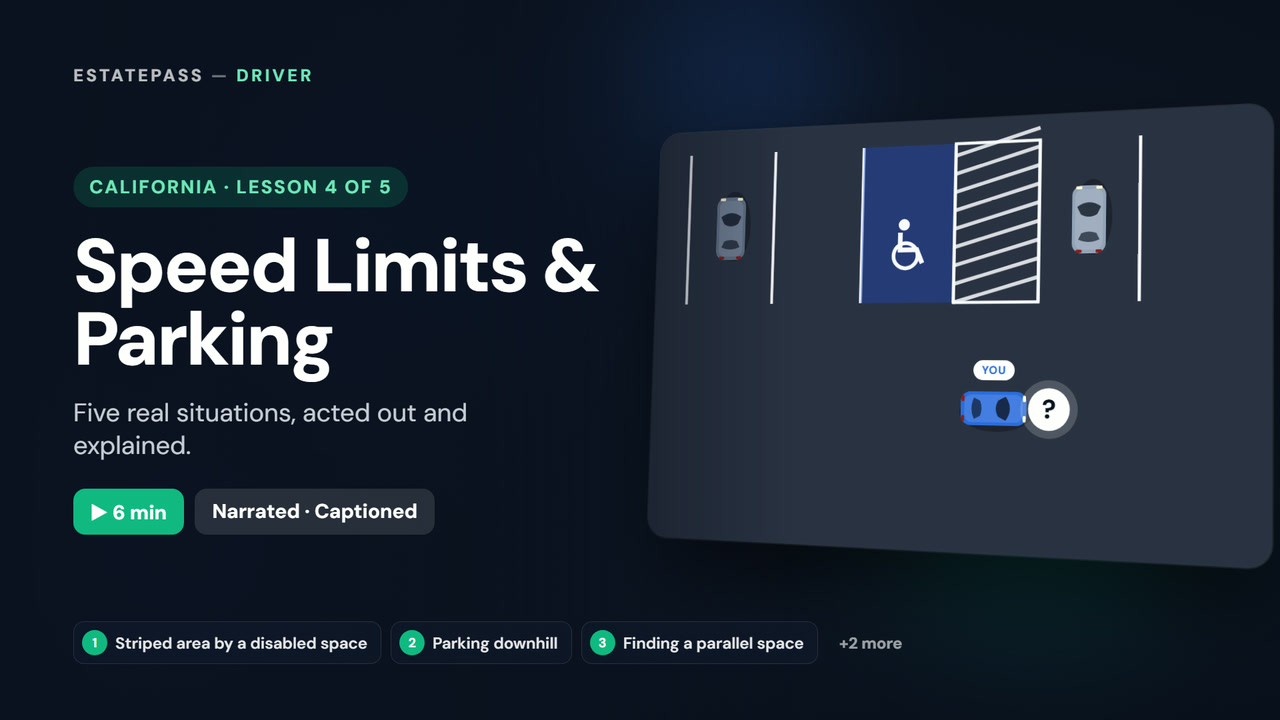
- 0:17The area next to a disabled parking space is painted with diagonal lines. May you park there?
- 1:14You park facing downhill next to a curb. Which way should you turn your front wheels?
- 2:06When looking for a space to parallel park, how long should it be?
- 2:58Who may park at a blue curb?
- 3:52What is the speed limit at a blind intersection?
- 4:46Recap
In short
Never park in the crosshatched area next to a designated disabled parking space; it is needed for wheelchair access. Headed downhill, turn your front wheels into the curb (toward the side of the road). Look for a space at least three feet longer than your vehicle, and signal that you plan to park.
The five situations
Pick an answer first, the way the video pauses for you. Each one cites the California Driver's Handbook.
Situation 1
The area next to a disabled parking space is painted with diagonal lines. May you park there?
Answer: C. No. Never park in the crosshatched area next to a designated disabled parking space; it is needed for wheelchair access.
California Driver's Handbook › Section 6 (cont.) › Parking › Illegal Parking
Situation 2
You park facing downhill next to a curb. Which way should you turn your front wheels?
Answer: A. Into the curb. Headed downhill, turn your front wheels into the curb (toward the side of the road).
California Driver's Handbook › Section 6 (cont.) › Parking › Parking on a Hill
Situation 3
When looking for a space to parallel park, how long should it be?
Answer: A. At least three feet longer than your car. Look for a space at least three feet longer than your vehicle, and signal that you plan to park.
California Driver's Handbook › Section 6 (cont.) › Parking › Parallel Parking
Situation 4
Who may park at a blue curb?
Answer: B. Drivers with a disabled placard or plate. Blue is for disabled persons or someone driving a disabled person, with a special placard or license plate.
California Driver's Handbook › Section 6 (cont.) › Parking › Parking at Colored Curbs
Situation 5
What is the speed limit at a blind intersection?
Answer: C. 15 mph. An intersection is blind if it has no stop signs at any corner and your view is blocked. The limit is 15 mph.
California Driver's Handbook › Section 7 (cont.) › Blind Intersections
Transcript
0:00Intro
Speed limits and parking rules are full of numbers the test loves to ask about. Let's lock in five of them from the California Driver's Handbook. For each one, pick your answer before I reveal it.
0:17Situation 1
You spot what looks like an empty space: a striped area right next to a disabled parking spot. The area next to a disabled parking space is painted with diagonal lines. May you park there? The answer is C: No. Never park in the crosshatched area next to a designated disabled parking space; it is needed for wheelchair access. Those crosshatched lines keep room for a wheelchair ramp or lift. Never park there.
1:14Situation 2
You're parking on a steep street, facing downhill, right next to a curb. You park facing downhill next to a curb. Which way should you turn your front wheels? The answer is A: Into the curb. Headed downhill, turn your front wheels into the curb (toward the side of the road). Facing downhill, turn your front wheels into the curb. If the car rolls, the curb stops it.
2:06Situation 3
You're looking for a space to parallel park on a busy street. When looking for a space to parallel park, how long should it be? The answer is A: At least three feet longer than your car. Look for a space at least three feet longer than your vehicle, and signal that you plan to park. Look for a space at least three feet longer than your car, and signal that you're planning to park.
2:58Situation 4
There's an open spot along a curb painted blue. Who may park at a blue curb? The answer is B: Drivers with a disabled placard or plate. Blue is for disabled persons or someone driving a disabled person, with a special placard or license plate. Blue is for people with a disability, or someone driving them, with the special placard or license plate.
3:52Situation 5
You're approaching an intersection with no stop signs on any corner, and hedges block your view of the cross street. What is the speed limit at a blind intersection? The answer is C: 15 mph. An intersection is blind if it has no stop signs at any corner and your view is blocked. The limit is 15 mph. That's a blind intersection, and the speed limit is 15 miles per hour.
4:46Recap
Never park in the crosshatched area next to a designated disabled parking space; it is needed for wheelchair access. Headed downhill, turn your front wheels into the curb (toward the side of the road). Look for a space at least three feet longer than your vehicle, and signal that you plan to park. Blue is for disabled persons or someone driving a disabled person, with a special placard or license plate. An intersection is blind if it has no stop signs at any corner and your view is blocked. Nice work. Try more speed and parking questions in Practice by Topic, then test yourself with a full mock exam.
The rules in this lesson
- Never park in the crosshatched area next to a designated disabled parking space; it is needed for wheelchair access.
- Headed downhill, turn your front wheels into the curb (toward the side of the road).
- Look for a space at least three feet longer than your vehicle, and signal that you plan to park.
- Blue is for disabled persons or someone driving a disabled person, with a special placard or license plate.
- An intersection is blind if it has no stop signs at any corner and your view is blocked.
Original practice lesson written from the California Driver's Handbook. EstatePass is not affiliated with or endorsed by the California DMV; these are not official test questions.