
California video lessons · Lesson 2 of 10
California Right-of-Way and Pedestrians: five situations explained
All five situations and their answers are below. To watch the lesson, create a free account.
In this video
- 0:00Intro
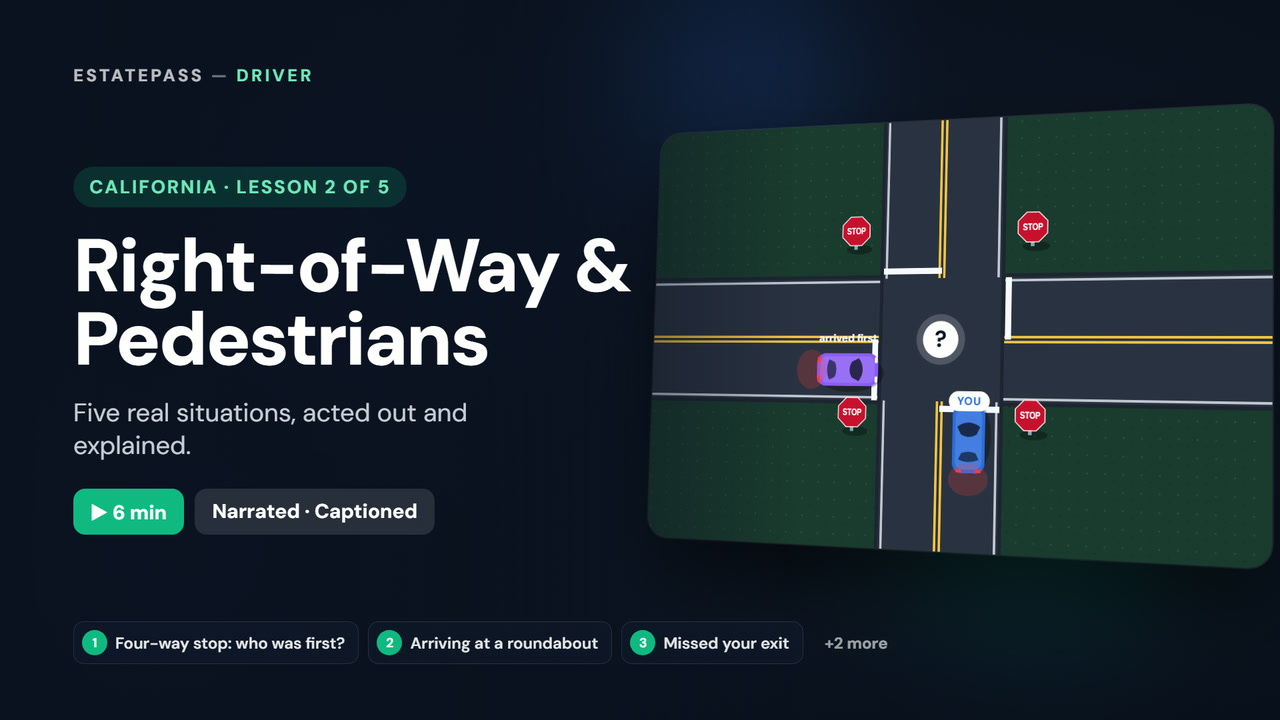
- 0:16At a four-way stop, a car on your left stopped well before you. Who goes first?
- 1:21When you arrive at a roundabout, whom must you yield to?
- 2:21You miss your exit while driving in a roundabout. What should you do?
- 3:24A pedestrian at the curb makes eye contact with you. What does this usually mean?
- 4:20Which statement about pedestrians is true?
- 5:15Recap
In short
The vehicle that arrives first has the right-of-way. Slow down as you approach and yield to all traffic already in the roundabout. Do not stop or back up in a roundabout.
The five situations
Pick an answer first, the way the video pauses for you. Each one cites the California Driver's Handbook.
Situation 1
At a four-way stop, a car on your left stopped well before you. Who goes first?
Answer: C. The car that arrived first. The vehicle that arrives first has the right-of-way. The right-hand rule applies only when vehicles arrive at the same time.
California Driver's Handbook › Section 7 › Right-of-Way Rules › Intersections
Situation 2
When you arrive at a roundabout, whom must you yield to?
Answer: C. All traffic already in the roundabout. Slow down as you approach and yield to all traffic already in the roundabout. Enter when there is a gap big enough to merge safely.
California Driver's Handbook › Section 7 › Right-of-Way Rules › Roundabouts
Situation 3
You miss your exit while driving in a roundabout. What should you do?
Answer: B. Continue around until you return to your exit. Do not stop or back up in a roundabout. If you miss your exit, keep going around until you come back to it.
California Driver's Handbook › Section 7 › Right-of-Way Rules › Roundabouts
Situation 4
A pedestrian at the curb makes eye contact with you. What does this usually mean?
Answer: C. They are ready to cross; yield to them. If a pedestrian makes eye contact, they are ready to cross the street. Yield to them.
California Driver's Handbook › Section 7 › Right-of-Way Rules › Pedestrians
Situation 5
Which statement about pedestrians is true?
Answer: B. They have the right-of-way but must follow road rules. Although pedestrians have the right-of-way, they also must follow the rules of the road.
California Driver's Handbook › Section 7 › Right-of-Way Rules › Pedestrians
Transcript
0:00Intro
Right-of-way comes down to one question: who goes first? Let's work through five everyday situations from the California Driver's Handbook. For each one, pick your answer before I reveal it.
0:16Situation 1
You pull up to a four-way stop. A car on your left had already stopped there a few seconds before you. At a four-way stop, a car on your left stopped well before you. Who goes first? The answer is C: The car that arrived first. The vehicle that arrives first has the right-of-way. The right-hand rule applies only when vehicles arrive at the same time. First to stop is first to go. The yield-to-the-right rule only breaks a tie when two cars arrive at the same time.
1:21Situation 2
You're approaching a roundabout, and cars are already circling inside it. When you arrive at a roundabout, whom must you yield to? The answer is C: All traffic already in the roundabout. Slow down as you approach and yield to all traffic already in the roundabout. Enter when there is a gap big enough to merge safely. Slow down, yield to everyone already in the circle, and enter when there's a gap big enough to merge safely.
2:21Situation 3
You're circling a roundabout, and you realize you just passed the exit you wanted. You miss your exit while driving in a roundabout. What should you do? The answer is B: Continue around until you return to your exit. Do not stop or back up in a roundabout. If you miss your exit, keep going around until you come back to it. No stopping, no backing up. Just go around once more and take your exit the next time it comes up.
3:24Situation 4
A pedestrian standing at the curb turns and looks right at you as you approach. A pedestrian at the curb makes eye contact with you. What does this usually mean? The answer is C: They are ready to cross; yield to them. If a pedestrian makes eye contact, they are ready to cross the street. Yield to them. Eye contact usually means they're ready to cross. Slow down and yield.
4:20Situation 5
Pedestrians often get the right-of-way, but that doesn't mean anything goes. Which statement about pedestrians is true? The answer is B: They have the right-of-way but must follow road rules. Although pedestrians have the right-of-way, they also must follow the rules of the road. Pedestrians have the right-of-way, and they also have to follow the rules of the road, just like you.
5:15Recap
The vehicle that arrives first has the right-of-way. Slow down as you approach and yield to all traffic already in the roundabout. Do not stop or back up in a roundabout. If a pedestrian makes eye contact, they are ready to cross the street. Although pedestrians have the right-of-way, they also must follow the rules of the road. Nice work. Try more right-of-way questions in Practice by Topic, then test yourself with a full mock exam.
The rules in this lesson
- The vehicle that arrives first has the right-of-way.
- Slow down as you approach and yield to all traffic already in the roundabout.
- Do not stop or back up in a roundabout.
- If a pedestrian makes eye contact, they are ready to cross the street.
- Although pedestrians have the right-of-way, they also must follow the rules of the road.
Original practice lesson written from the California Driver's Handbook. EstatePass is not affiliated with or endorsed by the California DMV; these are not official test questions.