
Airspace Classes B Through G
~14 min read · Describe each airspace class’s shape and rules and where sUAS need authorization.
Airspace class determines the single most consequential preflight question: do I need FAA authorization before launch? The exam draws the map in words — you must know each class's shape, where it sits, and that B, C, D, and surface E require authorization while G does not.
Controlled airspace: B, C, D, E
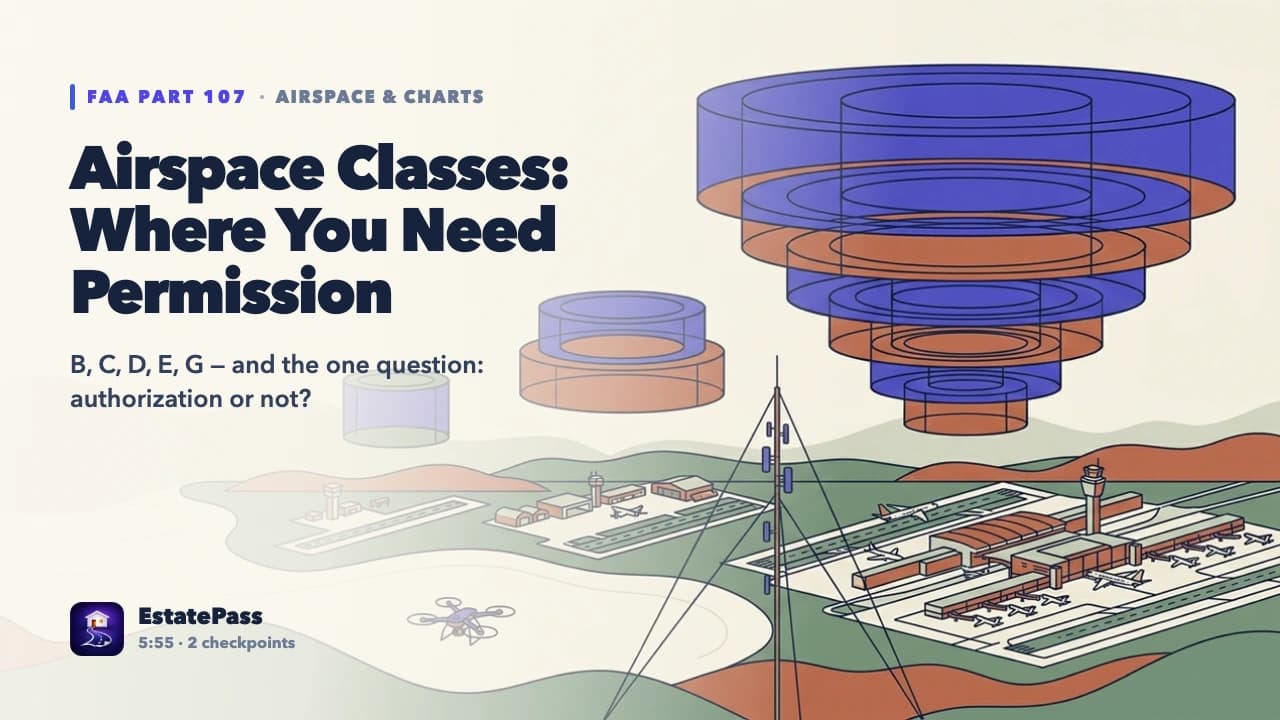
Class B surrounds the busiest airports — an upside-down wedding cake of shelves, dimensions tailored per airport. Class C rings airports with an operational tower and radar approach control: typically a 5-NM core from the surface to 4,000 ft AGL plus a 10-NM shelf from 1,200 to 4,000 ft AGL. Class D covers towered airports without radar service: usually a 4-NM radius up to 2,500 ft AGL. Class E is all other controlled airspace — it starts at the surface around some instrument airports, at 700 ft AGL under magenta shading, or at 1,200 ft AGL in most other places.
- B: biggest/busiest, tailored shelves (solid blue lines on the chart)
- C: 5 NM core + 10 NM shelf, tower + radar (solid magenta)
- D: ~4 NM to 2,500 ft AGL, tower only (dashed blue)
- E: everywhere else that is controlled; floor varies (surface / 700 / 1,200 AGL)
Uncontrolled airspace: G
Class G is everything below the Class E floor — from the surface up to 700 or 1,200 ft AGL in most of the country. This is where sUAS live by default: no ATC authorization needed in Class G, just the standard Part 107 rules. Class A (18,000 ft MSL and up) is irrelevant to sUAS operations.
What authorization means for sUAS
Under 107.41, operating in Class B, C, or D airspace, or within the lateral boundaries of the surface area of Class E designated for an airport, requires prior authorization — obtained instantly through LAANC for pre-approved altitude grids, or via the FAA DroneZone for everything else. Class E that begins at 700 or 1,200 ft AGL does not touch a typical sub-400-ft sUAS flight; it is the surface-designated E (dashed magenta) that catches pilots.
- Authorization needed: B, C, D, and E2 surface areas
- No authorization: Class G, and under E floors of 700/1,200 AGL
- A tower being closed does not convert D to G unless charted/NOTAMed that way
Worked example
You plan a 300-ft AGL roof survey 8 NM from a Class C primary airport. The sectional shows you are outside the solid magenta core but under the 10-NM shelf, whose floor is 1,200 ft AGL. Do you need an authorization?
Position yourself vertically. The Class C shelf above you starts at 1,200 ft AGL; your flight tops out at 300 ft AGL, far below the shelf floor. The airspace you actually occupy is whatever lies beneath the shelf — typically Class E at 700 ft or Class G. At 300 ft in Class G, no authorization is required. The trap is reading 'inside 10 NM of a Class C airport' as automatically controlled at the surface — lateral rings mean nothing without checking the floor above your operating altitude.
Common exam pitfalls
Assuming any flight near a big airport needs authorization.
Authorization follows the airspace you occupy. Under a shelf whose floor is above your altitude, you are in the lower class — often G, no authorization.
Ignoring surface-area Class E (dashed magenta).
E2 surface areas around instrument airports require authorization just like D — this is the most-missed case.
Confusing Class E's several floors.
E can start at the surface (dashed magenta), 700 AGL (inside magenta vignette), or 1,200 AGL (most everywhere else).
Big Cakes, Cores, Dashed towers, Everything else — and G is Go (no authorization).
Recap
- Class B: busiest airports, layered shelves, tailored dimensions
- Class C: 5-NM surface core + 10-NM shelf, tower with radar
- Class D: ~4 NM, to 2,500 ft AGL, tower without radar
- Class E: remaining controlled airspace; floors at surface, 700, or 1,200 AGL
- Authorization (LAANC/DroneZone) required for B, C, D, and surface E
- Class G: uncontrolled — fly under standard Part 107 rules, no authorization
VIDEO LESSON
Watch this lesson on video — free
Prove it: 10 questions on this topic
Every lesson ends with a ten-question check in the free course — your progress syncs between the web and the EstatePass app.