
Credible Witnesses
~11 min read · Use one known or two unknown credible witnesses, each properly sworn, with the right disqualifiers.
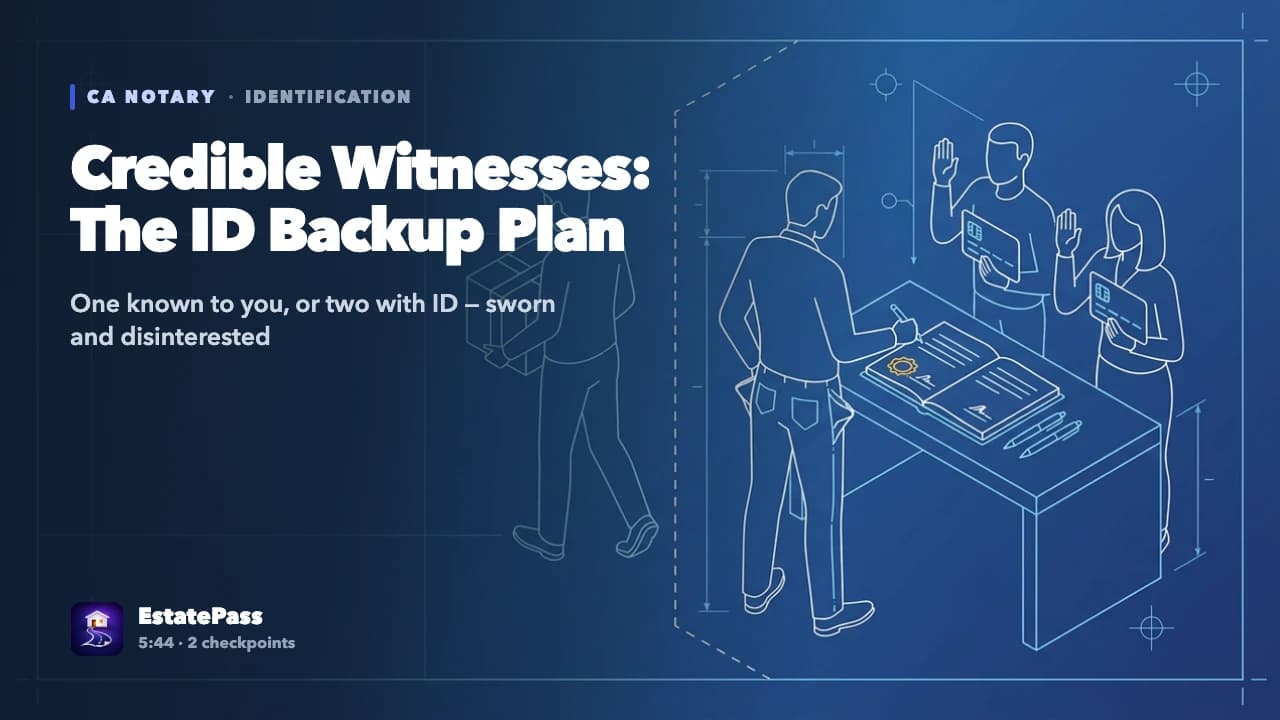
When a signer has no usable ID, credible witnesses are the statutory backup: one witness the notary personally knows, or two strangers with their own IDs. The exam drills the 1-vs-2 rule, the oath, and the five things every credible witness must be able to swear to.
One witness or two
One credible witness suffices if the notary personally knows the witness (and the witness presents paper ID from the menu as well, under current practice the witness is identified by the notary's personal knowledge). Two credible witnesses are required when the notary does not know them — each identified by their own satisfactory-evidence ID. In both patterns the witnesses must personally know the signer.
- 1 witness: personally known to the notary
- 2 witnesses: strangers to the notary, each with their own ID
- Witnesses must personally know the SIGNER in every case
The oath and the five assertions
Credible witnesses swear under oath to a package of facts: (1) the signer is the person named in the document; (2) the witness personally knows the signer; (3) the witness reasonably believes the signer's circumstances make obtaining conventional ID difficult or impossible; (4) the signer does not possess the required ID; and (5) the witness does not have a financial interest in and is not named in the document. The oath is mandatory — unsworn vouching is worthless — and each witness signs the journal.
- Sworn testimony, not casual confirmation
- Knows the signer; signer lacks and can't reasonably get ID
- Witness is disinterested: no financial stake, not named
- Witnesses sign the journal entry
Where the procedure breaks
The classic disqualifier: the helpful spouse, business partner, or co-signer who IS interested in the document — an interested witness invalidates the identification. Credible witnesses identify the signer for THIS act only; the identification does not carry to future notarizations. And the procedure never cures unwillingness or incapacity — it substitutes for ID, nothing else.
Worked example
An elderly signer in assisted living must sign a trust amendment; her purse was stolen and DMV replacement will take weeks. Her son (named as successor trustee in the amendment) offers to vouch, along with her longtime caregiver, whom you have never met. Build a valid identification.
The son is disqualified: he is named in the document — an interested witness cannot serve regardless of honesty. The caregiver qualifies on knowledge (knows the signer well) but is a stranger to you, so the two-witness pattern applies: the caregiver plus one more disinterested person who personally knows the signer — another staff member, a fellow resident, a friend — each presenting their own satisfactory-evidence ID, each swearing the five-part oath, each signing the journal. Alternative: if any available witness is someone YOU personally know, one suffices. Then the act proceeds normally (with a thumbprint if the document affects real property).
Common exam pitfalls
Letting a beneficiary or named party vouch.
Credible witnesses must be disinterested — no financial stake, not named in the document.
Skipping the witnesses' oath.
The sworn oath is the mechanism. Administer it audibly to each witness, then have them sign the journal.
Reversing the 1-vs-2 rule.
One witness only when the NOTARY personally knows the witness; otherwise two, each with their own ID.
Known to me: one. Unknown to me: two, with ID. Interested: zero, ever.
Recap
- 1 credible witness if personally known to the notary; else 2 with their own IDs
- Witnesses personally know the signer; signer lacks reasonably obtainable ID
- Five-part sworn oath per witness; witnesses sign the journal
- Disinterest is absolute — named or benefiting witnesses are out
- Identification is per-act, not durable
- Substitutes for ID only — never for willingness or awareness
VIDEO LESSON
Watch this lesson on video — free
Prove it: 10 questions on this topic
Every lesson ends with a ten-question check in the free course — your progress syncs between the web and the EstatePass app.