
Satisfactory Evidence of Identity
~12 min read · Apply the ID list and the current-or-issued-within-5-years rule to every signer.
California defines 'satisfactory evidence' of identity with a precise ID menu and one governing freshness rule: current, or issued within the past five years. And the rule the exam most wants you to know is the one California removed — personal knowledge no longer counts.
The paper ID menu
Group one — sufficient alone: a California driver's license or ID card, a U.S. passport (or passport card), an out-of-state or foreign government driver's license/ID, a foreign passport, U.S. military ID, and inmate identification (in custody settings). Group two documents (also acceptable, and the exam rarely splits the groups): an employee ID issued by a California governmental agency, an ID card issued by a federally recognized tribal government. Every ID must contain a photograph, description, signature, and identifying number — the four features that make it evidence.
- CA DL/ID, U.S. or foreign passport, other states' and foreign DLs
- Military ID, tribal ID, CA government-employee ID, inmate ID in custody
- Required features: photo, description, signature, serial/ID number
The five-year freshness rule
An ID qualifies if it is current or was issued within the past five years. An expired license can still work: expired in 2024 but issued in 2022 passes (issued within five years); a license issued eight years ago and expired last year fails. The issue date, not the expiration date alone, decides borderline cases.
- Current = valid today
- OR issued within 5 years, even if now expired
- Check the ISSUE date on expired IDs
What satisfactory evidence is not
Personal knowledge is not satisfactory evidence in California — knowing your neighbor for twenty years counts for nothing; she presents ID or credible witnesses like a stranger. Social Security cards, credit cards, and birth certificates (no photo/signature package) never qualify. If reasonable doubt remains despite paperwork — appearance grossly mismatched to the photo — the notary refuses: satisfactory evidence means the absence of reasonable doubt, and the paperwork is the floor, not a safe harbor.
Worked example
Three signers, one afternoon: (1) your business partner of 15 years, no wallet; (2) a French national with a passport from France, current; (3) a retiree whose California license expired 14 months ago but shows an issue date four years back. Who passes identification?
Signer 1 fails today: personal knowledge is not satisfactory evidence in California — no ID means credible witnesses or another day, partnership notwithstanding. Signer 2 passes: a current foreign passport is on the menu. Signer 3 passes: the license is expired, but issued four years ago — within the five-year issuance window, it remains satisfactory evidence. The exam pattern: one nostalgic trap (personal knowledge), one foreign-document surprise (passports work), one date-math check (issue date governs expired IDs).
Common exam pitfalls
Accepting a signer you know personally without ID.
California abolished personal knowledge as satisfactory evidence — everyone shows ID or brings credible witnesses.
Rejecting every expired ID reflexively.
Expired is fine if ISSUED within the past five years. Read the issue date.
Treating any official-looking card as ID.
It needs photo, description, signature, and number — Social Security cards and credit cards never qualify.
Fresh-or-five: current now, or born within five years. And nobody is a familiar face.
Recap
- Menu: CA DL/ID, U.S./foreign passports, other DLs, military, tribal, CA-agency employee, inmate ID
- Each must carry photo, description, signature, number
- Current OR issued within five years — issue date decides expired cases
- Personal knowledge is NOT satisfactory evidence in California
- SSN cards, credit cards, birth certificates never qualify
- Reasonable doubt survives paperwork — refuse when it does
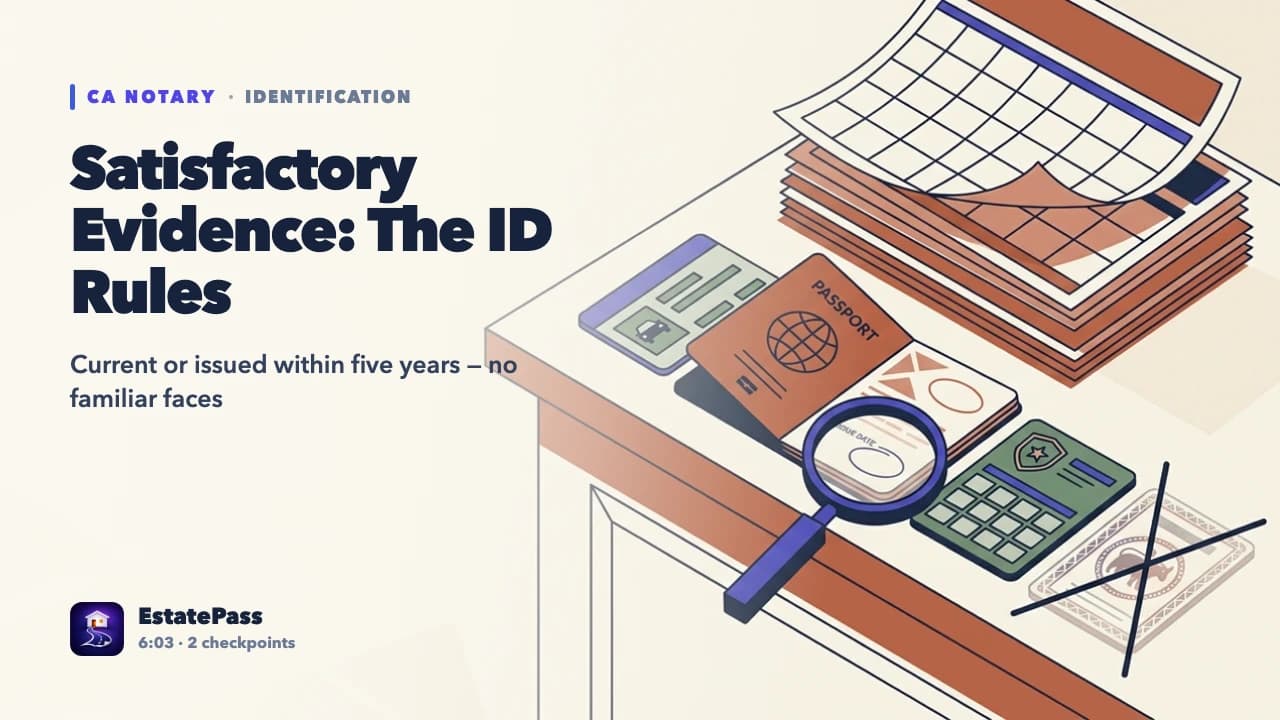
VIDEO LESSON
Watch this lesson on video — free
Prove it: 10 questions on this topic
Every lesson ends with a ten-question check in the free course — your progress syncs between the web and the EstatePass app.