
Maximum Fees
~10 min read · Charge at most $15 per signature/acknowledgment and handle travel fees lawfully.
Notary fees are capped by statute — per signature, not per document — and the exam cares more about the structure than the dollar figure (which the legislature adjusts periodically; an increase is already scheduled). Learn what the cap covers, what escapes it, and the acts that must always be free.
How the cap works
GC 8211 sets a maximum fee per notarial act: acknowledgments and jurats are capped per signature notarized, deposition services and certified POA copies have their own line items. The cap is a ceiling, not a price: a notary may charge less or nothing. Whatever is charged — including zero — is entered in the journal. Charging above the cap is a disciplinary ground with a $750 civil penalty.
- Cap is PER SIGNATURE for acknowledgments/jurats — not per document, not per page
- Charging less or nothing is always allowed
- Every fee (or '0') goes in the journal; overcharging = $750 family
Travel and the employed notary
Travel fees are not notarial fees: they are unregulated by the cap, must be agreed to in advance by the client, and best practice records them separately in the journal so the notarial fee itself stays within the cap. An employed notary whose employer paid for the commission may charge fees, but where the arrangement requires it (public-entity settings), fees are remitted to the employer and still journaled individually.
- Travel: uncapped, disclosed and agreed in advance, listed separately
- Employer arrangements: fees may flow to the employer; journal entries unchanged
- Never fold travel into the 'notary fee' line
The mandatory free list
Certain acts are zero-fee by statute: vote-by-mail ballot identification envelopes and election materials, a U.S. military veteran's application or claim for pension, allotment, allowance, compensation, insurance, or other benefits, nomination documents, and public-entity pension affidavits. Charging anything for these is a violation regardless of how small.
- Veterans' benefit claims: free
- Vote-by-mail envelopes and election materials: free
- Free means free — no 'processing' surcharges
Worked example
A mobile notary drives 40 minutes to notarize a trust package: five documents, two signers, eight total signatures requiring acknowledgment, plus one veteran's VA pension claim form. She quotes 'the statutory maximum per signature, plus a $40 travel fee we agreed on by phone.' Structure the lawful bill and journal.
Notarial fees: eight signatures × the per-signature cap — the count is signatures notarized, not five documents. The VA pension claim: statutorily free; zero for that act no matter what else is billed. Travel: the $40 is lawful because it was disclosed and agreed in advance; it is not a notarial fee and is recorded separately. Journal: one entry per act, each showing its fee — the acknowledgments with their per-signature charges, the VA form with '0', travel noted apart from the notarial fee column. The exam's angles: per-signature math, the always-free veteran act, and travel's separate, pre-agreed, uncapped status.
Common exam pitfalls
Charging per document or per page.
The statutory cap for acknowledgments and jurats runs per SIGNATURE notarized.
Memorizing this year's dollar figure as eternal.
The legislature adjusts the schedule (an increase is already enacted with a future operative date). Learn the structure; check the current handbook for today's numbers.
Hiding travel inside the notary fee.
Travel is separate, uncapped, agreed in advance, and journaled apart — folding it in creates an overcharge on its face.
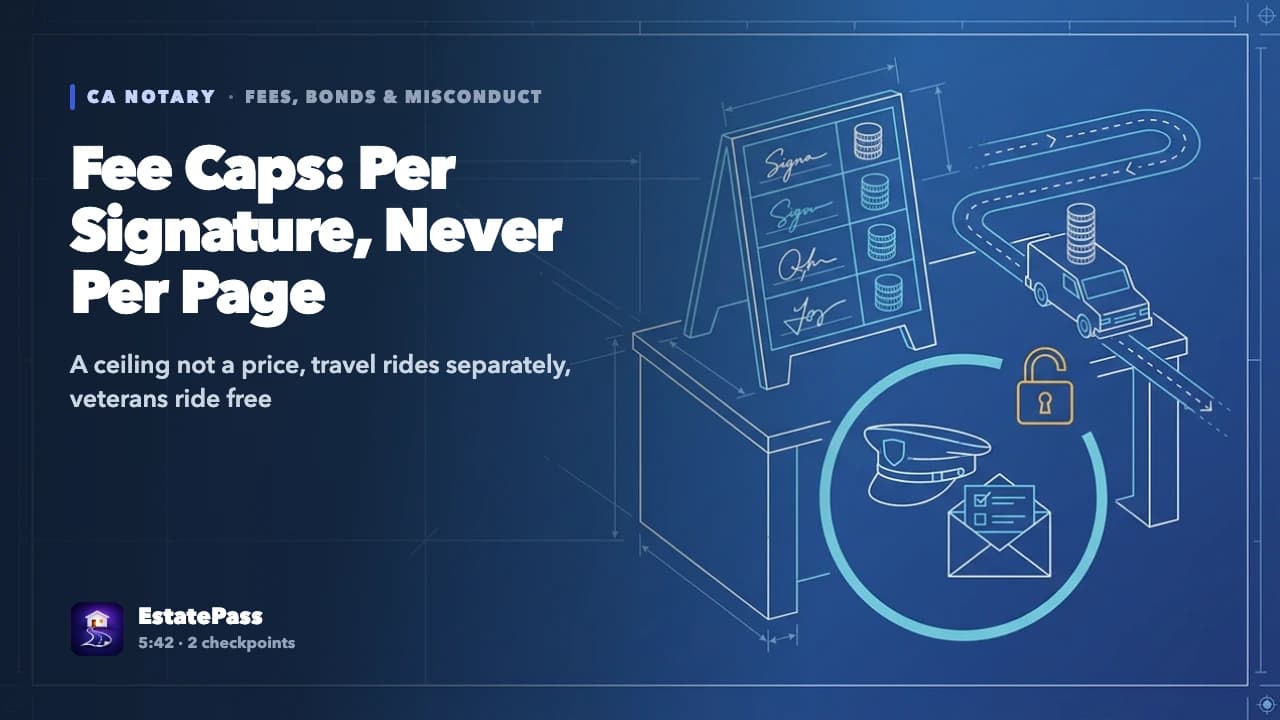
Per signature, ceiling not price, travel rides separately, veterans and voters ride free.
Recap
- Statutory maximum per signature for acknowledgments/jurats; separate line items for depositions and POA copies
- May always charge less or nothing; journal every fee including zero
- Overcharging: disciplinary ground + $750-family penalty
- Travel fees: uncapped, pre-agreed, separately recorded
- Employed notaries may remit fees to the employer; journaling unchanged
- Statutorily free: veterans' benefit claims, vote-by-mail envelopes, election materials
VIDEO LESSON
Watch this lesson on video — free
Prove it: 10 questions on this topic
Every lesson ends with a ten-question check in the free course — your progress syncs between the web and the EstatePass app.