
Beneficial Interest & Refusal
~9 min read · Refuse when you are a party or beneficiary, and know the narrow exceptions.
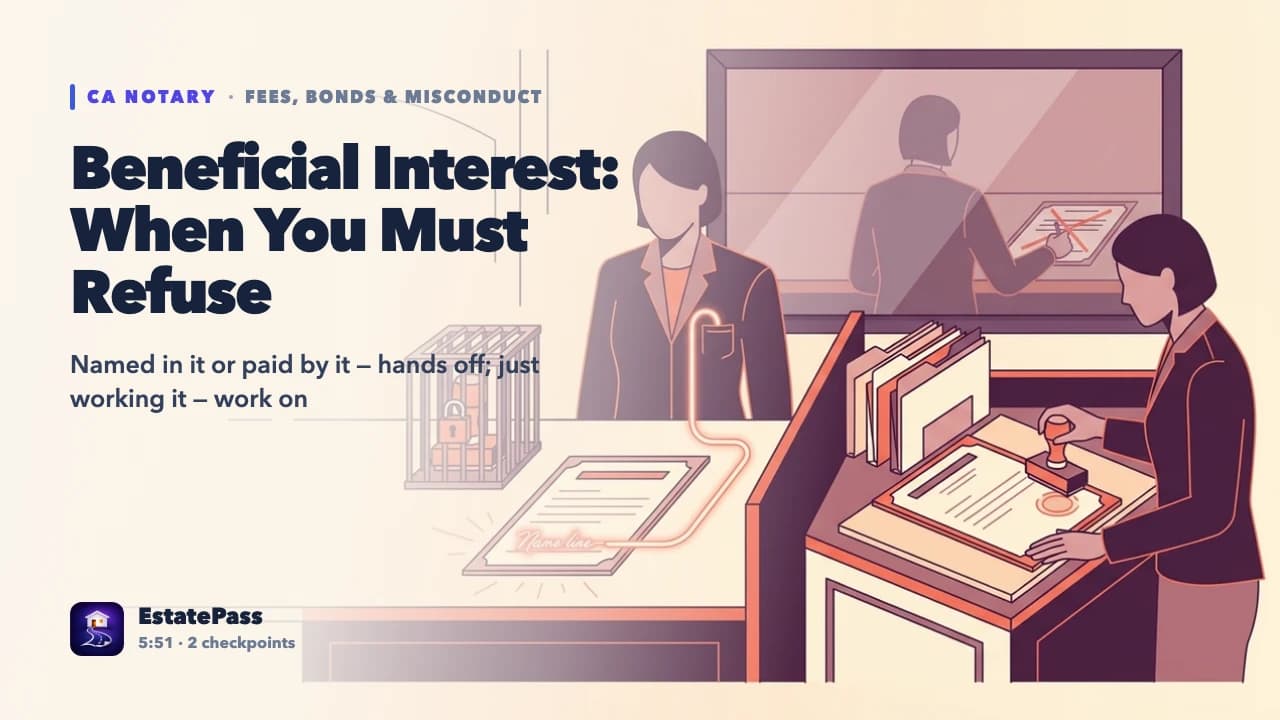
A notary who profits from the deal cannot notarize it. California defines the disqualifying 'beneficial interest' with two precise lists — named as a principal in a financial transaction, or holding a party role in a real-property transaction — and one crucial carve-out: professionals acting purely as agents are clean.
The two disqualification lists
GC 8224 bars notarizing when the notary is: (1) named individually as a principal to a financial transaction, or (2) named individually as grantor, grantee, mortgagor, mortgagee, trustor, trustee, beneficiary, vendor, vendee, lessor, or lessee in a real-property transaction. Separately, GC 8224.1: a notary may never take the acknowledgment or proof of an instrument the notary personally executed.
- Financial deals: named as a principal → out
- Real property: any party-role title on the list → out
- Your own signature: never notarizable by you
The agent carve-out
Acting as an agent, employee, insurer, attorney, escrow holder, or lender for a party is expressly not a beneficial interest. The escrow officer notarizing the buyer's deed in her own escrow, the bank employee notarizing the bank's loan documents, the attorney notarizing a client's affidavit — all permitted (commission and employment rules aside). The line is personal stake: your NAME in the instrument or your OWN money moving, versus your professional role in someone else's transaction.
- Agent/employee/attorney/escrow/lender roles: NOT beneficial interest
- Salary and ordinary fees are not a 'stake' in the deal
- Personal name in the document or personal profit = the disqualifier
Refusals: required, permitted, and forbidden
Must refuse: beneficial interest, identity not established, incomplete document, apparent duress or incapacity, the signer won't provide a required thumbprint or oath. May refuse: reasonable suspicion of fraud, requests outside business capacity. May not refuse: for discriminatory reasons, or because the notary dislikes a lawful transaction. Every refusal gets a factual journal note.
Worked example
Four requests reach an escrow-officer notary in one week: (a) notarize the deed in an escrow she is handling, fee paid to her employer; (b) notarize her brother's refinance deed of trust; (c) notarize a lease naming herself as lessor; (d) notarize her own affidavit of residency. Which may she take?
(a) Yes — escrow holder is the carve-out's textbook case; handling the escrow professionally is not a beneficial interest. (b) Yes, cautiously — California does not disqualify relatives by blood alone; the brother's deed is fine so long as she is not named in it and takes no personal stake (best practice flags appearance, but law permits). (c) No — 'lessor' is on the real-property party list; her name in the lease disqualifies her. (d) No — GC 8224.1, her own executed instrument can never receive her notarization; another notary takes it. Pattern: role in the deal decides everything; family ties alone decide nothing.
Common exam pitfalls
Assuming family relationship itself disqualifies.
California's test is beneficial interest, not blood. A relative's document is notarizable unless the notary is named or benefits.
Refusing as escrow officer or lender's employee out of caution.
Those professional roles are expressly excluded from beneficial interest — the statute anticipates them.
Notarizing your own signature 'since you know it's genuine.'
Never — your own instruments go to another notary, always.
If the deal pays YOU or names YOU, hands off; if you're just working the file, work on.
Recap
- Beneficial interest: named principal (financial) or listed party role (real property)
- Agent, employee, attorney, escrow holder, lender roles are exempt
- Never notarize an instrument you executed
- Relatives' documents allowed absent your name or stake
- Mandatory refusals: interest, ID failure, incompleteness, duress, refused oath/print
- No discriminatory refusals; journal every refusal factually
VIDEO LESSON
Watch this lesson on video — free
Prove it: 10 questions on this topic
Every lesson ends with a ten-question check in the free course — your progress syncs between the web and the EstatePass app.