
Stairs, Handrails & Guards
~12 min read · Apply the stair geometry numbers: rise, run, riser uniformity, rail height, sphere rules.
Falls are the home's deadliest hazard, and stair geometry is the countermeasure: risers to 7¾, treads from 10, uniformity within ⅜, handrails at 34–38 inches for four or more risers, guards at 36 with the 4-inch sphere. The numbers are stable; the findings are everywhere.
Geometry
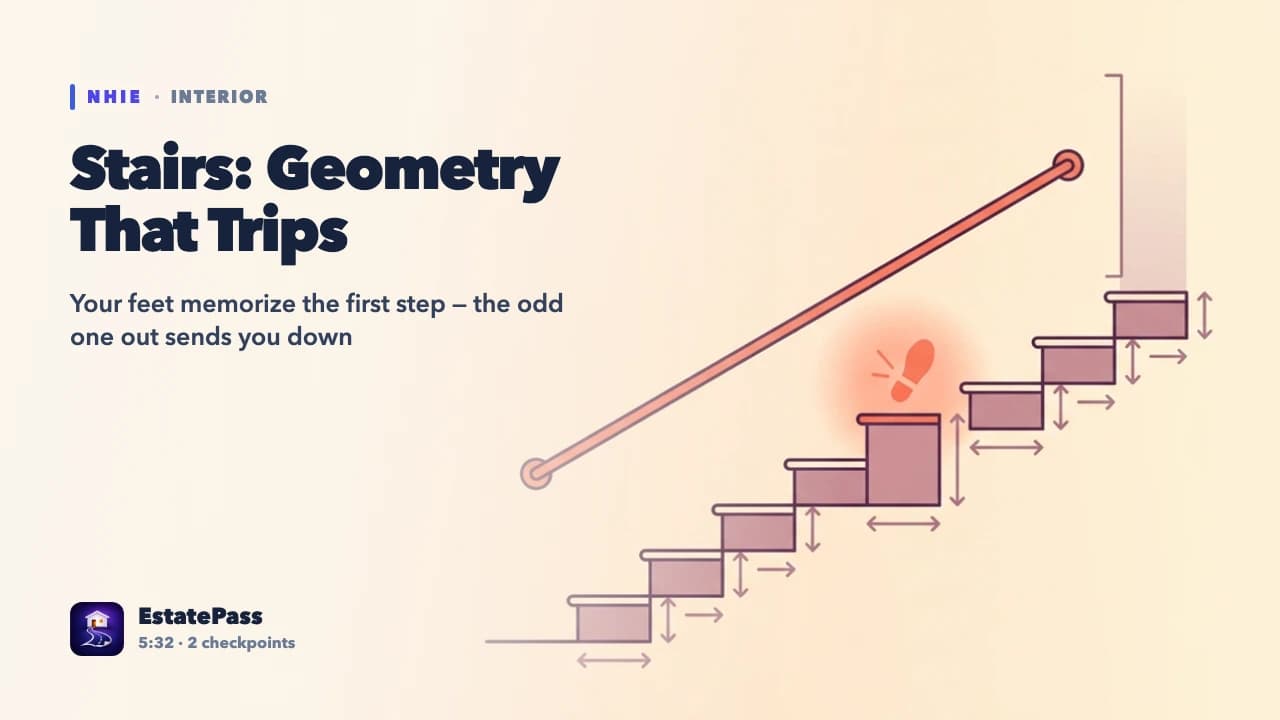
Residential benchmarks: risers max 7¾ inches, treads min 10 inches (nosing rules ride along), uniformity within ⅜ inch between largest and smallest riser — and tread — in a flight (the body memorizes the first two steps; step three's extra half-inch is the trip), headroom 6'8" minimum, width 36 inches, landings at doors. Measure the flight's extremes; the uniformity finding outnumbers all others because settled bottom steps and DIY additions break it constantly.
- ≤7¾ rise, ≥10 tread, ⅜ uniformity
- 6'8" headroom, 36-in width
- The odd step out is the injury mechanism
Handrails
Flights with four or more risers need a continuous handrail at 34–38 inches above nosings, graspable (round ~1¼–2 inches or equivalent profiles — a 2×6 on edge is a finding: you can't wrap a hand around it), returned to the wall (ends that snag sleeves), and secure under load (pull on it). Missing rails on basement stairs are the routine version; decorative-but-ungraspable rails the deluxe version.
- 4+ risers → handrail, 34–38 in, continuous
- Graspability: the wrap-your-hand test
- Returns to wall; solid under a firm pull
Guards
Open sides of stairs, landings, lofts, and raised floors need guards at 36 inches minimum (stairs' guard height follows its own line), with openings rejecting a 4-inch sphere (child head/torso rule; the triangle at stair edges has its own slightly larger allowance) — horizontal 'ladder' infill gets a climbability note. Test attachment: guards take lateral load. Interior balconies, split-level half-walls cut low, and open stairwells in older homes furnish the findings.
Worked example
A finished-basement stair: twelve risers measuring 7¼–8¼ inches with the bottom step the tall one; no handrail; the open side is guarded by decorative horizontal cables spaced 6 inches apart at 32 inches high. List the findings with their numbers.
Geometry: the 8¼ riser exceeds 7¾ AND the flight varies a full inch — nearly triple the ⅜ uniformity allowance, with the anomaly at the bottom where descending momentum peaks: the worst place. Handrail: twelve risers demands one — absent entirely: safety finding, 34–38 graspable continuous rail specified. The guard: 32 inches misses the 36 minimum; 6-inch cable spacing passes a 4-inch sphere with room to spare, and horizontal cables invite climbing — three guard defects in one assembly. Report frame: falls are the leading home-injury mechanism; every line here is a safety item with the stable numbers cited — the rare inspection section where citing figures IS the professional standard.
Common exam pitfalls
Measuring one typical step and moving on.
Uniformity is the killer metric — measure the flight's extremes, especially top and bottom steps.
Crediting any rail-shaped object.
Graspability is functional: if a falling hand can't close around it, it's trim, not a handrail.
Passing stylish cable guards uncounted.
Height, sphere rule, climbability, and attachment apply regardless of aesthetics.
Seven-three-quarters up, ten deep, three-eighths true; rail at four risers, guard at thirty-six, nothing four inches wide gets through.
Recap
- Risers ≤7¾, treads ≥10, uniformity ≤⅜
- Headroom 6'8", width 36 in
- Handrail at 4+ risers: 34–38 in, graspable, continuous, returned
- Guards 36 in min; 4-in sphere rule; climbability noted
- Load-test rails and guards
- Stairs are the report's premier safety section
VIDEO LESSON
Watch this lesson on video — free
Prove it: 10 questions on this topic
Every lesson ends with a ten-question check in the free course — your progress syncs between the web and the EstatePass app.