
Reconciling to Final Value
~10 min read · Weight the approaches by quality of data and relevance, and defend the final opinion.
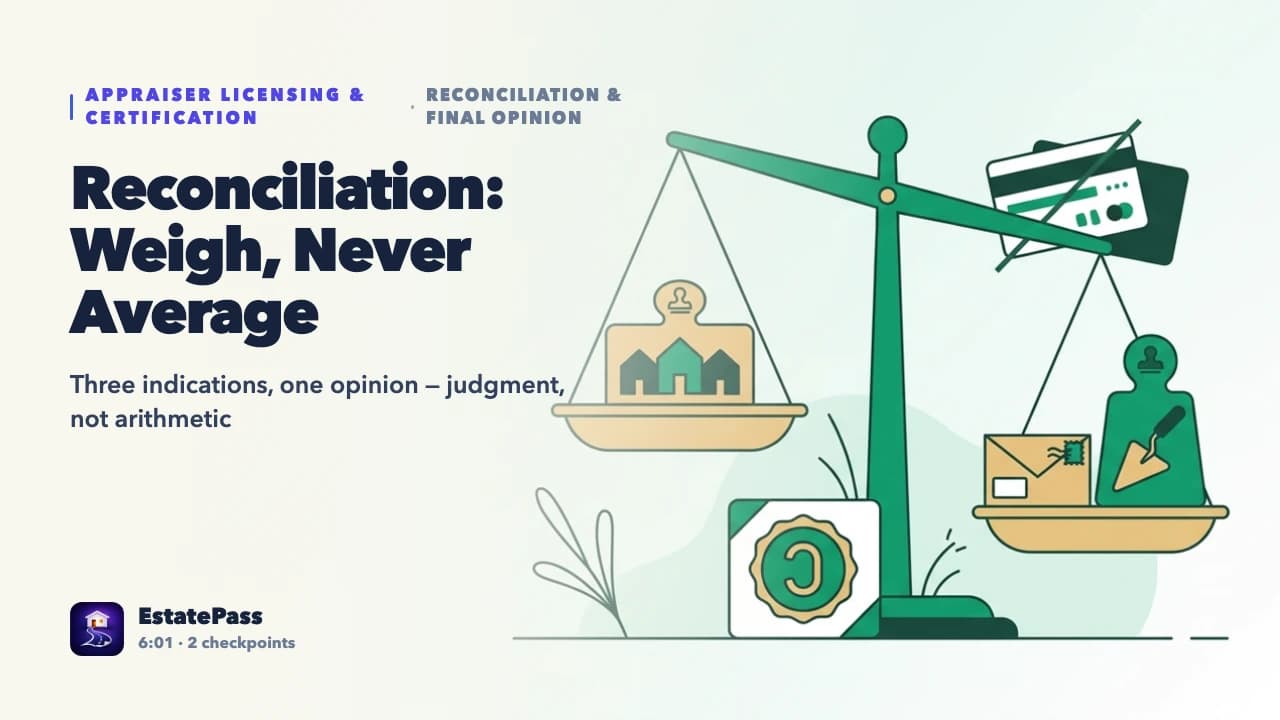
Final reconciliation converts three approach indications into one opinion — by weighing data quality, approach relevance, and property type, never by averaging. The exam asks which approach leads for which property, and why.
The weighing criteria
Weight each indication by: quantity and quality of data behind it (verified comps vs thin extractions), the approach's relevance to how this property's buyers actually decide, and the precision of the inputs (a cost approach on a 40-year-old building rides a fragile depreciation estimate). Reconciliation reviews the whole appraisal — arithmetic, consistency, logic — before weighting; it never introduces new data, and it never averages.
- Data quality × approach relevance × input precision
- Review for consistency before weighting
- No averaging, no new data at this stage
Which approach leads where
Sales comparison leads for residential and anything with an active resale market — it mirrors buyer behavior. Income leads for investment property — apartments, offices, retail — because investors buy income streams. Cost leads for new construction (little depreciation to estimate), special-purpose properties (schools, churches — no comps, no income), and insurance/feasibility work. Secondary approaches corroborate and bracket; divergent indications demand diagnosis, not blending.
- Residential → sales comparison
- Investment property → income
- New/special-purpose → cost
- Divergence is a signal to investigate, not average away
Stating the opinion
The final value may be a point estimate (lending standard), a range, or a relationship to a benchmark, per the assignment. Round to honest precision (typically nearest $1,000–$5,000 residential). The report explains the weighting — 'primary weight to the sales comparison approach, supported by income' is the professional sentence; silence or a three-way average is the review finding.
Worked example
A 15-unit apartment building: sales comparison indicates $2,310,000 (three decent but adjustment-heavy comps); income indicates $2,215,000 (strong rent roll, extracted cap rates from four verified sales); cost indicates $2,650,000 (40-year-old building, big depreciation estimates). Reconcile.
Relevance: apartment buyers are investors — the income approach mirrors their decision math: it leads. Data check: the income indication rests on verified extractions and an audited rent roll — high quality; the sales grid needed heavy adjustments (gross percentages high) — corroborative; the cost approach carries a 40-year depreciation guess — weakest, useful mainly as a ceiling sanity check (and its distance from the others flags the depreciation estimate, not the market). Opinion: weighted toward income, supported by sales — ≈ $2,240,000, rounded honestly. The $425,000 cost-approach gap gets explained (accrued depreciation uncertainty), not averaged in: (2,310+2,215+2,650)/3 = $2,392,000 would let the weakest number move the answer $150,000.
Common exam pitfalls
Averaging the three approaches.
Weight by relevance and data quality — the mean gives your most fragile approach equal authority.
Forcing all three approaches on every assignment.
Scope of work includes the applicable approaches; an excluded approach is explained, not faked.
Implying false precision.
Round the conclusion to what the data honestly supports.
Relevance picks the leader, data picks the weight, and nobody averages.
Recap
- Weigh by data quality, approach relevance, input precision
- Sales comparison leads residential; income leads investment; cost leads new/special-purpose
- Divergent indications get diagnosed
- Point, range, or benchmark per assignment; honest rounding
- Explain the weighting in the report
- Reconciliation reviews — it never averages or adds data
VIDEO LESSON
Watch this lesson on video — free
Prove it: 10 questions on this topic
Every lesson ends with a ten-question check in the free course — your progress syncs between the web and the EstatePass app.