
Weather Minimums in Practice
~10 min read · Apply 3 SM visibility and 500-below/2,000-horizontal cloud clearance to real scenarios.
Part 107's weather minimums are only two numbers — 3 statute miles and 500/2,000 from clouds — but the exam tests whether you can apply them from the control station, at night, and against real sky conditions.
The rule as written
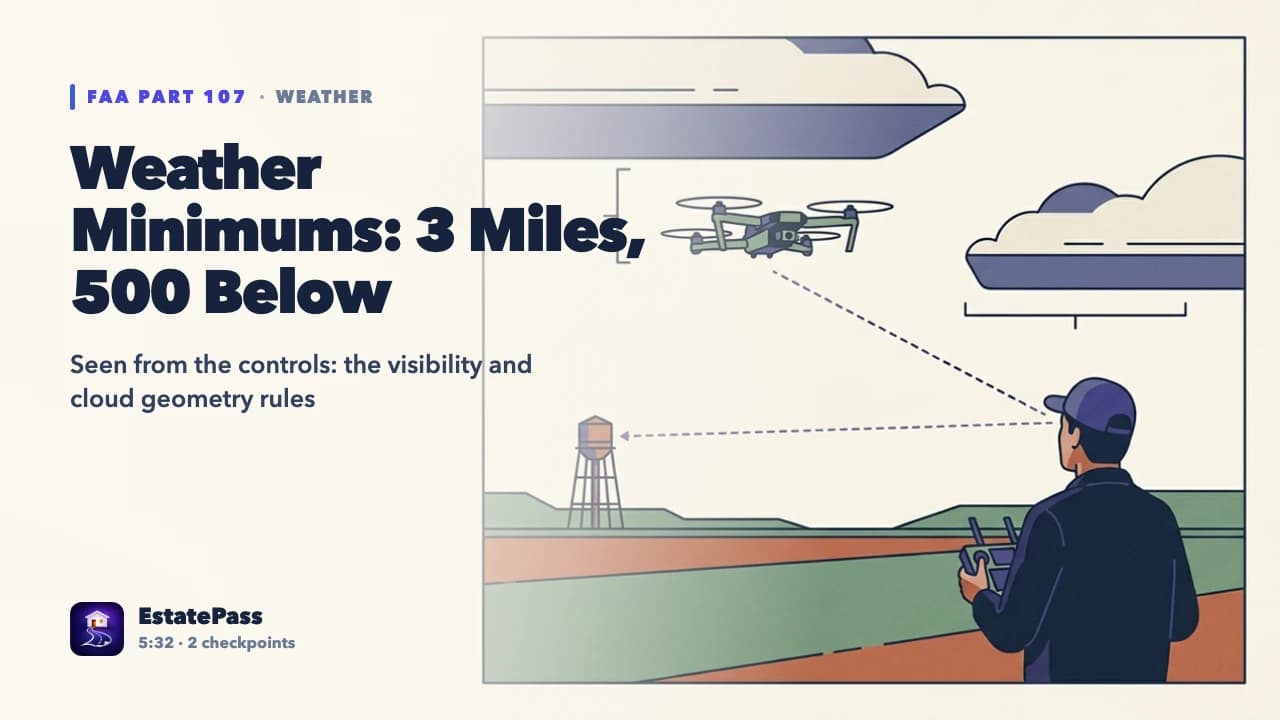
107.51: minimum flight visibility is 3 statute miles as observed from the control station, and the sUAS must stay at least 500 feet below and 2,000 feet horizontally from clouds. There is no ceiling minimum by name — the cloud-clearance geometry creates one: with a ceiling at 900 ft AGL, flying 400 ft AGL leaves exactly 500 ft below the deck; any lower ceiling forces you down proportionally.
- 3 SM visibility, measured at the control station (not the aircraft)
- 500 ft below / 2,000 ft horizontal from clouds
- Effective ceiling for 400-ft ops: BKN/OVC at 900 ft AGL
Judging it in the field
Without an on-site METAR, estimate: visibility by identifying known landmarks at known distances (the water tower 3 miles out); cloud height from a nearby METAR, terrain references, or conservative assumption. Haze, smoke, and drizzle days sit near the legal line — if you cannot verify 3 SM, you do not have it. At night, judging visibility and cloud distance is harder; position lights on distant structures serve as visibility gauges, and extra conservatism is the expected answer.
- Use landmarks at known distances as a visibility ruler
- Nearest METAR ceilings + terrain as cloud-height cross-checks
- Cannot verify the minimum = it does not exist
Why the geometry exists
The clearances buy reaction time: a manned aircraft descending out of a cloud base at 120 knots covers 2,000 ft horizontally in about 10 seconds. Your 500-below/2,000-beside bubble is the time budget for see-and-avoid to work. Waivers of 107.51 exist (night ops formerly rode them), but absent one, the numbers are absolute — including for Category 1 micro-drones.
Worked example
Afternoon haze. From your launch point you can just make out a grain elevator you know is 2.5 miles away; beyond it, everything dissolves. The nearest METAR (12 NM away) reports 5 SM and SCT025. Legal to fly?
The METAR is advisory here — 107.51 visibility is what YOU observe at the control station. Your landmark test proves about 2.5 SM: below the 3-SM minimum, so the flight is illegal regardless of the airport's 5 SM a dozen miles away. The scattered layer at 2,500 ft is not the problem (400 + 500 = 900 < 2,500). The answer: wait for the haze to lift, verify a 3-mile landmark, then fly. Exam phrasing will try to sell you the METAR; the rule buys only your local observation.
Common exam pitfalls
Using the nearest airport METAR as your legal visibility.
The minimum is flight visibility FROM THE CONTROL STATION. A distant METAR neither grants nor denies it — your observation governs.
Flying 'clear of clouds' like recreational rules.
Part 107 requires hard geometry: 500 below, 2,000 horizontal — even for tiny aircraft.
Forgetting the derived ceiling.
Ceiling 900 ft AGL is the break-even for 400-ft flight. Lower deck → lower max altitude.
Three miles seen, five hundred beneath, two thousand beside.
Recap
- 3 SM flight visibility observed from the control station
- 500 ft below and 2,000 ft horizontally from clouds
- Ceiling 900 AGL is the effective floor-of-legality for 400-ft ops
- Verify visibility with known-distance landmarks; unverifiable = unavailable
- METARs inform but do not substitute for local observation
- Minimums apply day and night, to every size of sUAS
VIDEO LESSON
Watch this lesson on video — free
Prove it: 10 questions on this topic
Every lesson ends with a ten-question check in the free course — your progress syncs between the web and the EstatePass app.